🛒 Best Price Today on Amazon
Prime members get fast, free shipping on everything above, plus member-only deals. New members get a 30-day free trial — cancel anytime.
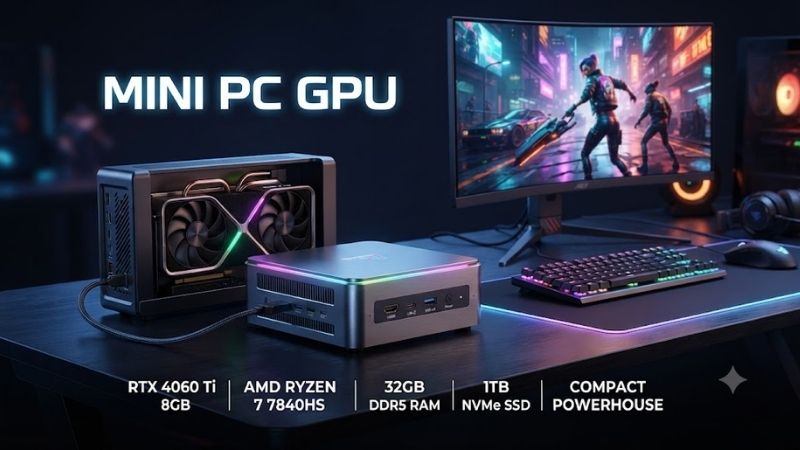
Mini Pc Gpu buyers now have far more capable choices than basic office boxes. Modern systems combine high-end mobile CPUs with RTX graphics or powerful Radeon integrated GPUs, making compact gaming, video editing, local AI, and multi-monitor work realistic. The best option depends on GPU class, cooling, memory, storage, and upgradeability.
Quick Comparison
| Product | Best For | Key Advantage | Limitation |
|---|---|---|---|
| ASUS ROG NUC 2025 | Best Overall | Up to RTX 5080 Laptop GPU | Very expensive |
| ASUS NUC 15 Performance | Best Creator Mini PC | RTX 5060/5070 in 3L chassis | Lower GPU ceiling than ROG NUC |
| MINISFORUM AtomMan G7 Ti | Best RTX 4070 Value | RTX 4070 Laptop GPU at up to 140W | Uses previous-generation NVIDIA GPU |
| GMKtec EVO-X2 | Best Integrated GPU | Radeon 8060S with 40 RDNA 3.5 CUs | Soldered memory |
| GEEKOM MEGAMINI G1 | Best Water-Cooled Pick | RTX 4060 8GB in 5.74L chassis | Larger than ultra-compact mini PCs |
| MINISFORUM AI X1 Pro | Best eGPU-Ready Pick | Radeon 890M plus OCuLink | Integrated GPU is weaker than discrete RTX |
Best Mini PC GPU Systems
ASUS ROG NUC 2025 — Best Overall
Best For: High-end gaming, streaming, content creation, and users replacing a conventional gaming tower.
Key Features:
- Intel Core Ultra 9 275HX options
- NVIDIA RTX 50-series Laptop GPUs
- Up to RTX 5080 Laptop GPU
- Up to 96GB DDR5 memory support
- PCIe 4.0 and PCIe 5.0 M.2 support
- Wi-Fi 7
- 2.5Gb Ethernet
- Triple-fan cooling
- Vapor-chamber cooling
ROG NUC 2025 is one of the most powerful true mini gaming PCs available. ASUS offers configurations ranging from RTX 5060 to RTX 5080 Laptop graphics, paired with Intel Core Ultra HX processors. That gives buyers far more GPU performance than ordinary integrated-graphics mini PCs while keeping the system dramatically smaller than a tower.
The cooling system uses three fans and a unified vapor-chamber design, an important feature because both the CPU and GPU can generate substantial heat during gaming or rendering. ASUS also supports up to five 4K displays, making the same system useful for editing, development, streaming, and complex workstation layouts.
What Makes It Different: ROG NUC pushes laptop-class RTX 50-series hardware into a compact desktop chassis while keeping memory and storage accessible. It provides significantly more graphics headroom than Radeon-based mini PCs and supports DLSS 4 features on compatible games.
Pros:
- Up to RTX 5080 Laptop graphics
- Strong cooling system
- Upgradeable memory and storage
Cons:
- High purchase price
- Laptop GPU cannot be replaced like a desktop card
Who Should Buy It: Choose ROG NUC if gaming performance is the main priority and you want the closest mini-PC alternative to a powerful conventional gaming desktop.
ASUS NUC 15 Performance — Best for Creators
Best For: Video editing, 3D work, business graphics workloads, and compact professional workstations.
Key Features:
- Intel Core Ultra 9 275HX or Ultra 7 255HX
- NVIDIA RTX 5070 or RTX 5060 Laptop GPU
- 3-liter chassis
- Up to 96GB memory support
- Wi-Fi 7
- Bluetooth 5.4
- Up to five display support
- Triple-fan cooling
- Dual vapor chambers
ASUS NUC 15 Performance takes many of the same core ideas as ROG NUC but packages them for professional and general high-performance use. It pairs Intel Core Ultra HX processors with RTX 5060 or RTX 5070 Laptop graphics, making it substantially more capable than ordinary office NUC systems.
The 3-liter chassis uses QuietFlow cooling with three fans and dual vapor chambers, helping the compact system manage CPU and GPU heat during sustained applications. ASUS also supports up to five displays, which is useful for editors, developers, financial users, and professionals working across several high-resolution monitors.
What Makes It Different: NUC 15 Performance provides discrete RTX graphics without the gaming-first styling of the ROG model. Its more restrained design fits offices and professional studios while still supporting GPU-accelerated applications, CUDA workflows, video effects, and modern gaming.
Pros:
- RTX 5060 and 5070 options
- Compact 3-liter chassis
- Strong multi-monitor support
Cons:
- Less GPU performance than top ROG NUC models
- Still more expensive than integrated-GPU mini PCs
Who Should Buy It: Choose this model if you need RTX acceleration for creative or professional workloads but prefer a cleaner workstation design over a gaming-focused chassis.
MINISFORUM AtomMan G7 Ti — Best RTX 4070 Value
Best For: Gaming, rendering, video editing, and buyers who want a dedicated NVIDIA GPU without paying for newer RTX 50-series hardware.
Key Features:
- Intel Core i9-14900HX
- NVIDIA GeForce RTX 4070 Laptop GPU
- Up to 140W GPU TGP with Dynamic Boost
- DDR5-5600 memory
- Up to 96GB memory support
- Compact vertical chassis
- High-performance cooling system
AtomMan G7 Ti pairs Intel’s Core i9-14900HX with an RTX 4070 Laptop GPU operating at up to 140W with Dynamic Boost. That combination remains highly capable for 1080p and 1440p gaming, GPU-accelerated creation, 3D work, and CUDA applications even though newer RTX 50-series systems now exist.
The mini PC supports up to 96GB of DDR5-5600 memory, giving creators and power users more headroom than systems limited to 32GB or 64GB. Its discrete NVIDIA GPU also provides features such as DLSS 3, ray tracing, NVENC video encoding, and CUDA support that are absent from integrated Radeon-only systems.
What Makes It Different: G7 Ti occupies an attractive middle ground between mainstream integrated-graphics mini PCs and extremely expensive RTX 50-series compact systems. Its RTX 4070 Laptop GPU is substantially stronger than ordinary iGPUs while keeping total system size far below a gaming tower.
Pros:
- RTX 4070 Laptop GPU
- High 140W GPU power limit
- Up to 96GB DDR5 memory
Cons:
- Older GPU generation
- GPU remains non-upgradeable
Who Should Buy It: Pick the G7 Ti if you want serious gaming and creator performance but do not need the latest RTX 50-series graphics or the highest possible mini-PC GPU tier.
GMKtec EVO-X2 — Best Integrated GPU Mini PC
Best For: Local AI, compact gaming, unified-memory workloads, and users who want strong graphics without a discrete GPU.
Key Features:
- AMD Ryzen AI Max+ 395
- 16 CPU cores and 32 threads
- Radeon 8060S integrated graphics
- 40 RDNA 3.5 compute units
- Up to 128GB LPDDR5X memory
- Up to 96GB configurable GPU memory
- Dual M.2 storage slots
- 50-TOPS NPU
GMKtec EVO-X2 is unusual because its Radeon 8060S integrated GPU contains 40 RDNA 3.5 compute units, far beyond the small iGPUs found in conventional mini PCs. The Ryzen AI Max+ 395 also combines 16 Zen 5 CPU cores with a 50-TOPS NPU, making the machine suitable for gaming, content creation, and local AI.
The system can be configured with 64GB or 128GB of LPDDR5X memory, and the 128GB configuration can allocate very large amounts of unified memory to graphics or AI workloads. This is especially useful for local language models and GPU workloads that would exceed the VRAM capacity of many consumer discrete GPUs.
What Makes It Different: EVO-X2 delivers workstation-like unified memory and unusually powerful integrated graphics in one compact platform. It avoids a separate GPU and dedicated VRAM pool, allowing CPU, GPU, and AI workloads to access the same high-capacity memory architecture.
Pros:
- Powerful Radeon 8060S iGPU
- Up to 128GB unified memory
- Strong local AI capabilities
Cons:
- Memory is soldered and non-upgradeable
- Discrete RTX systems remain better for some CUDA workloads
Who Should Buy It: Choose EVO-X2 if local AI, large unified memory, and compact all-in-one performance matter more than having a traditional NVIDIA graphics card.
GEEKOM MEGAMINI G1 — Best Water-Cooled Mini PC
Best For: Gaming, 3D applications, video editing, and users who want a distinctive compact desktop.
Key Features:
- Intel Core i9-13900H/HK platform
- NVIDIA GeForce RTX 4060 8GB
- 8GB GDDR6 VRAM
- Water cooling
- Dual industrial-grade fans
- 5.74-liter chassis
- Up to 64GB DDR5
- Dual M.2 storage
- OCuLink and USB4
MEGAMINI G1 combines an RTX 4060 8GB GPU with an Intel Core i9 platform inside a 5.74-liter chassis. GEEKOM uses a dedicated water-cooling loop and dual fans to remove heat from both major processors, which is unusual in the mini-PC category and visually distinguishes the system from simple air-cooled boxes.
The RTX 4060 provides 8GB of GDDR6 VRAM and supports DLSS 3, ray tracing, CUDA acceleration, and NVIDIA’s video-processing ecosystem. The machine also includes OCuLink, USB4, 2.5Gb Ethernet, Wi-Fi 6E, dual M.2 slots, and DDR5 memory support, making it a flexible workstation beyond gaming.
What Makes It Different: Few mini PCs use liquid cooling. MEGAMINI G1 combines that thermal approach with a transparent chassis, RGB lighting, and an integrated status display showing CPU and GPU activity and temperatures.
Pros:
- RTX 4060 with 8GB VRAM
- Integrated water cooling
- Broad connectivity including OCuLink
Cons:
- 5.74L is large by mini-PC standards
- Older CPU and GPU than newer premium systems
Who Should Buy It: Pick the MEGAMINI G1 if you want discrete NVIDIA graphics and a visually distinctive compact gaming machine without paying for a current RTX 5080-class mini PC.
MINISFORUM AI X1 Pro — Best eGPU-Ready Mini PC
Best For: Compact productivity today with an external GPU upgrade path later.
Key Features:
- AMD Ryzen AI 9 HX 370
- 12 CPU cores and 24 threads
- Radeon 890M integrated graphics
- Up to 128GB DDR5-5600
- Three M.2 2280 SSD slots
- OCuLink
- Dual USB4
- Dual 2.5Gb Ethernet
- HDMI 2.1 and DisplayPort 2.0
AI X1 Pro uses AMD Radeon 890M graphics built into the Ryzen AI 9 HX 370. The iGPU is suitable for esports, lighter gaming, media work, and GPU-accelerated applications, while the CPU provides 12 cores and 24 threads. The system also supports up to 128GB of replaceable DDR5 memory.
The most important GPU feature is OCuLink. This PCIe-based external connection allows users to attach a compatible desktop graphics enclosure with less interface overhead than a typical USB4 eGPU setup. Dual USB4 ports add another expansion route, while three M.2 slots provide unusually strong storage flexibility.
What Makes It Different: The AI X1 Pro lets buyers start with capable Radeon 890M graphics and later add significantly more GPU performance externally. That is valuable because most mini PCs provide almost no graphics upgrade path after purchase.
Pros:
- OCuLink external GPU support
- Up to 128GB replaceable RAM
- Three M.2 SSD slots
Cons:
- Radeon 890M trails discrete RTX GPUs
- External GPU requires additional hardware
Who Should Buy It: Choose the AI X1 Pro if compact productivity and upgrade flexibility matter more than having maximum graphics performance on day one.
How to Choose a Mini PC With the Right GPU
Integrated vs Discrete Graphics
Integrated graphics share the processor package and system memory, reducing size, heat, and complexity. Radeon 890M is strong enough for esports and lighter games, while Radeon 8060S represents a much larger step toward discrete-class performance. These solutions are also useful when low power consumption and unified memory matter.
Discrete GPUs such as RTX 4060, RTX 4070, and RTX 50-series Laptop chips provide dedicated VRAM and considerably higher gaming and rendering performance. The trade-off is higher power use, more cooling hardware, greater chassis volume, and typically a much higher system price.
Match GPU Power to Resolution
For basic desktop work and media, a high-end GPU is unnecessary. Radeon 890M can handle multi-monitor productivity and lighter gaming. Users targeting modern games at higher settings should prioritize systems with RTX 4060-class graphics or better, particularly if ray tracing and advanced upscaling features matter.
Higher-resolution gaming places much more pressure on the GPU than the CPU. An RTX 5070, 5070 Ti, or 5080-class mini PC therefore makes more sense for demanding 1440p or 4K gaming than buying an expensive CPU paired with modest integrated graphics.
Check Whether the GPU Is Replaceable
Most mini PCs use soldered laptop GPUs or integrated graphics, meaning the internal graphics processor cannot be upgraded. Memory and SSDs may be replaceable while the GPU remains permanently attached to the motherboard. Buyers should therefore choose enough GPU performance for several years of expected use.
OCuLink changes this calculation. A mini PC such as AI X1 Pro can attach an external desktop GPU later, providing an upgrade path without replacing the entire computer. The downside is an additional enclosure or dock, graphics card, power supply, and more desk space.
Consider VRAM and Unified Memory
Discrete RTX GPUs use dedicated VRAM, which provides predictable high-bandwidth memory for games and professional applications. An RTX 4060 with 8GB can handle many workloads comfortably, but more demanding texture packs, rendering projects, or local AI models can exceed that capacity.
Ryzen AI Max systems approach memory differently by sharing a large LPDDR5X pool between CPU and GPU. EVO-X2 configurations with 128GB can allocate far more memory to graphics or AI than ordinary gaming GPUs, although this architecture does not automatically make every game faster than an RTX system.
Pay Attention to Cooling
Mini PCs compress CPU and GPU heat into very small spaces. Cooling design therefore matters more than raw specification sheets suggest. Vapor chambers, multiple fans, liquid cooling, and large internal heatsinks help processors maintain performance instead of reducing clock speeds during extended gaming or rendering sessions.
A more powerful GPU also produces more noise and heat. Buyers prioritizing a silent office should not automatically choose the highest RTX tier available. A lower-power integrated GPU or midrange discrete solution may deliver a better balance for everyday productivity.
Check Memory and Storage Upgrades
Some mini PCs use standard DDR5 SODIMMs, while others use soldered LPDDR5X. Replaceable SODIMMs are better for users who may move from 32GB to 64GB or 96GB later. Soldered memory can offer higher bandwidth but requires choosing the correct capacity at purchase.
Multiple M.2 slots are equally valuable. Games, video projects, AI models, and creative assets can consume terabytes quickly, so a system with two or three NVMe slots provides much more expansion flexibility than a machine with only one internal SSD position.
FAQ
Can a Mini PC Have a Dedicated GPU?
Yes. Systems such as ROG NUC, ASUS NUC 15 Performance, AtomMan G7 Ti, and MEGAMINI G1 include dedicated NVIDIA Laptop GPUs. These machines deliver considerably more graphics performance than ordinary office mini PCs, although their GPUs are normally soldered and cannot be replaced like a desktop graphics card.
What Is the Best Mini PC GPU for Gaming?
ROG NUC 2025 offers the highest GPU ceiling among these picks, with configurations reaching the RTX 5080 Laptop GPU. Buyers who need less performance can choose RTX 4070 or RTX 4060 systems, while Radeon 8060S and Radeon 890M machines are better when compact size and integrated graphics are priorities.
Is Radeon 890M Good Enough for Gaming?
Radeon 890M is capable of esports titles, older games, and many modern games at carefully selected resolution and quality settings. It is considerably more capable than basic integrated graphics, but an RTX 4060 or faster discrete GPU provides substantially more headroom for demanding AAA games, ray tracing, and higher resolutions.
Can I Add a Desktop GPU to a Mini PC?
Some models support external GPUs through OCuLink or USB4. OCuLink generally offers a more direct PCIe connection and is useful for high-performance eGPU setups. Mini PCs without either an external GPU interface or an internal PCIe expansion slot usually cannot receive a meaningful graphics upgrade.
Are Mini PCs Good for Local AI?
They can be, especially systems with NVIDIA RTX GPUs or large unified-memory AMD processors. CUDA-supported RTX systems work with many established AI applications, while Ryzen AI Max+ systems can allocate unusually large amounts of unified memory to local models that may not fit inside the VRAM of mainstream gaming cards.
Conclusion
The best Mini Pc Gpu depends on whether you prioritize maximum gaming speed, integrated graphics, AI, or future expansion. ROG NUC leads for raw RTX performance, NUC 15 Performance suits creators, G7 Ti offers strong RTX 4070 value, EVO-X2 excels in unified-memory workloads, MEGAMINI G1 adds water cooling, and AI X1 Pro provides an OCuLink upgrade path.