🛒 Best Price Today on Amazon
Prime members get fast, free shipping on everything above, plus member-only deals. New members get a 30-day free trial — cancel anytime.
- What Is Computer Hardware?
- Central Processing Unit
- Motherboard
- Random Access Memory
- Storage Devices
- Graphics Processing Unit
- Power Supply Unit
- Computer Case
- Cooling System
- Network Hardware
- Sound Hardware
- Monitor
- Keyboard
- Mouse
- Input Devices
- Output Devices
- Ports and Connectors
- Expansion Cards
- How the Hardware Parts Work Together
- Internal vs External Computer Hardware
- FAQ
- Conclusion
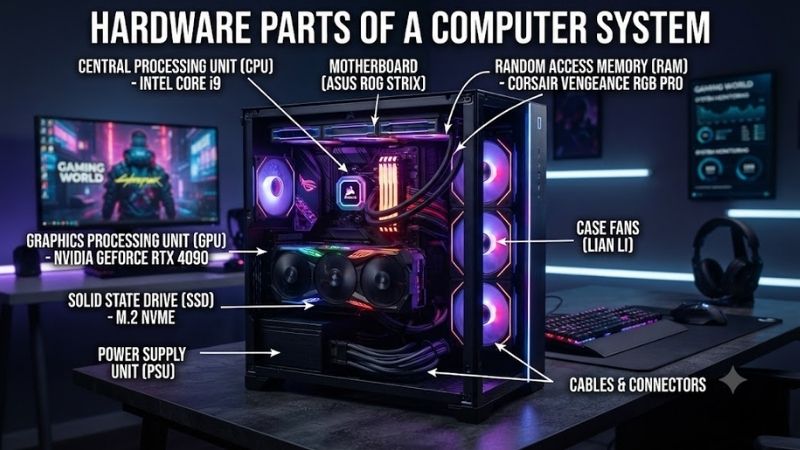
The hardware parts of a computer system include the physical components that process data, store information, display graphics, connect devices, and provide power. Important parts include the CPU, motherboard, RAM, storage drives, graphics hardware, power supply, cooling system, case, monitor, keyboard, mouse, and network hardware.
What Is Computer Hardware?
Computer hardware refers to the physical components that make up a computer system. These parts can be seen, touched, installed, removed, upgraded, or replaced. Hardware works together with software, which provides the instructions that tell the physical components what tasks to perform.
A complete computer system includes both internal and external hardware. Internal components perform most of the processing and storage work inside the case, while external devices allow the user to interact with the system, view information, enter commands, hear audio, communicate, and connect additional equipment.
Central Processing Unit
The central processing unit, or CPU, executes program instructions and performs calculations required by the operating system and applications. It handles logic, data processing, game calculations, software operations, and many background tasks that occur while a computer is running.
Modern CPUs contain multiple cores and threads that allow several tasks to be processed efficiently. Performance depends on architecture, clock speed, core count, cache, power limits, and workload. A faster processor is especially useful for gaming, video editing, software development, rendering, and heavy multitasking.
Motherboard
The motherboard is the main circuit board that connects the computer’s internal hardware. The processor, memory, storage devices, graphics card, network hardware, and expansion cards all communicate through the motherboard either directly or through cables and connectors.
Motherboards also determine many compatibility options. Processor socket, chipset, RAM generation, expansion slots, M.2 connections, USB ports, audio hardware, and networking features all depend on the specific board. Choosing the wrong motherboard can prevent other components from working together correctly.
Random Access Memory
Random access memory, or RAM, temporarily stores data that active programs need quickly. When you open a browser, game, document, or editing application, part of its working data is loaded into RAM because the processor can access it much faster than data stored on long-term drives.
RAM is volatile memory, which means its contents disappear when the computer loses power. More memory can improve multitasking when the system would otherwise run out of available RAM. Capacity, speed, latency, memory generation, and the number of installed modules can all affect system behavior.
Storage Devices
Storage hardware keeps the operating system, applications, documents, games, photos, videos, and other files even after the computer is turned off. The most common types are solid-state drives and hard disk drives, although external storage and network storage can also be used.
SSDs use flash memory and provide much faster access than mechanical hard drives. HDDs use spinning magnetic platters and remain useful for large, inexpensive storage. Many modern computers use an SSD for Windows and applications while keeping an HDD for backups, media libraries, or archived files.
Graphics Processing Unit
The graphics processing unit, or GPU, creates images and handles highly parallel workloads. It is especially important for gaming, 3D rendering, visual effects, video editing, artificial intelligence applications, and professional software that can use GPU acceleration.
Some processors include integrated graphics, allowing a computer to display images without a separate card. Dedicated graphics cards provide more performance and include their own video memory and cooling hardware. The right choice depends on display resolution, game requirements, software needs, budget, and power supply capacity.
Power Supply Unit
The power supply unit converts electricity from the wall into the voltages needed by the computer’s components. It delivers power to the motherboard, processor, graphics card, storage drives, cooling hardware, and other internal devices.
A good PSU should provide enough capacity for the complete system with appropriate connectors and safety protections. Wattage alone does not determine quality. Internal design, efficiency, voltage regulation, protection features, and build quality also matter, especially in gaming PCs with powerful graphics cards.
Computer Case
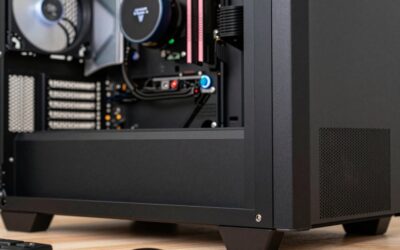
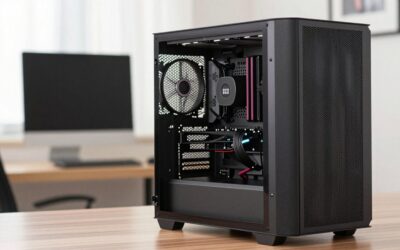
The computer case houses and protects the internal hardware. It provides mounting locations for the motherboard, power supply, graphics card, storage devices, fans, radiators, and other components while also affecting airflow, cable management, and ease of maintenance.
Cases come in different sizes, including full tower, mid tower, Micro ATX, and Mini ITX designs. Before choosing one, check motherboard support, graphics card clearance, CPU cooler height, radiator compatibility, storage positions, and space for cables. A larger case usually provides easier installation and expansion.
Cooling System
Computer components produce heat while operating, so the cooling system keeps temperatures under control. Common cooling hardware includes CPU heatsinks, cooling fans, liquid coolers, graphics card coolers, thermal paste, and case fans that move air through the enclosure.
Proper cooling helps maintain stable performance and prevents thermal throttling. High temperatures can cause processors or graphics cards to reduce speed automatically. Cooling requirements depend on component power consumption, case airflow, room temperature, fan placement, and the type of workload running on the computer.
Network Hardware
Network hardware allows a computer to communicate with other devices and connect to the internet. Common components include Ethernet adapters, Wi-Fi adapters, Bluetooth modules, network cards, and integrated motherboard controllers.
Ethernet provides a wired connection that is often preferred for desktop gaming, large file transfers, and stable office networking. Wi-Fi provides greater convenience and flexibility. Actual network speed depends on the adapter, router, cables, signal quality, internet service, and other devices using the network.
Sound Hardware
Audio hardware processes sound for speakers, headphones, and microphones. Most motherboards include integrated audio, which is sufficient for normal gaming, video calls, music playback, and general computer use.
Dedicated sound cards and external audio interfaces are used when additional inputs, outputs, higher-quality recording, professional microphones, or studio equipment are required. USB headsets can also include their own digital audio hardware, reducing dependence on the motherboard’s analog audio system.
Monitor
The monitor is an output device that displays text, images, videos, applications, and games. Important specifications include screen size, resolution, refresh rate, panel technology, brightness, response characteristics, color performance, and available video connections.
Gaming users may prioritize high refresh rates and adaptive synchronization, while office users often focus on text clarity and workspace. Creative professionals may require better color accuracy. The monitor connects to the graphics hardware through interfaces such as HDMI, DisplayPort, or supported USB-C connections.
Keyboard
The keyboard is an input device used to enter text, commands, shortcuts, and game controls. Keyboards may use membrane, mechanical, optical, or magnetic switch technologies and can connect through USB, Bluetooth, or a dedicated wireless receiver.
Different layouts suit different needs. Full-size keyboards include a number pad, while tenkeyless and compact layouts save desk space. Gaming models may add programmable keys, adjustable actuation, high polling rates, onboard profiles, or RGB lighting, while office keyboards may focus more heavily on quiet operation and comfort.
Mouse
The mouse is an input device that controls pointer movement and provides buttons for selecting, dragging, scrolling, and interacting with software. Modern mice use optical sensors to detect movement and can connect through a cable, Bluetooth, or a dedicated wireless receiver.
Gaming mice usually emphasize sensor accuracy, low latency, polling rate, weight, switch design, and programmable buttons. Productivity mice may focus more on ergonomics, battery life, silent operation, multi-device support, and additional scrolling controls. Shape and hand fit are often more important than maximum sensor sensitivity.
Input Devices
Input devices allow users to send information and commands to the computer. Common examples include keyboards, mice, microphones, webcams, scanners, game controllers, drawing tablets, and touchscreens.
Each device converts physical actions or real-world information into digital data that the computer can process. A microphone converts sound, a camera captures images, and a controller converts button presses and movement. The type of input hardware required depends on how the computer is used.
Output Devices
Output devices present information produced by the computer. Monitors display visual output, speakers reproduce audio, printers create physical documents, and headphones provide private sound.
Some devices can serve both input and output roles. A touchscreen displays information while also detecting touch, while a headset may combine headphones and a microphone. Understanding these categories helps explain how users exchange information with a computer system.
Ports and Connectors
Ports and connectors allow internal and external hardware to communicate. USB ports support storage devices, keyboards, mice, cameras, controllers, and many other accessories. HDMI and DisplayPort carry video and audio signals to monitors, while Ethernet provides wired networking.
Inside the computer, connectors include PCI Express slots, M.2 sockets, SATA ports, power connectors, fan headers, and front-panel connections. Compatibility depends on both the physical connector and the supported standard, so matching shape alone does not always guarantee that every feature will work.
Expansion Cards
Expansion cards add capabilities that are not already provided by the motherboard. They normally install into PCI Express slots and can include graphics cards, network adapters, sound cards, capture cards, USB expansion cards, and specialized storage controllers.
Available expansion space depends on motherboard and case size. Large graphics cards can cover neighboring slots, while compact systems may have very limited expansion capacity. Before installing a card, check slot type, available clearance, power requirements, and operating-system compatibility.
How the Hardware Parts Work Together
When you start a program, the storage drive provides the required files, RAM holds active data, and the CPU executes instructions. If graphics are required, the GPU processes visual information and sends the final image to the monitor.
Meanwhile, the motherboard connects the components, the power supply provides electricity, the cooling system removes heat, and network hardware handles online communication. The computer only works effectively when all these parts are compatible and communicate correctly.
Internal vs External Computer Hardware
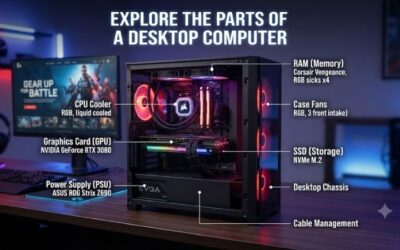
Internal hardware includes the CPU, motherboard, RAM, storage, GPU, power supply, cooling system, and expansion cards. These components are installed inside the case and usually require opening the computer for maintenance or upgrades.
External hardware includes the monitor, keyboard, mouse, speakers, webcam, printer, external drives, and other peripherals. These devices are generally easier to replace and can often be moved between different computers without changing the internal system.
FAQ
What Are the Main Hardware Parts of a Computer System?
The main parts include the CPU, motherboard, RAM, storage, graphics hardware, power supply, cooling system, and case. A complete setup also normally includes a monitor, keyboard, mouse, and networking hardware.
Which Hardware Part Processes Data?
The CPU performs most general processing and executes program instructions. The GPU handles graphics and highly parallel workloads, while other specialized hardware may process audio, networking, or storage tasks.
Which Hardware Stores Data Permanently?
SSDs and HDDs provide long-term storage. They retain the operating system, programs, and files even after the computer is switched off, unlike RAM, which loses its contents without power.
Is the Motherboard the Most Important Part?
The motherboard is essential because it connects the components, but no single part can make a complete computer work alone. The CPU, memory, storage, power supply, and other hardware must all function together.
What Is the Difference Between Hardware and Software?
Hardware is the physical equipment, while software is the set of digital instructions and programs that run on the hardware. An operating system is software, while the CPU and storage drive are hardware.
Conclusion
The hardware parts of a computer system each perform a specific function. The CPU processes instructions, RAM manages active data, storage keeps files, the GPU handles graphics, and the motherboard links everything together. Understanding these parts makes it easier to choose components, diagnose problems, and upgrade a computer confidently.