🛒 Best Price Today on Amazon
Prime members get fast, free shipping on everything above, plus member-only deals. New members get a 30-day free trial — cancel anytime.
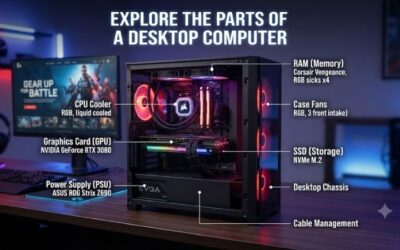
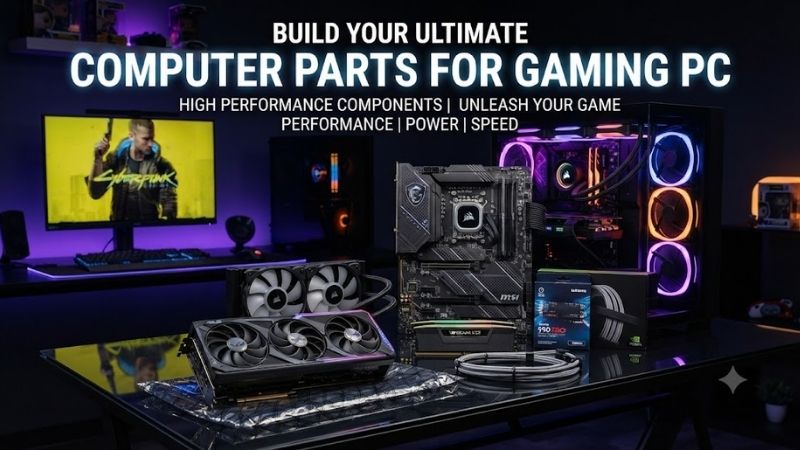
The main computer parts for gaming PC builds include a processor, graphics card, motherboard, memory, storage, power supply, CPU cooler, and case. Choosing compatible components matters more than simply buying the most expensive hardware. A balanced gaming PC should match the target resolution, refresh rate, games, upgrade plans, and total budget.
Quick answer: Our top pick in 2026 is the Component — our #1 rated choice. See the full ranked comparison, alternatives and buying advice below.
Essential Gaming PC Parts at a Glance
| Component | Recommended Example | Main Role |
|---|---|---|
| CPU | AMD Ryzen 7 9800X3D | Game logic and CPU processing |
| GPU | NVIDIA GeForce RTX 5070 Ti | Graphics rendering |
| Motherboard | ASUS TUF Gaming B850-Plus WiFi | Connects core components |
| RAM | 32GB DDR5 Kit | Active system memory |
| SSD | Samsung 990 Pro 2TB | Games and operating system |
| Power Supply | Corsair RM850x | Provides stable system power |
| CPU Cooler | Thermalright Phantom Spirit 120 SE | Controls CPU temperatures |
| PC Case | Lian Li Lancool 216 | Airflow and component housing |
AMD Ryzen 7 9800X3D
Best For: High-performance gaming CPUs
The processor handles game logic, simulation, background applications, operating-system tasks, and instructions that ultimately feed the graphics card. For a gaming-focused build, strong single-thread performance and consistent frame delivery are generally more important than buying the processor with the largest possible number of cores.
AMD’s Ryzen 7 9800X3D is a strong example of a gaming-oriented CPU because the X3D design provides additional cache that can benefit many games. This type of processor is especially relevant for powerful systems targeting high refresh rates where the graphics card is fast enough for CPU performance to become more important.
CPU requirements also change with resolution. Competitive gaming at 1080p or 1440p and very high frame rates places more emphasis on processor performance. At 4K with demanding visual settings, the graphics card usually becomes the larger limitation, meaning overspending heavily on the CPU may deliver relatively small gains.
Key Features
- Eight-core gaming-focused design
- Sixteen processing threads
- Large 3D V-Cache
- AM5 platform
- DDR5 memory support
- Strong high-refresh gaming potential
- Suitable for powerful GPUs
- Good platform upgrade flexibility
What Makes It Different
The Ryzen 7 9800X3D focuses heavily on gaming performance rather than maximizing workstation core counts. It is particularly attractive when the goal is high frame rates and strong minimum-frame performance without moving into a larger and more power-hungry productivity-oriented processor.
Pros
- Excellent gaming performance
- Strong frame consistency
- Modern AM5 platform
- Good match for high-end GPUs
- Efficient gaming-focused design
Cons
- More expensive than mainstream CPUs
- Excessive for entry-level gaming systems
- Requires compatible AM5 motherboard
Use Case: High-refresh 1440p gaming, premium 4K gaming, esports, simulation games, and powerful gaming builds.
Who It’s For: Gamers building around a high-performance graphics card and prioritizing maximum gaming performance.
NVIDIA GeForce RTX 5070 Ti
Best For: High-performance 1440p and 4K gaming
The graphics card is normally the most important component for gaming performance. It renders the game world, lighting, textures, effects, and frames displayed on the monitor. When setting a gaming PC budget, allocating a larger portion toward the GPU usually produces a bigger gaming improvement than overspending on secondary components.
A GPU in the RTX 5070 Ti class is suitable for powerful 1440p gaming and can also handle 4K depending on the game and selected settings. Modern rendering features such as ray tracing and upscaling increase the importance of choosing a GPU with enough processing performance and video memory.
The correct graphics card depends strongly on the monitor. Buying an extremely powerful GPU for a 1080p 60Hz display wastes potential, while pairing an underpowered card with a 4K high-refresh monitor creates the opposite problem. Build around the resolution and frame-rate target rather than choosing components independently.
Key Features
- High-performance gaming GPU
- Suitable for 1440p high refresh
- Capable of 4K gaming
- Hardware ray-tracing support
- AI-assisted upscaling features
- Modern display outputs
- Large video-memory capacity
- Hardware video encoding support
What Makes It Different
A powerful modern GPU affects visual quality and frame rate more directly than almost any other component. It determines whether demanding settings, high resolutions, ray tracing, and high refresh rates are practical within a particular gaming system.
Pros
- Excellent 1440p capability
- Strong 4K potential
- Modern rendering features
- Good match for high-refresh monitors
- Useful video encoding features
Cons
- Major portion of total build cost
- Requires sufficient PSU capacity
- Large models need substantial case clearance
Use Case: AAA games, 1440p high-refresh gaming, 4K gaming, streaming, and GPU-accelerated creative applications.
Who It’s For: Gamers who want strong performance without building around the most expensive flagship GPU tier.
ASUS TUF Gaming B850-Plus WiFi
Best For: Balanced AM5 gaming builds
The motherboard connects the CPU, memory, storage, graphics card, networking, and peripheral interfaces. It normally has much less direct influence on FPS than the CPU or GPU, so buyers should prioritize compatibility, connectivity, expansion, and reliable power delivery rather than paying heavily for decorative features.
A B850-class motherboard provides a sensible foundation for an AM5 gaming system. It supports modern Ryzen processors, DDR5 memory, M.2 storage, PCIe expansion, and current connectivity while avoiding some of the additional cost associated with top-tier enthusiast boards.
Built-in Wi-Fi and Bluetooth are useful when Ethernet is unavailable or wireless accessories need to connect without separate adapters. Multiple M.2 slots are also valuable because modern games consume significant storage, making future SSD expansion easier when the original drive becomes full.
Key Features
- AM5 processor socket
- DDR5 memory support
- Multiple M.2 storage positions
- PCIe graphics-card slot
- Integrated Wi-Fi
- Bluetooth connectivity
- USB connectivity
- BIOS update functionality
- ATX form factor
What Makes It Different
A good mainstream motherboard provides the features gaming users actually need without consuming budget that could improve GPU performance. The goal is compatibility, enough expansion, reliable networking, and an upgrade path rather than paying for extreme overclocking features most gamers never use.
Pros
- Modern AM5 compatibility
- Built-in wireless networking
- Multiple storage options
- Good upgrade flexibility
- Suitable for mainstream and premium CPUs
Cons
- ATX board requires compatible case
- Premium boards offer more expansion
- Motherboard features rarely increase FPS directly
Use Case: Gaming desktops, multi-SSD systems, Wi-Fi gaming setups, and long-term AM5 builds.
Who It’s For: Gamers wanting a balanced motherboard that supports modern hardware without unnecessary flagship pricing.
32GB DDR5 Memory Kit
Best For: Modern gaming and multitasking
System memory temporarily holds information that the processor and applications need quickly. For current gaming PCs, 32GB provides a comfortable capacity for demanding games, launchers, browser tabs, voice chat, background applications, and occasional streaming without creating unnecessary memory pressure.
A dual-module configuration is usually preferable because it enables the intended memory-channel operation while leaving the system straightforward to configure. For mainstream gaming, extremely high memory speeds often provide much smaller performance gains than upgrading the graphics card or processor.
Compatibility should be checked against the motherboard and CPU platform. Memory profiles can simplify configuration, but advertised speeds may require enabling the correct BIOS setting. Users should prioritize a reliable compatible kit before chasing extreme frequency numbers with limited real-world gaming benefit.
Key Features
- 32GB total capacity
- DDR5 technology
- Dual-module configuration
- Suitable for modern gaming
- Supports multitasking
- Available with performance memory profiles
- Compatible with modern desktop platforms
What Makes It Different
Thirty-two gigabytes provides enough headroom for modern games and normal background applications without moving into unnecessarily large memory capacities. It is a practical middle point between minimum configurations and workstation-oriented systems carrying 64GB or more.
Pros
- Plenty of capacity for gaming
- Good for multitasking
- Suitable for current platforms
- Leaves room for demanding games
- Better long-term flexibility than 16GB
Cons
- More expensive than basic 16GB kits
- Excessive speeds provide limited gaming benefit
- Platform compatibility must be checked
Use Case: Gaming, Discord, streaming, browser multitasking, light content creation, and everyday desktop use.
Who It’s For: Most users building a midrange or high-end gaming PC.
Samsung 990 Pro 2TB SSD
Best For: Gaming storage and operating systems
A fast SSD is now a core gaming component rather than an optional upgrade. Windows, applications, and modern games benefit from low access latency and strong transfer performance. Mechanical hard drives remain useful for archives, but they are no longer ideal as the primary storage device in a performance-focused gaming PC.
A 2TB NVMe SSD provides a useful balance between capacity and cost. Large games can consume more than 100GB each, so a 1TB drive may fill quickly once Windows, applications, and several major titles are installed. Two terabytes provides much more practical breathing room.
PCIe 4.0 NVMe drives already offer more than enough performance for the majority of gaming workloads. Faster-generation drives may produce impressive sequential benchmark results, but gaming improvements are often smaller. Capacity and reliable real-world performance should therefore take priority over chasing maximum benchmark numbers.
Key Features
- 2TB storage capacity
- M.2 NVMe format
- PCIe 4.0 interface
- High sequential performance
- Low access latency
- Suitable for Windows and games
- No moving mechanical parts
What Makes It Different
A fast NVMe SSD improves the responsiveness of the entire system rather than only one game. Booting, installing software, launching games, moving files, and updating applications all benefit while the compact M.2 format eliminates additional data and power cables.
Pros
- Fast loading
- Large 2TB capacity
- Compact installation
- Silent operation
- Excellent primary-drive choice
Cons
- Costs more than hard-drive storage
- Premium sequential speeds do not always improve FPS
- M.2 slots can be limited on cheaper motherboards
Use Case: Windows, games, applications, active projects, and frequently accessed files.
Who It’s For: Nearly every modern gaming PC builder.
Corsair RM850x Power Supply
Best For: Powerful gaming systems
The power supply converts wall electricity into the voltages used by the computer. A quality PSU is important because every major component depends on it. Selecting purely by advertised wattage is a mistake; build quality, efficiency, protection features, connector support, and reputable platform design also matter.
An 850-watt unit provides useful headroom for many performance-oriented gaming systems using powerful CPUs and GPUs. The exact requirement depends on the installed graphics card, processor, and peripherals, so builders should check manufacturer guidance rather than automatically assuming every gaming PC needs the same wattage.
Modern graphics cards may use newer power connections, making current PSU standards useful when building from scratch. Native cabling can reduce the need for adapters and simplify cable management. Fully modular designs also allow unnecessary cables to remain outside the case, improving airflow and installation cleanliness.
Key Features
- 850W capacity
- High efficiency
- Fully modular cabling
- Modern GPU power support
- Cooling fan
- Electrical protection features
- Suitable for performance gaming PCs
What Makes It Different
A good PSU does not increase frame rates, but it protects the stability and upgrade potential of the complete system. Spending slightly more on a reliable power supply is usually wiser than choosing the cheapest unit capable of meeting the theoretical wattage requirement.
Pros
- Strong power capacity
- Modular cables
- Good upgrade headroom
- Clean cable management
- Suitable for high-performance GPUs
Cons
- Overkill for entry-level systems
- Quality units cost more
- Correct GPU connectors still need verification
Use Case: Midrange and high-end gaming PCs, future GPU upgrades, and performance-oriented systems.
Who It’s For: Builders who want reliable power delivery and enough capacity for powerful hardware.
Thermalright Phantom Spirit 120 SE
Best For: Air-cooled gaming CPUs
The CPU cooler removes heat from the processor so it can maintain stable operating frequencies. Many gaming CPUs can be cooled effectively with a quality tower air cooler, avoiding the additional pump, tubing, and radiator components of liquid cooling.
The Phantom Spirit 120 SE represents the type of dual-tower air cooler that works well in performance gaming systems. Its large heatsink area and multiple fans allow substantial heat dissipation while keeping the design mechanically simple compared with an all-in-one liquid cooler.
Case clearance should always be checked because large tower coolers can interfere with tall memory modules or narrow cases. Socket compatibility also matters. When correctly installed in a well-ventilated case, a strong air cooler can provide excellent performance without requiring liquid cooling.
Key Features
- Dual-tower heatsink design
- Multiple heat pipes
- Dual-fan configuration
- Broad modern socket support
- No pump
- Suitable for gaming processors
- Replaceable standard fans
What Makes It Different
Large air coolers offer strong cooling with relatively few failure points. There is no pump to wear out and no liquid loop to manage, making them appealing to users who prioritize reliability and straightforward maintenance.
Pros
- Strong cooling capability
- Good value
- No liquid pump
- Straightforward maintenance
- Suitable for many gaming CPUs
Cons
- Large physical size
- RAM clearance needs checking
- Can complicate motherboard access
Use Case: Gaming CPUs, quiet builds, long-term desktop systems, and users avoiding liquid cooling.
Who It’s For: Gamers who want strong CPU cooling without paying for an AIO.
Lian Li Lancool 216
Best For: Airflow-focused gaming builds
The case determines how easily components fit, how effectively air moves through the system, and how convenient future upgrades will be. Gaming cases should provide sufficient GPU clearance, CPU cooler space, fan positions, storage mounting, and front-panel ventilation rather than prioritizing appearance alone.
The Lancool 216 represents an airflow-focused design with a ventilated front and large intake fans. High-airflow cases can help both the processor and graphics card maintain lower temperatures without forcing every fan to operate at maximum speed.
Builders should verify motherboard format, graphics-card length, radiator support, power-supply dimensions, and front I/O before buying any case. A beautiful enclosure becomes frustrating quickly if the planned GPU or cooler does not physically fit.
Key Features
- Airflow-focused front panel
- Large intake fans
- ATX motherboard support
- Strong GPU clearance
- Cable-management space
- Tempered-glass side panel
- Multiple cooling positions
- Modern front I/O
What Makes It Different
The Lancool 216 prioritizes unrestricted airflow rather than using a mostly sealed front panel. This can improve GPU and CPU cooling while allowing fans to run more quietly during gaming.
Pros
- Excellent airflow potential
- Good component compatibility
- Large included fans
- Easy upgrade access
- Useful cable-management space
Cons
- Larger than compact cases
- Mesh designs allow more dust
- Appearance may not suit minimalist offices
Use Case: High-performance gaming PCs, air cooling, large graphics cards, and upgrade-friendly builds.
Who It’s For: Builders who prioritize temperatures, airflow, and easy hardware installation.
How to Choose Computer Parts for a Gaming PC
Set the Gaming Target First
Decide whether the system is intended for 1080p, 1440p, or 4K before choosing parts. Resolution strongly affects GPU requirements, while refresh-rate targets influence both CPU and GPU selection. A balanced 1440p system can outperform an poorly allocated expensive build where too much budget goes toward components that barely affect gaming.
Spend More on the GPU
For most gaming systems, the graphics card deserves the largest share of the hardware budget. A more expensive motherboard, oversized RAM kit, or premium SSD rarely compensates for an underpowered GPU. Once the processor is strong enough, additional budget should usually move toward graphics performance.
Check Compatibility
Confirm CPU socket, motherboard chipset, RAM type, case dimensions, GPU clearance, cooler height, and PSU connectors before purchasing. Modern PC components are modular, but they are not universally interchangeable. A compatibility check before ordering is far easier than discovering that one expensive part does not physically or electrically fit.
Choose at Least 32GB for a New Performance Build
Sixteen gigabytes can still run many games, but 32GB gives a new gaming PC more breathing room for modern titles and background programs. Higher capacities are primarily useful for content creation, virtual machines, professional workloads, or specific heavily modded games.
Buy Enough SSD Capacity
A gaming computer can fill a 1TB SSD surprisingly quickly. Two terabytes is a more comfortable starting point for users who maintain several AAA titles simultaneously. Additional M.2 drives can be installed later if the motherboard has available slots.
Do Not Ignore the PSU and Case
Neither component appears on an FPS chart, but both affect reliability and usability. The power supply must safely support the CPU and GPU, while the case needs enough airflow and physical space. Cutting costs too aggressively in these areas can create instability, noise, and upgrade problems.
FAQ
What Parts Do I Need to Build a Gaming PC?
You need a CPU, GPU, motherboard, RAM, storage drive, power supply, CPU cooling solution, and case. You will also need an operating system and peripherals such as a monitor, keyboard, and mouse, although these are normally considered separate from the internal PC build.
Which PC Part Is Most Important for Gaming?
The graphics card is generally the most important component for gaming performance, particularly at 1440p and 4K. The CPU also matters, especially at lower resolutions and very high refresh rates. A balanced system avoids pairing a powerful GPU with an unnecessarily weak processor.
Is 32GB RAM Enough for Gaming?
Yes. Thirty-two gigabytes is an excellent capacity for modern gaming PCs and provides room for background applications, browsers, voice chat, and normal multitasking. Most gamers do not need 64GB unless they also perform demanding professional workloads or use applications with unusually high memory requirements.
Is 1TB SSD Enough for Gaming?
One terabyte can work, but large game installations quickly consume available capacity. A 2TB SSD provides a more comfortable starting point for a new performance build. Users who play only a few games at a time can begin with 1TB and add another drive later.
Do Gaming PCs Need Liquid Cooling?
No. Many gaming processors perform extremely well with quality tower air coolers. Liquid cooling can provide additional thermal capacity and a different appearance, but it is not automatically required. Cooler selection should be based on the processor’s heat output, case compatibility, noise goals, and budget.
Conclusion
The essential computer parts for gaming PC builds are the CPU, GPU, motherboard, RAM, SSD, PSU, cooler, and case. Prioritize the graphics card, choose a processor strong enough for your target frame rate, use 32GB of compatible memory, install sufficient SSD storage, and never overlook reliable power delivery, cooling, airflow, or component compatibility.
Ready to decide? Our #1 pick for 2026 is the Component.
Live price & availability on Amazon.