🛒 Best Price Today on Amazon
Prime members get fast, free shipping on everything above, plus member-only deals. New members get a 30-day free trial — cancel anytime.
Valorant rounds turn on the first shot. A duel is usually settled by whoever stops moving, settles the crosshair and clicks first, so the mouse decision that matters is not raw DPI or lighting. It is whether the shape lets you stop a flick exactly on a head-sized target, whether the shell stays put during fast horizontal swipes, and whether the wireless link reports movement quickly enough that nothing feels delayed when you counter-strafe.


This guide is for ranked grinders, casual competitive players and anyone moving up from an office mouse. Every pick below was chosen from its Amazon listing details: the stated weight, the sensor and polling figures the listing itself publishes, and whether the shell is symmetrical or ergonomic, because those three things decide how a rifle actually handles in a tactical shooter.
Quick Picks
As an Amazon Associate we earn from qualifying purchases
| Product | Best for | Key spec from title |
|---|---|---|
| Logitech G Pro X Superlight 2 | Players who want one proven symmetrical shape | 60 g, HERO 2 sensor, 8 kHz report rate |
| Razer Viper V3 Pro | Claw and fingertip players chasing the lightest shell | 54 g, Focus Pro 35K sensor, true 8K polling |
| Pulsar X2V2 | Small-to-medium hands wanting a compact symmetrical mouse | 53 g, PAW3395 sensor, 26,000 DPI |
| Razer DeathAdder V3 Pro | Palm-grip players who aim with their whole arm | 63 g, ergonomic shape, Focus Pro 30K sensor |
How to Choose
Weight decides how your flicks stop
In a game built around holding angles and snapping to corners, mass works against you at the end of every movement. A lighter mouse needs less force to start a swipe and, more importantly, less force to stop one, which is where overshooting a headshot usually comes from. The four mice here sit between 53 g and 63 g as listed, a narrow band, yet even that small gap is noticeable across a long ranked session. Players who aim mostly with the wrist tend to feel heavy shells sooner, while arm aimers spread the effort across bigger muscles and tolerate a few extra grams.
Polling rate and click response
A standard gaming mouse reports its position 1,000 times per second. Two listings here go further: the Superlight 2 states an 8 kHz report rate, and the Viper V3 Pro states true 8K polling with the required dongle included. Higher polling smooths cursor movement and trims the delay between a physical click and the shot registering, which matters when two players swing the same corner. Treat it as a refinement rather than a requirement, though. A stable 1,000 Hz link with optical switches still answers instantly, and the DeathAdder V3 Pro shows that a 1,000 Hz listing can suit serious play when the shape fits your hand.
Symmetrical or ergonomic for rifle aiming
Shell shape decides which muscles do the fine correction after a flick. Symmetrical mice such as the Superlight 2, Viper V3 Pro and X2V2 leave the hand position open, so claw and fingertip players can micro-adjust with their fingers while the wrist handles the larger sweep. Ergonomic shells like the DeathAdder V3 Pro fill the palm and lock the hand into one repeatable posture, which many arm aimers find steadier for holding a static angle. Neither is objectively better. The right answer is the shape that matches how your hand already rests when you are not thinking about it.
Battery life and charging habits
Wireless freedom only helps if the mouse is awake when the match starts. Listed battery figures here range from up to 90 hours on the DeathAdder V3 Pro to up to 95 hours on the Viper V3 Pro, and the Superlight 2 charges over USB-C. Build a routine around those numbers: park the mouse on its cable between sessions, or top it up on the night you would normally do aim training. Players who raise the polling rate should expect shorter runs between charges, so check the listing figures for the mode you actually plan to run rather than the headline number.
The 4 Best Options
Logitech G Pro X Superlight 2
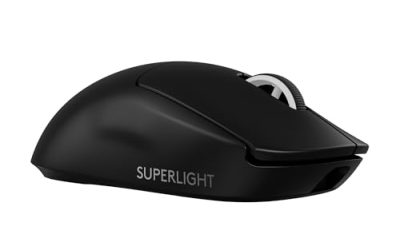
The Superlight 2 is the safe pair of hands in this group: a symmetrical shell at a listed 60 g, driven by the HERO 2 sensor and an 8 kHz report rate over LIGHTSPEED wireless. For Valorant that combination means wide, low-sensitivity swipes track without spin-outs and the final finger correction lands where you pointed it. Five programmable buttons cover the essentials without crowding the sides, and LIGHTFORCE hybrid switches give a crisp, definite click that suits tap-firing and short bursts at range.
Specs
- Weight: 60 g as listed
- Sensor: HERO 2, up to 44,000 DPI
- Report rate: 8 kHz
- Connection: LIGHTSPEED wireless, USB-C charging
- Switches: LIGHTFORCE hybrid switches
- Buttons: 5 programmable buttons
- Shape: symmetrical, listed for PC and Mac
Best for: Players who want a proven symmetrical mouse with high polling already built in.
Watch out for: Only five buttons, so players who bind several abilities and pings to the mouse should map carefully before a match.
ASIN: B09NBWL8J5
Razer Viper V3 Pro
At a listed 54 g in this black version, the Viper V3 Pro is the lightest full-size option here, and its symmetrical shell is shaped for the claw and fingertip holds most high-level riflers use. The Focus Pro 35K sensor is paired with true 8K polling, and Razer includes the HyperPolling dongle in the box per the listing, so the high polling mode does not need a separate purchase. Gen-3 optical switches answer clicks without mechanical contact delay, and the listed battery runs up to 95 hours, which covers weeks of evening queues for most players.
Specs
- Weight: 54 g as listed for the black version
- Sensor: Focus Pro 35K optical, up to 35,000 DPI
- Polling: true 8K polling, HyperPolling dongle included per listing
- Connection: HyperSpeed wireless
- Switches: Gen-3 optical switches
- Buttons: 8 programmable buttons
- Battery: up to 95 hours as listed
Best for: Claw and fingertip players who want the lightest shell and 8K polling out of the box.
Watch out for: The flat symmetrical shape offers little palm support, so committed palm-grip players may find long sessions tiring.
ASIN: B0CW25XR5R
Pulsar X2V2
The X2V2 takes the compact route: a listed 53 g in a symmetrical medium shell that smaller hands can wrap without stretching. Its PAW3395 sensor is rated to 26,000 DPI in the listing, optical switches handle the clicks, and the 2.4 GHz link is listed at a 1 ms response, the standard competitive class. For Valorant players who aim with a relaxed claw and make many small corrections around a held angle, that small, light package is easy to place precisely and easy to lift for resets between angles.
Specs
- Weight: 53 g as listed
- Sensor: PAW3395, up to 26,000 DPI
- Connection: 2.4 GHz wireless, 1 ms as listed
- Switches: optical switches
- Shape: symmetrical, medium size
Best for: Small-to-medium hands that want a light, compact symmetrical mouse for claw aiming.
Watch out for: Confirm the live listing before buying, and note that polling above the listed rate needs Pulsar’s separate 4K dongle, which this listing does not include.
ASIN: B0CH9Z587R
Razer DeathAdder V3 Pro

The DeathAdder V3 Pro is the ergonomic counterpoint to three symmetrical shells. Its right-handed shape, listed at 128 × 68 × 44 mm and 63 g, fills the palm and gives arm aimers a stable platform for holding one angle through a long round. The Focus Pro 30K sensor and Gen-3 optical switches keep tracking and clicks competitive, HyperSpeed wireless keeps the desk clear, and the listed battery stretches to 90 hours. Players whose aim style is patience, crosshair placement and one clean burst rather than constant flicking will feel most at home here.
Specs
- Weight: 63 g as listed
- Dimensions: 128 × 68 × 44 mm as listed
- Sensor: Focus Pro 30K optical, up to 30,000 DPI
- Connection: HyperSpeed wireless
- Switches: Gen-3 optical switches
- Buttons: 5 programmable buttons
- Battery: up to 90 hours as listed
- Shape: ergonomic, right-handed
Best for: Palm-grip and arm-aiming players who hold angles and want a supportive ergonomic shell.
Watch out for: The standard listing is the 1,000 Hz model; 8K polling is only available through the separate HyperPolling dongle, and the shape is right-handed only.
ASIN: B0B6XZLNHQ
Which One Fits Your Situation
You flick with a claw grip and hate heavy mice
Start with the Viper V3 Pro. Its 54 g shell and flat symmetrical profile are built for the constant lift, swipe and stop rhythm of a claw rifler, and the included dongle means the 8K polling mode works from day one. If your hand is on the smaller side, the 53 g X2V2 gives the same aiming style in a more compact frame.
You hold angles with a relaxed palm grip
Choose the DeathAdder V3 Pro. The ergonomic shell supports the whole hand, which keeps micro-movements calm when you are holding a doorway for half a round, and the 90-hour listed battery means it rarely needs the cable mid-week. Its 1,000 Hz polling is standard class, so pick it for the shape rather than for headline polling figures.
You want one mouse for ranked play and everything else
The Superlight 2 splits the difference. It is light enough for tactical shooters, symmetrical enough for any grip, and its 8 kHz report rate and USB-C charging keep it current for other titles too. Five buttons is the trade-off: fine for Valorant’s compact ability set, tighter if your other games lean on mouse binds.
You are upgrading from a heavy office mouse
Any pick here will feel dramatically lighter, so buy for shape first. Measure your current grip honestly: fingers curled and palm hovering points to the Viper V3 Pro or X2V2, while a palm that rests fully on the shell points to the DeathAdder V3 Pro. Expect a short adjustment period while your stopping distance recalibrates to the lower weight.
Common Mistakes
- Chasing the highest DPI figure instead of setting a sensitivity you can control at low values.
- Buying a symmetrical mouse for a palm grip, then blaming aim when the unsupported hand tires.
- Turning on the highest polling mode without checking how it changes battery life between charges.
- Copying a professional player’s sensitivity without matching it to your own mouse weight and pad space.
- Ignoring shell size and buying a medium mouse for a large hand, which forces an uncomfortable claw.
Frequently Asked Questions
Is wireless fast enough for competitive Valorant?
Yes. Modern gaming wireless links such as LIGHTSPEED and HyperSpeed report at the same 1,000 Hz class as wired mice, and two listings here go beyond that to 8 kHz reporting. In practice, shape fit and a stable connection matter far more than the cable you removed.
Does 8K polling actually change anything in game?
It smooths the stream of position reports, which can make fast swipes feel marginally cleaner and trims click timing slightly. The gain is small next to choosing the right weight and shape. Treat 8K as a bonus on a mouse that already fits, not as a reason to buy one that does not.
Which shape is better for holding angles, symmetrical or ergonomic?
Ergonomic shells support the palm and reward a settled, repeatable posture, which suits holding one angle patiently. Symmetrical shells free the fingers for constant small corrections, which suits players who clear multiple angles. Match the shell to the role you actually play round after round.
How light should a Valorant mouse be?
Most competitive players settle somewhere in the 50 g to 65 g band covered by these four listings. Lighter helps flicks stop on target and reduces wrist fatigue, but going light with a shape your hand dislikes costs more accuracy than the saved grams return. Fit first, weight second.