🛒 Best Price Today on Amazon
Prime members get fast, free shipping on everything above, plus member-only deals. New members get a 30-day free trial — cancel anytime.
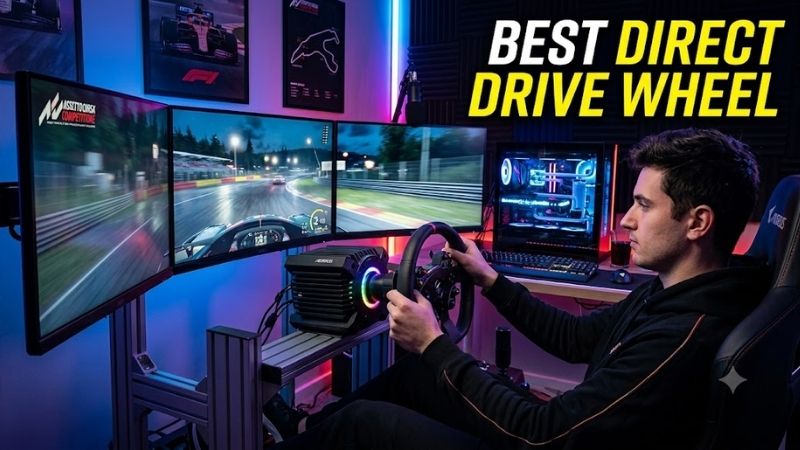
The best direct drive wheel delivers detailed force feedback without the belts or gears used in traditional racing wheels. Torque matters, but smoothness, mounting strength, software, quick release design, wheel ecosystem, and platform compatibility determine whether a wheel base actually fits your sim racing setup.
Best Direct Drive Wheels at a Glance
| Direct Drive Wheel | Best For | Peak Torque | Platform |
|---|---|---|---|
| MOZA R12 V2 | Overall PC sim racing | 12 Nm | PC |
| Logitech G PRO Racing Wheel | PC and console simplicity | 11 Nm | PC / PlayStation or Xbox versions |
| SIMAGIC Alpha Mini | Compact enthusiast rigs | 10 Nm | PC |
| Fanatec CSL DD | Entry-level direct drive | 5 Nm / 8 Nm | PC, Xbox with compatible wheel |
| Asetek La Prima | Premium PC ecosystem | 12 Nm | PC |
1. MOZA R12 V2
Best For: PC racers wanting strong performance without extreme torque
MOZA R12 V2 sits in a useful middle ground between entry-level direct drive bases and high-torque enthusiast equipment. Its 12 Nm peak output provides enough strength to communicate weight transfer, curb strikes, front-tire loading, and traction changes while retaining additional force headroom for detailed feedback.
The V2 uses a 21-bit magnetic encoder with more than two million positions per revolution and a 1000 Hz USB refresh rate. High encoder resolution does not automatically make someone faster, but it gives the control system fine steering information that can help the motor reproduce smaller force changes smoothly around the center.
MOZA’s ecosystem is another important advantage. Compatible steering wheels, pedals, shifters, handbrakes, dashboards, and other accessories can connect around the same platform. The R12 also includes ports for several peripherals, which can reduce cable clutter compared with connecting every accessory independently to the PC.
Key Features
- 12 Nm peak torque
- 21-bit magnetic encoder
- 1000 Hz USB refresh rate
- Aluminum-alloy housing
- 90 to 2700-degree rotation range
- MOZA quick release support
- Pedal, shifter, handbrake, dash, and E-stop ports
- Four-hole bottom mounting
- Optional desktop clamp
- PC compatibility
What Makes It Different
The R12 V2 combines substantial torque with a relatively compact enclosure and broad MOZA accessory support. Twelve newton-meters is strong enough for a serious cockpit without immediately requiring the extreme structural demands associated with 20 Nm-class equipment, making it a practical step into enthusiast-level PC sim racing.
Pros
- Strong 12 Nm output
- Detailed encoder system
- Broad accessory ecosystem
- Compact wheel-base dimensions
- Multiple peripheral connections
- Good torque headroom for serious racing
Cons
- PC only
- Desk clamp is optional
- Strong torque deserves a rigid mounting platform
- Complete ecosystem cost rises with accessories
Use Case: iRacing, Assetto Corsa Competizione, rally simulations, Formula racing, drifting, GT racing, and dedicated PC racing rigs.
Who It’s For: PC sim racers who have outgrown entry-level direct drive but do not need an extreme high-torque wheel base.
2. Logitech G PRO Racing Wheel
Best For: PC and console racers wanting an integrated system
Logitech G PRO Racing Wheel produces 11 Nm of direct drive torque and combines the wheel base with a complete steering wheel. Unlike bases sold separately, this approach reduces the number of components a first-time direct drive buyer must select, while still delivering substantially stronger feedback than Logitech’s older gear-driven wheels.
TRUEFORCE adds higher-frequency effects generated from supported game physics and audio data. The feature can communicate engine texture, road surface, and other detail beyond conventional steering forces when a game supports it. Compatibility varies by title, so the 11 Nm direct drive motor remains the more universal part of the experience.
Platform selection needs attention because Logitech sells versions for different systems. Depending on configuration, the PRO Racing Wheel supports PC with PlayStation or PC with Xbox. That makes it one of the simpler routes into powerful console-compatible direct drive, where hardware licensing limits the number of available options.
Key Features
- 11 Nm direct drive torque
- TRUEFORCE feedback technology
- Magnetic gear-shift paddles
- Dual clutch paddles
- Integrated wheel controls
- On-wheel configuration functions
- PC compatibility
- PlayStation or Xbox versions
- Compatible PRO-series accessories
What Makes It Different
Logitech packages powerful direct drive into a relatively straightforward wheel-and-base system rather than expecting every buyer to assemble an ecosystem immediately. Console support is also important, because many specialist PC wheel bases cannot connect directly to PlayStation or Xbox hardware without licensed components.
Pros
- Strong 11 Nm force feedback
- Console-compatible versions
- Wheel included
- TRUEFORCE in supported games
- Familiar Logitech software ecosystem
- Simple route into premium direct drive
Cons
- Complete system costs more than entry-level bases
- TRUEFORCE depends on game integration
- Ecosystem is less expansive than some specialist brands
- Large torque still benefits from rigid mounting
Use Case: Gran Turismo, Forza, Assetto Corsa Competizione, F1 titles, console sim racing, and PC setups where straightforward configuration matters.
Who It’s For: Racers who want strong direct drive with fewer ecosystem decisions, especially users who need official console compatibility.
3. SIMAGIC Alpha Mini
Best For: Compact PC sim racing cockpits
SIMAGIC Alpha Mini is a 10 Nm direct drive base aimed at users moving beyond starter hardware without stepping into very high torque. Ten newton-meters gives the wheel enough strength to produce clear steering weight and strong transient effects while remaining manageable in compact aluminum-profile or sturdy wheel-stand setups.
Its compact housing is especially valuable when the wheel base sits between a monitor and the driver’s knees. Large motors can force cockpit geometry to change, while a smaller base gives more freedom to position the steering shaft correctly. Proper wheel height and distance often affect comfort more than another few newton-meters of torque.
SIMAGIC also offers an established ecosystem of steering wheels, pedals, shifters, handbrakes, and other racing hardware. The Alpha Mini therefore works well as the center of a gradually expanding rig. Buyers should still confirm individual accessory and game compatibility rather than assuming every third-party component communicates through the base.
Key Features
- 10 Nm direct drive torque
- Compact motor housing
- SIMAGIC quick release ecosystem
- PC-focused compatibility
- Compatible steering-wheel ecosystem
- Aluminum-oriented construction
- Software force-feedback configuration
- Suitable for dedicated cockpit mounting
What Makes It Different
Alpha Mini emphasizes a compact enthusiast experience. Its 10 Nm output sits above many starter systems without creating the mounting demands of extreme torque bases, while SIMAGIC’s wheel and peripheral ecosystem allows drivers to build a serious cockpit around the unit rather than treating it as a temporary beginner product.
Pros
- Strong 10 Nm output
- Compact design
- Large SIMAGIC ecosystem
- Suitable for enthusiast cockpits
- Good step up from entry-level hardware
Cons
- PC focused
- Requires separate steering wheel
- Best experience needs rigid mounting
- Complete rig cost can increase quickly
Use Case: GT racing, Formula cars, drifting, rally, iRacing, Assetto Corsa, and compact aluminum-profile cockpit builds.
Who It’s For: PC racers wanting a compact direct drive base with enough torque for long-term enthusiast use.
4. Fanatec CSL DD
Best For: Entry-level direct drive racing
Fanatec CSL DD remains one of the more accessible ways to move from gear- or belt-driven feedback into a direct drive system. The base provides 5 Nm in its standard configuration and can reach 8 Nm with the larger Boost Kit power supply, giving users an upgrade path without replacing the wheel base itself.
Five newton-meters is enough to demonstrate why direct drive feels different: steering forces are delivered directly from the motor shaft without a belt or gear transmission between the motor and wheel. Moving to 8 Nm provides additional headroom, allowing strong effects to coexist with smaller details without reaching the torque ceiling as quickly.
Fanatec’s ecosystem is a major part of the appeal. The CSL DD works on PC, while Xbox compatibility is possible when a compatible Xbox-licensed steering wheel is attached. PlayStation users need a PlayStation-compatible Fanatec base instead, such as the Gran Turismo DD Pro or other officially supported models.
Key Features
- 5 Nm standard torque
- Up to 8 Nm with Boost Kit 180
- Direct drive motor
- PC compatibility
- Xbox support with compatible licensed wheel
- Fanatec steering-wheel ecosystem
- QR2 ecosystem compatibility
- Compact wheel-base format
What Makes It Different
The CSL DD gives newcomers a staged upgrade path. A user can begin at 5 Nm, add stronger power delivery later, and continue expanding with different steering wheels, pedals, shifters, and accessories. That progression is useful when the initial budget cannot cover a complete enthusiast cockpit all at once.
Pros
- Accessible direct drive entry point
- Upgradeable from 5 Nm to 8 Nm
- Broad Fanatec ecosystem
- Xbox support with compatible wheel
- Compact design
- Suitable for first direct drive rig
Cons
- 5 Nm may feel limited after experience grows
- PlayStation requires a different compatible base
- Accessories increase total system cost
- High forces still need secure mounting
Use Case: First direct drive setups, Formula racing, GT games, Forza, iRacing, and users upgrading gradually from entry-level racing wheels.
Who It’s For: New direct drive users who want an expandable ecosystem without immediately paying for a 10-to-15 Nm wheel base.
5. Asetek La Prima
Best For: Premium PC rigs focused on upgradeability
Asetek La Prima provides 12 Nm of maximum torque and uses a 22-bit absolute angle sensor. It is designed as the entry point into Asetek’s higher-end sim racing ecosystem, delivering substantial direct drive performance while sharing the brand’s quick release and cockpit-oriented hardware philosophy with more powerful models.
Its maximum torque slew rate is specified at 4 Nm per millisecond. Slew rate describes how quickly torque can change, which affects how sharply the wheel base can reproduce sudden impacts and transitions. It should not be compared in isolation, however, because software tuning, motor control, filtering, and game signals all influence feel.
The base uses adjustable T-nut mounting positions rather than relying exclusively on one fixed bolt pattern. That suits dedicated cockpits where wheel-base position needs to align precisely with the driver’s seat and monitor. At 8.5 kilograms, however, the La Prima is substantial enough that a rigid frame is strongly preferable to a lightweight desk.
Key Features
- 12 Nm maximum torque
- 22-bit absolute angle sensor
- 4 Nm/ms maximum torque slew rate
- Asetek SimSports quick release
- Adjustable T-nut mounting
- PC compatibility
- 8.5 kg base weight
- Dedicated sim-racing ecosystem
What Makes It Different
La Prima brings much of Asetek’s premium wheel-base architecture into a 12 Nm product that is more approachable than the company’s strongest bases. It targets users who want a cockpit-centered ecosystem with detailed hardware tuning and room to expand rather than a simple wheel clamped temporarily to a desk.
Pros
- Strong 12 Nm output
- High-resolution angle sensor
- Premium mounting system
- Robust construction
- Expandable Asetek ecosystem
- Suitable for long-term cockpit builds
Cons
- PC only
- Separate steering wheel required
- Heavy for desk-based use
- Best suited to rigid sim rigs
Use Case: Serious iRacing setups, endurance racing, GT simulation, Formula cars, and dedicated aluminum-profile cockpits.
Who It’s For: PC enthusiasts who want a premium direct drive ecosystem and expect their sim racing hardware to remain mounted permanently.
How to Choose the Best Direct Drive Wheel
Choose the Right Torque Range
Torque determines how strongly the wheel can resist your hands, but more is not always better. Around 5 to 8 Nm works well for beginners, while roughly 10 to 12 Nm provides significantly more headroom for enthusiasts. Very high torque bases require stronger rigs and careful force settings to remain comfortable and safe.
Torque Headroom Matters
A stronger wheel base does not need to be run at maximum force. Extra torque allows the system to reproduce strong steering loads while retaining smaller surface and grip details instead of clipping at its maximum output. This is why a 12 Nm base can feel more informative even when the average steering force is set much lower.
Use a Rigid Mount
Direct drive forces can flex lightweight desks, wheel stands, and thin mounting plates. That movement reduces perceived detail because some motor force bends the support instead of reaching your hands. Strong 10-to-12 Nm bases are best paired with a solid wheel stand or aluminum-profile cockpit designed for direct drive hardware.
Check Platform Compatibility
PC offers the widest direct drive selection. Console compatibility depends on licensing and can involve either the wheel base or steering wheel depending on the ecosystem. PlayStation and Xbox users should verify the exact base-and-wheel combination before buying, because USB connectivity alone does not guarantee console support.
Consider the Wheel Ecosystem
A wheel base is only one part of a racing system. Formula rims, round wheels, rally wheels, pedals, shifters, handbrakes, dashboards, and quick releases can eventually cost more than the original base. Examine the full ecosystem before committing because changing brands later may require replacing several accessories.
Quick Release Quality Matters
A quick release joins the steering wheel to the motor shaft. Any unwanted movement at this connection can reduce the solid feel direct drive is supposed to provide. A strong quick release also makes it practical to swap between a Formula-style wheel, round rally rim, and larger GT wheel without tools.
Software Is Part of the Hardware
Force-feedback software controls damping, friction, inertia, strength, filters, steering rotation, and other parameters. Good presets make setup easier, while advanced controls let experienced racers tailor feedback to specific simulations. A powerful motor with poorly configured software can feel worse than a weaker system tuned correctly.
Think About Pedals Separately
Direct drive improves steering feedback, but pedals have a major influence on consistency and lap times. A strong wheel base paired with basic brake hardware may not be the most balanced upgrade. Racers building from scratch should budget for a stable cockpit and a quality load-cell brake rather than spending everything on torque.
Direct Drive vs Belt and Gear-Driven Wheels
Gear-driven wheels use mechanical gears between the motor and steering shaft, which can introduce noise and a notchy sensation. Belt-driven systems generally feel smoother but still place a transmission stage between the motor and wheel. Direct drive connects the wheel shaft more directly to the motor for faster, cleaner feedback.
That difference is most noticeable in small details and rapid transitions rather than raw strength alone. A direct drive base can communicate changes in tire load, curb texture, oversteer, and steering weight with less mechanical filtering. Proper game settings remain essential because excessively strong or noisy feedback can hide those details.
FAQ
How Much Torque Do I Need for Direct Drive?
Most users can start comfortably around 5 to 8 Nm, while 10 to 12 Nm provides more headroom for enthusiasts. You do not need to run a stronger base at maximum output. Additional torque is useful because it reduces clipping and allows strong cornering forces and smaller feedback details to exist simultaneously.
Is Direct Drive Better for Sim Racing?
Direct drive generally provides faster and more detailed force feedback because the steering wheel connects directly to the motor rather than using belts or gears. That can make tire loading and traction changes easier to feel. It does not automatically improve lap times, because driving skill and pedal control remain critical.
Can I Mount a Direct Drive Wheel to a Desk?
Some lower- and mid-torque bases offer optional desk clamps, but the desk must be strong enough to resist the forces involved. Higher torque can shake lightweight furniture and monitors. A rigid wheel stand or cockpit normally provides a better experience because it keeps the wheel position stable under load.
Is 12 Nm Too Much for Beginners?
Not necessarily, because force output can be reduced in software. A 12 Nm base can operate at gentler settings while preserving upgrade headroom. Beginners should start with moderate force, learn how the wheel reacts, secure the mounting properly, and avoid unnecessarily high torque that causes fatigue or makes catching slides more difficult.
Do I Need a Direct Drive Wheel for iRacing?
No. iRacing works with many gear-, belt-, and direct-drive systems. Direct drive can make subtle changes in steering load easier to interpret and provides a smoother, stronger connection to the simulated car, but competitive performance still depends heavily on practice, braking consistency, racecraft, and setup knowledge.
Should I Upgrade the Wheel or Pedals First?
If your current pedals lack consistent brake control, a quality load-cell pedal set can produce a larger improvement in driving consistency than adding more steering torque. If the pedals are already strong and the current wheel feels vague, noisy, or weak, upgrading to direct drive becomes a more meaningful next step.
Conclusion
The best direct drive wheel depends on torque needs, platform, rig strength, and the ecosystem you want to build around. MOZA R12 V2 and Asetek La Prima offer strong 12 Nm PC options, Logitech adds console-friendly 11 Nm performance, SIMAGIC targets compact enthusiast rigs, while CSL DD provides an accessible entry point.