🛒 Best Price Today on Amazon
Prime members get fast, free shipping on everything above, plus member-only deals. New members get a 30-day free trial — cancel anytime.
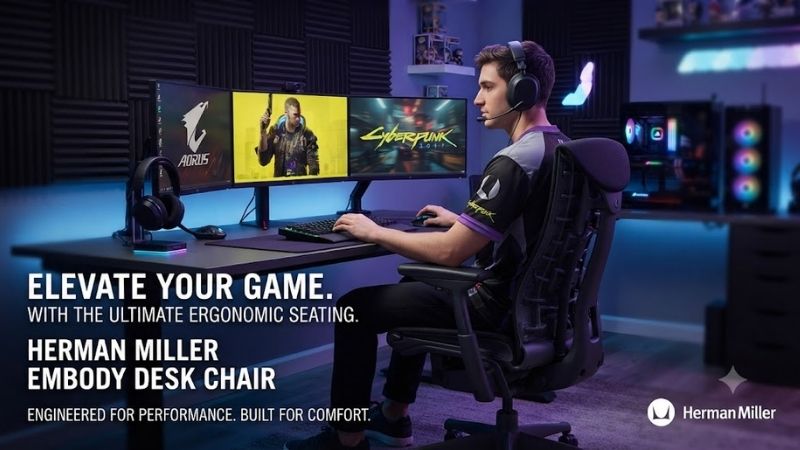
The Herman Miller Embody desk chair is designed for people who spend long hours working, gaming, or creating at a computer. Its Pixelated Support system, adjustable seat depth, Backfit mechanism, flexible backrest, and pressure-distributing seat make it unusually adaptable, although its premium price and relatively simple armrests limit its appeal.
Quick answer: Our top pick in 2026 is the Specification — our #1 rated choice. See the full ranked comparison, alternatives and buying advice below.
Herman Miller Embody Specifications
| Specification | Herman Miller Embody |
|---|---|
| Chair Type | Ergonomic Work Chair |
| Overall Height | 42–43.5 inches |
| Overall Width | 29.5 inches |
| Overall Depth | 29 inches |
| Seat Height | 16–20.5 inches |
| Seat Depth | 15–18 inches |
| Weight Capacity | 300 lb |
| Back Support | PostureFit, lumbar support, Pixelated Support |
| Seat Depth | Adjustable |
| Armrests | Height and width adjustable |
| Tilt | Adjustable tension and limiter |
| Upholstery | Medley or Sync polyester options |
| Warranty | 12 years |
| Assembly | Fully assembled |
Herman Miller lists the Embody at 29.5 inches wide and 29 inches deep, with a total height between approximately 42 and 43.5 inches. Standard seat height adjusts from 16 to 20.5 inches, while seat depth adjusts from 15 to 18 inches. The chair supports users weighing up to 300 pounds.
Performance
Best For: Long work sessions, programming, gaming, writing, editing, design work, and users who want a flexible ergonomic backrest.
Key Features:
- Pixelated Support system
- Backfit adjustment
- PostureFit sacral support
- Adjustable 15–18-inch seat depth
- Adjustable recline tension
- Tilt limiter
- Height and width adjustable arms
- Four-layer suspended seat
- 300-pound weight capacity
- 12-year warranty
The Embody feels different from conventional office chairs because the seat and back are built to respond to movement rather than simply cushion the body. Herman Miller’s Pixelated Support system uses numerous individual support elements beneath the surface that respond independently as body weight and posture shift during the day.
That design distributes pressure across a broader area instead of concentrating it beneath the hips or thighs. This becomes increasingly noticeable during longer sessions, when a conventional foam seat can begin to feel compressed. The Embody remains supportive without relying on an unusually thick cushion or a deeply sculpted bucket-style seat.
The chair’s four-layer seat combines fabric, suspension, and individually moving support elements. Herman Miller says the construction is designed to reduce seated pressure while allowing airflow through the layers. It is not as openly ventilated as an Aeron mesh seat, but it feels less heat-trapping than many heavily padded executive chairs.
Backfit and Back Support
Backfit is one of the Embody’s defining ergonomic features. Instead of moving a small lumbar pad up and down, the system changes the curvature and orientation of the entire backrest. A central spine and flexible ribs allow the chair to follow the user’s back while maintaining support across the lower, middle, and upper regions.
The adjustment requires some experimentation because turning the Backfit control changes how closely the chair follows the spine. Users with a flatter back may prefer a different setting from someone with more pronounced curvature. Once adjusted correctly, the backrest feels integrated with the torso rather than like a separate lumbar cushion pressing forward.
Herman Miller also incorporates PostureFit sacral support at the lowest part of the spine. Supporting the pelvis helps reduce the tendency to collapse into a slouched posture during long periods at the desk. This support works together with the flexible back rather than creating one aggressive pressure point behind the lower back.
The narrow upper section of the backrest is another deliberate design choice. It leaves more room around the shoulders and arms, making it easier to reach a mouse, keyboard, drawing tablet, or controller without the chair surrounding the upper torso. That freedom is particularly noticeable compared with wide executive or racing-style backs.
Seat Comfort
The adjustable seat depth is one of Embody’s strongest features for users with different leg lengths. Its 15-to-18-inch range allows the front edge to extend or retract so the seat can support the thighs without pressing too firmly behind the knees. This adjustability also makes the chair more adaptable than fixed-depth ergonomic models.
Seat firmness is supportive rather than plush. Users who expect thick memory foam may initially find it unusual because the comfort comes from flexible suspension instead of softness. Over longer sessions, however, the structure avoids the bottoming-out sensation that can occur when conventional foam compresses under concentrated body weight.
The seat also allows more freedom than chairs with pronounced side bolsters. Users can reposition their legs without hitting rigid raised edges, although Embody still works best when the feet remain supported and the user maintains a reasonably centered posture. Its shape provides guidance without feeling as restrictive as a racing-style gaming chair.
Recline and Movement
Embody’s tilt mechanism is designed to maintain support as the user moves from upright work into a deeper recline. Herman Miller also describes an extended recline function called the kicker, allowing users to lean farther back for stretching. Movement feels controlled instead of making the user choose between completely upright and fully reclined positions.
Tilt tension can be adjusted depending on body weight and personal preference, while the tilt limiter controls how far the chair reclines. The key benefit is that the backrest continues following the user instead of losing contact during movement. This makes position changes feel natural when alternating between focused work and relaxed reading.
For long desk sessions, this dynamic behavior is more useful than simply having a large recline angle. Remaining perfectly still for several hours can become uncomfortable regardless of how supportive the starting posture is. Embody encourages small posture changes while keeping the pelvis and spine supported through those movements.
Armrests
The Embody armrests adjust in height and width. Herman Miller recommends positioning them so the arms contact the pads without lifting the shoulders and keeping the elbows roughly aligned with the shoulders. The range is useful for accommodating different body widths and keyboard positions.
However, the arms are one of the chair’s biggest weaknesses compared with competitors offering 4D adjustment. There is no equivalent front-to-back sliding or extensive pivot adjustment found on chairs such as Steelcase Leap. Users who frequently change between keyboard, mouse, controller, and drawing-tablet positions may want greater flexibility.
The pads themselves provide adequate support, but the simpler adjustment system feels surprising on such an expensive chair. For users who mainly type at one workstation, this limitation may not matter. For gamers and creators who constantly change input devices, it is one of the few ergonomic areas where the Embody can feel less sophisticated.
Build Quality
Herman Miller uses a die-cast aluminum frame and five-star base along with the chair’s exposed suspension structure. The mechanical elements are intentionally visible rather than hidden behind thick plastic panels. This gives the Embody a distinctive technical appearance while also showing how the backrest flexes as the user moves.
The chair arrives fully assembled, which avoids the alignment and installation issues found with many flat-packed ergonomic chairs. That is useful because the back structure, seat suspension, and tilt mechanism are considerably more complex than a conventional budget office chair assembled with a few bolts and brackets.
Herman Miller currently provides a 12-year warranty for the Embody under its applicable terms. The long coverage is significant because a chair at this price needs to remain functional across years of daily use to justify its cost. Buyers should still check regional warranty conditions when purchasing through a reseller rather than directly.
Embody for Long Hours
The Embody is particularly convincing during long sessions because its strengths become more noticeable with time. The seat spreads pressure, the back follows small posture changes, and the user can alter seat depth and recline rather than remaining fixed in one position. These features matter more after several hours than during a five-minute showroom test.
It still does not eliminate the need to move away from the desk. Even a highly adjustable ergonomic chair cannot make sitting continuously for an entire day ideal. Embody works best when combined with regular standing, walking, stretching, and position changes rather than being treated as a solution that makes unlimited sitting comfortable.
Embody for Gaming
For PC gaming, the Embody works especially well when the keyboard and mouse remain the main input devices. The narrow upper back allows free shoulder movement, while adjustable seat depth helps create a comfortable distance from the desk. Recline is also useful between matches or when switching from competitive play to relaxed browsing.
It lacks the integrated headrest and aggressive recline angles common on gaming chairs, so players who regularly lean far back to use a controller may prefer a different design. Embody is ultimately a premium ergonomic work chair that happens to suit gaming well rather than a gaming chair redesigned with office-style ergonomics.
What Could Be Better?
The biggest disadvantage is price. Embody costs considerably more than mainstream office chairs, and much of that cost goes toward a complex support system that may not be necessary for someone sitting only a few hours per week. Its value improves when it becomes a primary chair used for work and gaming every day.
The armrests also deserve improvement. Height and width adjustment are useful, but front-to-back movement and pivot would make the chair better suited to varied computer setups. Some competing premium ergonomic chairs offer greater arm flexibility, which can matter when maintaining comfortable shoulder and wrist alignment.
There is also no standard integrated headrest. That fits Embody’s task-chair philosophy because the head should not require constant support during upright work, but users who spend significant time reclining may miss one. Third-party solutions exist, though they are separate accessories rather than part of Herman Miller’s original design.
Pros and Cons
Pros
- Excellent pressure distribution
- Pixelated Support responds to movement
- Adjustable 15–18-inch seat depth
- Backfit adjusts overall back curvature
- PostureFit sacral support
- Flexible narrow upper back
- Smooth supported recline
- Four-layer seat construction
- 300-pound capacity
- Arrives fully assembled
- 12-year warranty
- Strong for long work sessions
Cons
- Very expensive
- Armrests only adjust in height and width
- No integrated headrest
- Not as breathable as full mesh
- Backfit takes time to tune
- Design may look overly technical for some offices
Who Should Buy the Herman Miller Embody?
The Embody makes the most sense for people who spend six, eight, or more hours at a computer and want a chair built around active posture rather than thick cushioning. Programmers, writers, editors, designers, remote workers, and PC gamers can benefit from the adjustable seat depth, flexible back, and pressure-distributing suspension.
It is also particularly suitable for users who dislike aggressive lumbar cushions. Instead of pushing one pad against the lower spine, Embody shapes the entire backrest around the user. The result feels more integrated, although people who prefer very strong localized lumbar pressure may initially expect the support to feel more pronounced.
Who Should Skip It?
Users who prioritize maximum armrest adjustment, a built-in headrest, or thick plush cushioning should consider alternatives. The Embody’s comfort comes from suspension and dynamic support rather than softness, and its arm controls are relatively basic compared with some competing premium office chairs.
It is also difficult to justify for occasional use. Someone sitting only a few hours each week may get enough ergonomic support from a much less expensive chair. Embody becomes easier to recommend when the chair is used heavily enough that the 12-year warranty, durable construction, and advanced support system can provide long-term value.
FAQ
Is the Herman Miller Embody Good for Long Hours?
Yes. The Embody is designed specifically around prolonged seated work. Its Pixelated Support system distributes pressure, the seat depth adjusts from 15 to 18 inches, and the backrest follows posture changes. Those features make it well suited to users who spend most of their working day at a computer.
Does the Herman Miller Embody Have Lumbar Support?
Yes. Herman Miller lists both lumbar support and PostureFit sacral support as standard features. However, it does not use a conventional movable lumbar pad. Backfit changes the curvature of the entire backrest so it follows the shape of the user’s spine while the lower structure supports the pelvis.
Is the Embody Better Than the Aeron?
Neither is universally better. Embody provides adjustable seat depth, a flexible upholstered seat, and a backrest that adapts through Backfit. Aeron provides a cooler mesh suspension and three physical sizes. Embody may suit users wanting more freedom in the seat, while Aeron offers a more structured fit.
Does the Embody Have Adjustable Seat Depth?
Yes. The seat depth adjusts from 15 to 18 inches, allowing users to extend or shorten thigh support. This is one of the chair’s strongest ergonomic adjustments because it helps accommodate different leg lengths without requiring several chair sizes.
Is the Herman Miller Embody Worth It?
It can be worth the cost for someone using it every day for many hours. The combination of Pixelated Support, Backfit, adjustable seat depth, dynamic recline, durable construction, and a 12-year warranty provides strong long-term value. Casual users may not benefit enough to justify the premium price.
Conclusion
The Herman Miller Embody desk chair is one of the strongest premium options for long computer sessions because its support system responds to movement rather than forcing one fixed posture. Pixelated Support, Backfit, adjustable seat depth, responsive recline, and a 12-year warranty are excellent, although the basic armrests and premium price prevent it from being perfect.
Ready to decide? Our #1 pick for 2026 is the Specification.
Live price & availability on Amazon.