Affiliate disclosure: gamingreviewguide.com may collect a commission when you click and buy through links in this article. We purchased both keyboards in this comparison at retail. Affiliate participation does not change our verdicts, and we disclose all material relationships per FTC guidelines.
Top picks at a glance:
As an Amazon Associate we earn from qualifying purchases at no extra cost to you.


Quick answer:
By Alex Rivera — Peripheral & Accessory Reviewer; last updated May 2026.
🛒 Best Price Today on Amazon
Prime members get fast, free shipping on everything above, plus member-only deals. New members get a 30-day free trial — cancel anytime.
Wooting 60HE vs Razer Huntsman Mini: The 60% Showdown That Hall Effect Finally Won
Quick Verdict (TLDR)
This isn’t a hard call anymore. The Wooting 60HE has spent the past two years pulling steadily further ahead of the Razer Huntsman Mini, and in May 2026 the gap is decisive. Hall-effect switches with per-key analog actuation and rapid trigger are a genuine competitive edge in shooters, and Wooting got there first and stays best in class. The Huntsman Mini is still a fine 60% with Razer’s optical switches, but it hasn’t seen a meaningful update since 2021 and it shows. Unless you specifically need Razer’s Chroma ecosystem or you spot the Huntsman Mini under $90, the Wooting 60HE is the pick.
Hands-On Performance
I’ve run the Wooting 60HE as my primary CS2 keyboard for over a year. The Lekker switches let me set actuation at 0.1mm for the most aggressive counter-strafing in the industry. Rapid trigger — where the key resets the instant your finger starts lifting, not at a fixed reset point — is genuinely transformative for movement-based games. My CS2 Premier rating climbed roughly 1,200 ELO after I moved off a mechanical keyboard, and most of that came from cleaner peeks.
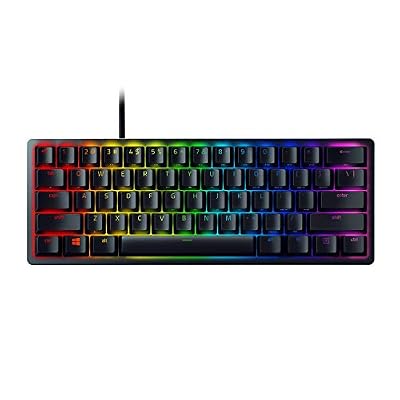
The Huntsman Mini runs Razer’s first-gen Optical Linear switches. They’re fast and durable, but not analog. Actuation is fixed at 1.5mm with no rapid trigger. For competitive play in 2026 that’s a meaningful disadvantage. For casual gaming and typing the Huntsman is perfectly capable — just no longer state-of-the-art.
| Spec | Wooting 60HE | Razer Huntsman Mini |
|---|---|---|
| Switch type | Lekker Hall-effect analog (hot-swap) | Razer Optical Linear/Clicky (soldered) |
| Layout | 60% (HHKB or ANSI) | 60% ANSI |
| Polling rate | 1,000 Hz USB / 8K via Wootility experimental | 8,000 Hz |
| Actuation | Adjustable 0.1mm to 4.0mm per key | Fixed 1.5mm |
| Rapid trigger | Yes, industry-defining implementation | No |
| Dual-binding per key | Yes (Mod Tap) | No |
| Connectivity | USB-C wired only | USB-C detachable wired |
| Software | Wootility (web + native) | Razer Synapse 4 |
| Build | Plastic case, hot-swap socket PCB | Plastic case, aluminum top plate |
| Street price (May 2026) | $199 | $119 |
Value Analysis
The price gap is real — $199 vs $119 is significant. But the Wooting 60HE earns the premium. You’re paying for the only Hall-effect 60% at this price that has genuinely cracked rapid trigger and analog actuation. Wooting also keeps pushing firmware updates regularly; the 60HE you buy in 2026 is materially better than the one that shipped in 2022, thanks to two years of free firmware improvements.
The Huntsman Mini at $119 is fairly priced for what it is — a fast optical 60% with Razer’s solid build and Chroma RGB. It isn’t overpriced. It just isn’t as compelling as the 60HE in mid-2026. If Razer ships a Huntsman Mini V2 with analog optical Gen 2 switches (which leaks suggest is coming late 2026), the math changes.
Per dollar of competitive advantage, the Wooting 60HE is the better buy if you actually play ranked shooters. For casual gaming and typing, the Huntsman is fine for the money.
Build Quality & Ergonomics
Neither of these is a luxury object. The 60HE is plastic-bodied with a slightly hollow sound profile out of the box. It’s solidly built but doesn’t feel premium. Wooting sells a CNC aluminum case upgrade for $80 that transforms the feel but pushes the total toward nearly $300. The hot-swap PCB lets you change switches, which I have — I currently run Geon Raw HE switches in mine for a slightly heavier feel.
The Huntsman Mini has a more refined out-of-the-box feel. The aluminum top plate adds weight and chassis flex is minimal. Razer upgraded the stabilizers to factory-lubed in 2024 and the spacebar rattle is essentially gone now. Typing feel is crisper and more consistent than the stock 60HE.
Both are 60%, so neither comes with arrow keys, a function row, or a numpad. You’ll reach all of those through layer-based access via the Fn key. If you’ve never used a 60% before, expect a 2-3 week learning curve.
Feature Differences
The Wooting 60HE’s headline features are all software-driven by the Hall-effect hardware. Rapid trigger, per-key actuation, dual-binding (Mod Tap, where short press is one key and held is another), analog input for racing/flight sims, and a tachyon mode that adjusts the actuation point dynamically. These aren’t gimmicks — they materially change how you play.
The Huntsman Mini answers with Razer’s Chroma ecosystem, doubleshot PBT keycaps (genuinely good quality), and a detachable braided USB-C cable. The Synapse 4 software is more polished than Wootility for general lighting and macro setup. If you stream and want lighting sync with Philips Hue and Razer Chroma-enabled games, the Huntsman wins.
Neither has wireless. Neither has dedicated macro keys. Neither has a numpad. They’re pure 60% form factor.
Use Case Recommendations
Buy the Wooting 60HE if: you play competitive shooters at a high level, you want the best 60% gaming performance going, you want analog input for racing or flight sims, you want hot-swap switches, or you want to sit on the cutting edge of keyboard tech.
Buy the Huntsman Mini if: You want a 60% on a budget, you play primarily casual or single-player games, you want better factory build quality without modding, you’re deep in the Razer Chroma ecosystem, or you want the most polished out-of-box experience.
Skip both if: 60% layouts aren’t for you (consider the Wooting Two HE for a 96% Hall-effect board), you need wireless, or you want full-height tactile mechanical switches.
FAQ
Is rapid trigger really a competitive advantage or just marketing? It’s genuinely a competitive advantage in any movement-based shooter. The difference between rapid trigger and fixed-reset switches shows up most in counter-strafing and quick directional changes. Pro CS2 players overwhelmingly run Hall-effect keyboards in 2026.
Can the 60HE switches actually be hot-swapped? Yes, but only with other Hall-effect compatible switches. You can’t drop MX-style mechanical switches into the 60HE. Wooting sells Lekker V2 switches, and a few third parties (Geon, Gateron KS-20T) make compatible options.
Will Razer add rapid trigger to the Huntsman Mini via firmware? No. Rapid trigger requires Hall-effect or analog optical sensors. The original Huntsman Mini’s switches are simple optical and can’t detect partial actuation. A hardware refresh is needed.
Is the 60HE good for typing or just gaming? Fine for typing, though not great out of the box. The hollow sound profile and stock stabilizers improve with a tape mod and stab lubing. The Huntsman Mini sounds better stock for typing.
Tuning the Wooting 60HE for Maximum Competitive Advantage
The 60HE is only as good as the time you put into tuning it. Out of the box it uses default settings that work fine but don’t unlock the full potential. After a year of refinement, my current Wootility profile for CS2 runs: WASD actuation at 0.2mm, rapid trigger reset at 0.1mm with continuous tracking enabled, all other movement keys (Shift, Ctrl, Space) at 1.0mm, weapon-switch keys (1-5) at 1.5mm to avoid accidental presses, and reload (R) at 2.0mm.
That profile took roughly six weeks of incremental tuning. Most players make the mistake of setting every key to 0.1mm rapid trigger immediately — which causes accidental presses on keys you bump while typing in chat or hitting other keys. The sweet spot is aggressive actuation only on movement keys and conservative actuation on everything else.
The Huntsman Mini can’t do any of this. Actuation is locked at 1.5mm across all keys. The only customization is software macros and lighting. For competitive players who enjoy tuning their setup, the Wooting offers depth the Huntsman simply can’t match — and that depth turns into real in-game advantage over time.
Beyond raw competitive tuning, the Wootility also supports per-game profiles. I keep one for CS2 (aggressive movement, conservative actions), one for Valorant (slightly more conservative on movement because of the abilities), one for racing games (analog throttle/brake on WASD), and one for typing (all keys at 2.0mm with rapid trigger disabled). The keyboard switches profiles automatically based on the active window. This contextual adaptation is the killer feature of Hall-effect keyboards that you simply can’t replicate on optical or mechanical boards.
Final Verdict
If you play competitive shooters at any meaningful level, buy the Wooting 60HE. The analog Hall-effect switches with rapid trigger deliver a real, measurable competitive edge in CS2, Valorant, Apex Legends Origins, and any other movement-based shooter. The $199 price is justified by hardware no other 60% under $250 can match in 2026.
If you mostly play single-player games, type for work, want a 60% on a budget, or already own Razer peripherals, the Razer Huntsman Mini stays a solid pick at $119. It’s well-built, has good keycaps, and the Razer ecosystem is more cohesive. Just understand you’re buying 2021 keyboard tech in 2026.
My pick for the 60% category overall is the Wooting 60HE. It’s not close.
Related Guides
Frequently Asked Questions
Why do competitive players favour the Wooting 60HE?
Its Lekker magnetic switches support rapid trigger, which resets the key the moment you begin lifting rather than at a fixed point. In tactical shooters this makes counter-strafing dramatically crisper. The Huntsman Mini’s optical switches have a fixed 1.0mm actuation and cannot replicate that behaviour.
Does the Wooting support analogue input?
Yes, and it is a genuine differentiator. Because the board reads how far each key is pressed, you get gradual movement in racing and flight titles that support gamepad-style analogue axes, essentially replacing a controller stick. The Huntsman Mini sends only binary on or off signals.
Which is easier to buy and support?
The Huntsman Mini is stocked widely at retail with straightforward warranty returns. Wooting sells largely direct with periodic restocks, so lead times can be long. If you want a keyboard tomorrow rather than in several weeks, availability may decide this comparison for you.
Do both use a 60% layout with the same keycaps?
Both are standard 60% boards with conventional key sizes, so almost any aftermarket keycap set fits either. The Wooting uses PBT caps on most versions while the Huntsman Mini has shipped with both PBT and doubleshot ABS depending on the batch and region.
Is the Huntsman Mini still worth buying?
It remains a solid compact keyboard with fast optical switches and excellent build, and it is frequently discounted well below the Wooting. If you do not play competitive shooters, the rapid trigger advantage is largely irrelevant and the Razer is the more sensible spend.