🛒 Best Price Today on Amazon
Prime members get fast, free shipping on everything above, plus member-only deals. New members get a 30-day free trial — cancel anytime.
- Best Thermal Paste for Gaming PC: Quick Comparison
- ARCTIC MX-6 – Best for Most Gaming PCs
- Noctua NT-H2 – Best for Long-Term Reliability
- Thermal Grizzly Kryonaut – Best for Overclocking
- Corsair XTM70 – Best for Guided Application
- be quiet! DC2 – Best Straightforward Alternative
- How to Choose Thermal Paste for a Gaming PC
- How to Apply Thermal Paste Correctly
- FAQ
- Conclusion
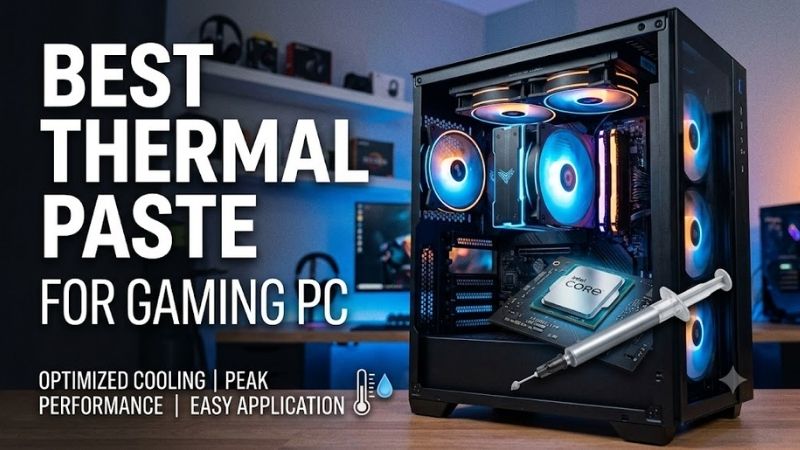
Choosing the best thermal paste for gaming PC builds matters when you want stable CPU temperatures, quieter fans, and reliable contact between the processor and cooler. The right compound will not transform a weak cooler, but it can reduce thermal resistance, improve heat transfer, and make a well-built gaming system easier to keep cool.
Quick answer: For most people in 2026, the best thermal paste for gaming pc is the Thermal Paste — our #1 rated choice. See the full ranked comparison, alternatives and buying advice below.
Best Thermal Paste for Gaming PC: Quick Comparison
| Thermal Paste | Best For | Electrical Conductivity | Notable Feature |
|---|---|---|---|
| ARCTIC MX-6 | Most gaming PCs | Non-conductive | No burn-in and high viscosity |
| Noctua NT-H2 | Easy long-term builds | Non-conductive | Long recommended CPU usage |
| Thermal Grizzly Kryonaut | Overclocking | Non-conductive | Designed for demanding thermal loads |
| Corsair XTM70 | Guided application | Non-conductive | Includes applicator kit and wipes |
| be quiet! DC2 | Straightforward CPU builds | Non-conductive | 7.5 W/mK manufacturer rating |
Thermal paste fills microscopic gaps between a CPU heat spreader and cooler base, allowing heat to transfer through a more consistent contact layer. For gaming PCs, differences between reputable compounds are often smaller than the gains from correct mounting pressure, proper paste coverage, sufficient radiator capacity, and good case airflow.
The products below were selected because they are conventional thermal compounds suited to desktop cooling rather than electrically conductive liquid-metal solutions. That distinction matters for everyday builders because accidental spillover around a CPU socket is less risky when the compound itself does not conduct electricity.
ARCTIC MX-6 – Best for Most Gaming PCs
Best For: Mainstream and high-performance gaming systems
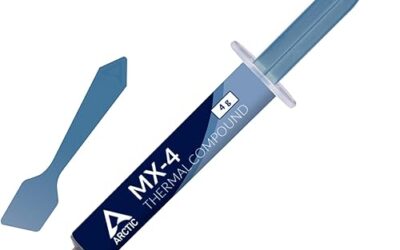
ARCTIC MX-6 is designed as a versatile thermal compound for processors, graphics chips, and other direct-die applications. ARCTIC states that MX-6 is neither electrically conductive nor capacitive and contains no liquid metal, making it easier to recommend for gaming PCs where safety, repeatability, and long-term use matter.
Its relatively viscous consistency helps the compound remain where it is applied instead of flowing easily away from the contact area. ARCTIC specifically highlights resistance to drying, bleeding, and pump-out, characteristics that can matter when a gaming CPU repeatedly cycles between idle temperatures and sustained loads during longer play sessions.
Key Features
- Available in multiple package sizes from 2g to 8g
- Electrically non-conductive
- Non-capacitive
- No liquid-metal components
- No burn-in period required
- Suitable for CPUs, GPUs, and direct-die applications
What Makes It Different
MX-6 focuses more on practical stability than headline conductivity numbers. The paste reaches its intended performance immediately after mounting, so builders do not need to wait for a curing or burn-in period. Its viscosity also makes it appealing for users concerned about compound movement during repeated heating and cooling cycles.
Pros
- Safe around electrical components
- Suitable for both CPU and GPU use
- No burn-in period
- Designed to resist pump-out
- Multiple syringe sizes available
Cons
- Thick consistency may require more care during manual spreading
- Does not target extreme liquid-metal-style applications
Use Case
MX-6 makes sense when assembling a modern gaming tower with a conventional air cooler or AIO liquid cooler. It is particularly useful when the system will run daily gaming workloads and the owner wants a compound that can be applied once, mounted correctly, and left in place without special maintenance or curing procedures.
Who It’s For
Choose MX-6 if you want a balanced thermal compound rather than a specialist paste. It fits first-time builders, gaming PC upgrades, CPU cooler swaps, and GPU repasting projects where electrical safety matters. Enthusiasts can still use it effectively, but its strongest appeal is its combination of versatility and straightforward handling.
Noctua NT-H2 – Best for Long-Term Reliability
Best For: Builders who prioritize easy maintenance
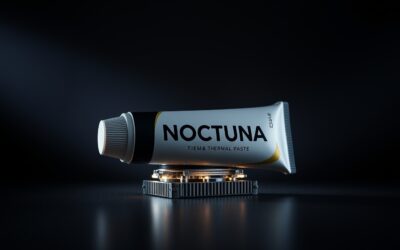
Noctua NT-H2 is the company’s second-generation thermal compound and uses a refined mixture of metal-oxide microparticles. Noctua lists the paste as electrically non-conductive and non-corroding, which means it can be used with common copper, aluminum, or nickel-plated cooler surfaces without the material concerns associated with conductive compounds.
Noctua recommends up to five years of usage on a CPU under its stated conditions, making NT-H2 attractive for builders who prefer to assemble a system and avoid unnecessary repasting. The 3.5g package is also rated by Noctua for roughly 15 applications on medium-sized CPUs, although actual usage naturally depends on application amount.
Key Features
- 3.5g and 10g versions available
- Electrically non-conductive
- Non-corroding
- Rated operating range of -50°C to +200°C
- Recommended CPU usage time of up to five years
- Cleaning wipes included with standard retail packages
What Makes It Different
NT-H2 stands out because Noctua provides unusually detailed guidance about storage, operating range, application counts, and long-term use. That documentation is valuable for builders who want predictable maintenance rather than chasing minor temperature differences between premium pastes that can vary with mounting conditions.
Pros
- Long recommended service interval
- No burn-in requirement
- Electrically non-conductive
- Cleaning wipes included
- Suitable for air and liquid cooling
Cons
- Premium positioning may be unnecessary for low-power CPUs
- Large 10g package is excessive for a single build
Use Case
NT-H2 works well in gaming systems built around tower air coolers, 240mm to 360mm AIO units, or custom cooling where the user wants a dependable interface compound. It is also convenient for builders who regularly change coolers because the supplied cleaning wipes simplify removal before applying a fresh layer.
Who It’s For
This is a strong fit for gamers who want a premium conventional paste without experimenting with electrically conductive materials. It is especially practical for people building systems intended to remain assembled for several years, along with enthusiasts who frequently maintain several PCs and can make use of the larger package.
Thermal Grizzly Kryonaut – Best for Overclocking
Best For: Enthusiast and overclocked gaming systems
Thermal Grizzly positions Kryonaut specifically for overclocking and demanding cooling applications. The manufacturer describes a carrier structure using nano-aluminum and zinc-oxide components and lists electrical conductivity at 0 pS/m. Its published operating-temperature range extends from -250°C to +350°C.
The key reason to consider Kryonaut is not that every gaming PC needs an extreme paste, but that heavily tuned processors create situations where builders may care about every part of the thermal path. A high-end CPU running elevated power limits places greater emphasis on cooler mounting, contact quality, fan behavior, and thermal-interface performance.
Key Features
- Designed for overclocking
- Electrically non-conductive
- Manufacturer-listed density of 3.7g/cm³
- Operating range of -250°C to +350°C
- Supplied with an application tool depending on package
- Available in multiple package sizes
What Makes It Different
Kryonaut is aimed more directly at enthusiast cooling than general-purpose compounds. Its positioning makes the most sense in systems using powerful CPUs, aggressive boost settings, manual overclocking, or large cooling solutions where the builder is already optimizing mounting pressure, airflow, radiator performance, and fan curves.
Pros
- Designed for overclocking
- Electrically non-conductive
- Broad stated temperature range
- Application tool included
- Well suited to enthusiast cooling projects
Cons
- More specialized than many gaming PCs require
- Correct mounting still matters more than paste alone
Use Case
Consider Kryonaut when building a high-end gaming rig with a powerful processor and cooling solution where thermal tuning is part of the project. It also makes sense when repeatedly testing coolers or CPU settings because enthusiasts working at this level are more likely to evaluate small temperature changes alongside voltage and power behavior.
Who It’s For
Kryonaut is best suited to experienced PC builders, overclockers, and users working with high-power hardware. A mainstream gaming CPU running stock settings does not automatically need an enthusiast-oriented compound, so buyers should consider whether their cooler, case ventilation, and CPU power settings justify the extra focus on thermal tuning.
Corsair XTM70 – Best for Guided Application
Best For: Builders who want an application kit
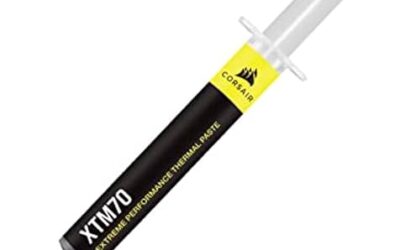
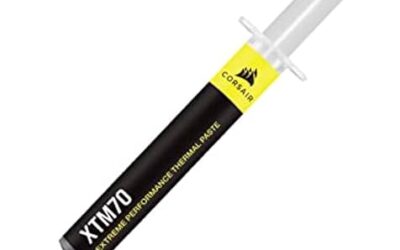
Corsair XTM70 is a 3g thermal compound packaged with an applicator card, templates, and cleaning wipes. Corsair states that the paste is electrically non-conductive and designed for high-performance CPUs, GPUs, consoles, and related components. The supplied accessories are its most practical advantage for inexperienced builders.
The template system allows users to spread a controlled layer rather than relying entirely on a dot, line, or cross pattern. CPU cooler pressure can normally distribute paste by itself, but some builders feel more confident seeing uniform coverage before installation. The included tools make that approach easier without needing separate applicators.
Key Features
- 3g net paste weight
- Electrically non-conductive
- Includes applicator card
- Includes application templates
- Includes three cleaning wipes
- Intended for CPUs, GPUs, and other cooled components
What Makes It Different
The biggest distinction is the complete application package. Many thermal compounds provide only a syringe, leaving the builder to decide how much paste to use and whether to spread it. XTM70 provides tools that support an even manual layer, which can remove uncertainty for users who are nervous about their first cooler installation.
Pros
- Complete application kit
- Electrically non-conductive
- Cleaning wipes included
- Suitable for CPU and GPU use
- Helpful for first-time manual spreading
Cons
- Application accessories are unnecessary for experienced builders
- Only 3g of paste in the standard package
Use Case
XTM70 is useful for a new gaming PC where the builder wants to clean the processor, control paste coverage, and install the cooler using a repeatable process. It also fits upgrade projects where an old cooler must be removed and cleaned before installing a replacement air cooler or liquid-cooling block.
Who It’s For
Choose XTM70 when application confidence matters as much as the compound itself. It is particularly appealing to first-time builders and people who dislike estimating paste coverage. Experienced PC enthusiasts who already have cleaning supplies and preferred application methods may find the extra accessories less important.
be quiet! DC2 – Best Straightforward Alternative
Best For: Conventional CPU and GPU cooling
be quiet! DC2 is a non-conductive thermal grease supplied in a 3g syringe. The manufacturer lists thermal conductivity at 7.5 W/mK and an operating range from -20°C to +120°C. It also includes a spatula, providing a simple option for builders who prefer to spread the compound manually before installing a cooler.
The company estimates that the 3g capacity can support around nine applications on average. That makes one syringe sufficient for multiple cooler installations in many situations, although the actual number depends on processor size and application thickness. Its straightforward specifications also make DC2 easy to understand compared with more specialized compounds.
Key Features
- 3g syringe
- Manufacturer rating of 7.5 W/mK
- Operating range of -20°C to +120°C
- Electrically non-conductive
- Application spatula included
- Intended for CPUs, GPUs, and other chips
What Makes It Different
DC2 offers a relatively simple package: conventional thermal grease, published conductivity, no electrical conductivity, and a spreading tool. There are fewer unusual features to consider, which can be an advantage for builders who simply want to replace old paste and reinstall a cooler without changing their cooling setup or learning a specialized application process.
Pros
- Simple application
- Electrically non-conductive
- Spatula included
- Published thermal-conductivity figure
- Enough paste for several typical applications
Cons
- Less specialized for extreme overclocking
- Maximum operating temperature is lower than some alternatives
Use Case
DC2 is appropriate for gaming desktops using standard air coolers or AIO units where the goal is replacing dried or poorly applied thermal compound. It is also convenient when servicing several PCs because the syringe contains enough material for repeated installations without requiring a large professional-size package.
Who It’s For
This paste suits gamers who want clearly documented specifications and simple handling. It is especially relevant for be quiet! cooler owners, although the compound itself is not restricted to that brand. Builders pursuing extreme overclocking may prefer a more enthusiast-focused product, while ordinary gaming systems should find DC2 more than practical enough.
How to Choose Thermal Paste for a Gaming PC
Electrical Conductivity
For most gaming builds, electrically non-conductive thermal paste is the safer choice. Small amounts can occasionally spread beyond the heat spreader during mounting, particularly if too much compound is applied. Non-conductive paste reduces the electrical risk associated with accidental contact around CPU sockets or nearby components.
Liquid metal operates differently and should not be treated as interchangeable with standard thermal paste. It can conduct electricity and may react with certain cooler materials. Unless you specifically understand those limitations and need the performance characteristics of liquid metal, a conventional non-conductive compound is easier to handle.
Application and Viscosity
Thicker thermal pastes can stay in place well but may require more effort to spread manually. Softer compounds may be easier to dispense, yet cooler mounting pressure is still responsible for creating the final interface layer. There is no universal application pattern that compensates for an incorrectly seated cooler or uneven mounting pressure.
For most desktop processors, the goal is enough compound to cover the contact region once the cooler is tightened. Using too little can leave uncovered areas, while excessive paste creates unnecessary mess. Always install the cooler according to its mounting instructions and tighten fasteners gradually where the cooler design requires alternating pressure.
Longevity
A gaming PC may run for years without needing its CPU cooler removed, so long-term stability can matter more than a small theoretical improvement in conductivity. Paste that resists drying, bleeding, or movement can reduce the need for routine repasting when temperatures remain normal and the cooler has not been disturbed.
There is no need to replace thermal paste on an arbitrary schedule if CPU temperatures remain consistent. Repasting becomes more relevant after removing the cooler, troubleshooting unexpected temperature increases, rebuilding a system, or discovering that the original compound was applied poorly during the first installation.
Cooler and CPU Matter More
Thermal paste cannot compensate for an undersized CPU cooler. A high-power processor paired with a weak heatsink may still run hot even with premium compound. Before replacing paste repeatedly, check cooler capacity, mounting hardware, pump operation on AIO systems, radiator airflow, case ventilation, and CPU power settings.
Gaming temperatures also depend on workload. Some games place modest load on the CPU, while simulation, strategy, competitive, or heavily threaded titles can behave differently. Background tasks, room temperature, fan curves, motherboard boost settings, and processor architecture can all influence temperatures independently of thermal paste.
How to Apply Thermal Paste Correctly
First, remove old compound from the CPU heat spreader and cooler contact surface using an appropriate cleaning method. Both surfaces should be clean and dry before fresh paste is applied. Avoid scraping the surfaces with tools that can damage their finish, and never reinstall a cooler onto a contaminated layer of old paste.
Apply an appropriate amount of fresh compound, then install the cooler without repeatedly lifting and reseating it. Follow the cooler manufacturer’s tightening sequence so mounting pressure remains balanced. Once installed, monitor CPU temperatures under both idle and gaming loads to confirm that the cooler is making proper contact.
If temperatures appear abnormally high, check mounting and cooler operation before assuming the paste itself is defective. An AIO pump connected incorrectly, protective film left on a cold plate, loose mounting bracket, blocked airflow, or aggressive motherboard power settings can create much larger thermal problems than the difference between reputable compounds.
FAQ
Does Thermal Paste Improve Gaming FPS?
Thermal paste does not directly increase frame rates. Its role is transferring heat from the processor to the cooler. However, if poor thermal contact causes a CPU to reach temperature limits and reduce clock speed, correcting the paste or cooler installation can restore normal performance during sustained gaming workloads.
How Often Should I Replace Thermal Paste?
There is no single replacement interval for every gaming PC. If temperatures remain stable and the cooler stays mounted, there may be little reason to disturb the installation. Replace the compound whenever the cooler is removed, or investigate repasting when temperatures rise unexpectedly after other cooling problems have been ruled out.
Is More Thermal Paste Better?
No. Thermal paste is intended to fill microscopic surface imperfections rather than create a thick insulating layer. Applying excessive compound can cause unnecessary spillover around the processor. The correct amount depends partly on CPU heat-spreader size, so follow the paste or cooler manufacturer’s recommended application method when available.
Is Electrically Conductive Paste Dangerous?
Electrically conductive thermal materials require significantly greater care because contact with exposed circuitry can create electrical problems. The conventional pastes in this roundup are marketed as non-conductive, making them more forgiving for gaming PC assembly and a more practical recommendation for most users.
Can I Use CPU Thermal Paste on a GPU?
Some compounds are explicitly suitable for both CPUs and GPUs, including several products in this roundup. GPU repasting is more complicated than installing a desktop CPU cooler because graphics cards may use thermal pads of specific thicknesses around memory and power components. Disassembly should therefore be approached carefully.
Does Expensive Thermal Paste Always Run Cooler?
Not necessarily. Results depend on the CPU, cooler, contact surfaces, mounting pressure, paste thickness, workload, and test environment. Once you compare reputable conventional compounds, installation quality can become more important than price. Choose a paste based on safety, handling, longevity, and your specific cooling goals.
Conclusion
The best thermal paste for gaming PC use depends on how much you value ease of application, long-term stability, or enthusiast tuning. ARCTIC MX-6 and Noctua NT-H2 suit most builds, while Kryonaut targets overclockers. Corsair XTM70 and be quiet! DC2 add practical alternatives for builders who prefer specific application styles.
Ready to decide? Our #1 pick for 2026 is the Thermal Paste.
Live price & availability on Amazon.