🛒 Best Price Today on Amazon
Prime members get fast, free shipping on everything above, plus member-only deals. New members get a 30-day free trial — cancel anytime.
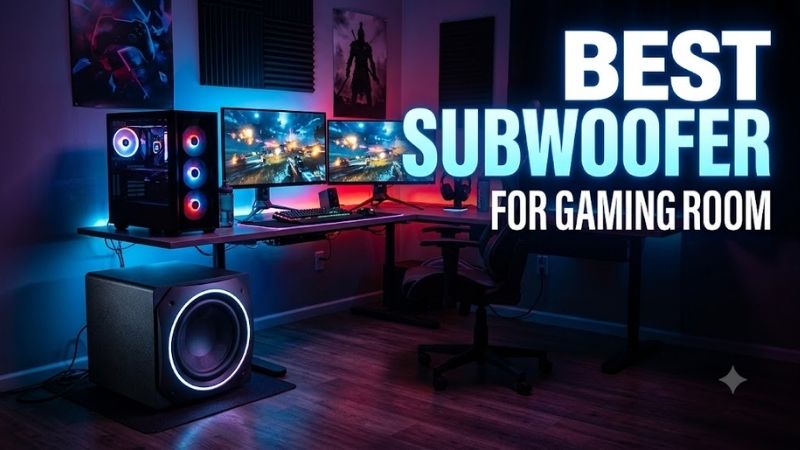
The best subwoofer for gaming room setups should add weight to explosions, engines, soundtracks, and environmental effects without turning every scene into uncontrolled rumble. Room size, bass extension, amplifier power, cabinet design, crossover control, placement, and speaker compatibility matter more than maximum volume alone.
Quick answer: For most people in 2026, the best subwoofer for gaming room for deep immersive bass is the Subwoofer — our #1 rated choice. See the full ranked comparison, alternatives and buying advice below.
Best Subwoofers for Gaming Rooms at a Glance
| Subwoofer | Best For | Driver | Main Strength |
|---|---|---|---|
| SVS SB-1000 Pro | Overall gaming room | 12-inch | Deep, controlled bass with DSP |
| RSL Speedwoofer 10S MKII | Powerful gaming and movies | 10-inch | Strong deep-bass output |
| Klipsch R-121SW | Large gaming rooms | 12-inch | High-impact cinematic bass |
| Audioengine S8 | Desktop gaming | 8-inch | Compact PC-friendly design |
| Kanto SUB8 | Smaller gaming rooms | 8-inch | Compact speaker-system integration |
1. SVS SB-1000 Pro
Best For: Gaming rooms needing deep but controlled bass
The SVS SB-1000 Pro is a strong choice for gaming because its sealed enclosure emphasizes controlled low-frequency reproduction rather than simply producing maximum boom. Its 12-inch driver can reach into frequencies that smaller desktop systems often miss, adding weight to explosions, vehicles, cinematic scores, and environmental effects.
A 325-watt RMS amplifier provides substantial output for a relatively compact subwoofer, while SVS specifies extension down to 20 Hz within its rated response. That matters in cinematic games because some low-frequency effects extend well below the range handled comfortably by bookshelf speakers or conventional gaming speaker systems.
The sealed cabinet also makes placement easier in smaller gaming rooms than many large ported alternatives. Although room acoustics still influence bass dramatically, a compact enclosure gives players more options beside a desk, near a media console, or along the front wall without consuming as much floor area.
The smartphone control system is another major advantage. Volume, crossover, phase, polarity, room-gain compensation, and parametric EQ can be adjusted without crawling behind the subwoofer. That convenience is valuable when switching between late-night gaming, music playback, and louder cinematic sessions.
Key Features
- 12-inch high-excursion driver
- 325 watts RMS amplification
- 820+ watts peak output
- 20–270 Hz rated frequency response
- Sealed cabinet design
- Smartphone control application
- Three-band parametric EQ
- Adjustable crossover and phase
- RCA and LFE connectivity
What Makes It Different
The SB-1000 Pro combines genuine deep-bass extension with unusually flexible digital control in a compact sealed cabinet. Instead of physically reaching behind the unit every time the system changes, gamers can create different bass settings for competitive gaming, single-player titles, movies, and music from the listening position.
Pros
- Deep low-frequency extension
- Compact for a 12-inch subwoofer
- Excellent control options
- App-based tuning
- Strong fit for gaming and music
- Sealed design supports precise bass
Cons
- More expensive than basic desktop subs
- Requires compatible speakers or receiver
- Powerful output can disturb neighboring rooms
Use Case: Dedicated gaming rooms, premium PC audio, console setups, home theater gaming, and systems combining gaming with movies and music.
Who It’s For: Gamers who want substantial low-frequency impact while maintaining enough control to keep bass tight and balanced.
2. RSL Speedwoofer 10S MKII
Best For: Gamers who want powerful cinematic bass
The RSL Speedwoofer 10S MKII is designed to deliver substantial low-frequency output from a 10-inch driver. Its combination of a high-excursion woofer, DSP-controlled amplifier, and specialized port system makes it well suited to gaming rooms where explosions, engines, cinematic effects, and movie playback are major priorities.
Its amplifier delivers 400 watts RMS, giving the subwoofer significant headroom for sudden gaming effects. RSL lists an anechoic response reaching 22 Hz in LFE mode, with room gain potentially extending useful output even deeper depending on the size and acoustic behavior of the room.
The selectable DSP modes are useful for mixed entertainment systems. LFE mode emphasizes deeper extension for cinematic material, while the alternative music-oriented mode changes the performance behavior for listening sessions. A gaming setup used for both action titles and music can therefore be tuned around different priorities.
The rear-vented enclosure requires more placement consideration than a compact sealed subwoofer. Leaving sensible breathing room around the cabinet helps avoid awkward interaction with walls. In exchange, the ported system can produce impressive output that suits medium-sized gaming rooms and large desktop speaker systems.
Key Features
- 10-inch high-excursion woofer
- 400-watt RMS amplifier
- More than 1,000 watts peak output
- 22–200 Hz rated response in LFE mode
- Selectable DSP modes
- Rear-vented enclosure
- Speaker-level connection support
- LFE connectivity
- Adjustable system controls
What Makes It Different
The Speedwoofer 10S MKII offers a combination of deep extension and considerable amplifier power without requiring a huge 12- or 15-inch driver. It is especially attractive for gamers who want to feel low-frequency effects physically but still need a cabinet that can fit into a realistic home gaming environment.
Pros
- Powerful deep bass
- Strong amplifier headroom
- Useful DSP modes
- Good for gaming and movies
- High-output 10-inch design
- Flexible system integration
Cons
- Larger than desktop-oriented subs
- Rear vent needs placement consideration
- Excessive for very small rooms
Use Case: Action games, racing simulators, cinematic RPGs, home theater gaming, movies, and medium-to-large entertainment rooms.
Who It’s For: Players who want more physical bass impact than compact desktop subwoofers can realistically provide.
3. Klipsch R-121SW
Best For: Large gaming rooms and cinematic systems
The Klipsch R-121SW uses a large 12-inch front-firing driver inside a rear-ported enclosure, giving it the physical capability to move substantially more air than small desktop subwoofers. This makes it a natural match for gaming rooms where cinematic scale and strong impact matter more than maintaining the smallest possible footprint.
Its all-digital amplifier is rated at 200 watts continuous and 400 watts peak, while the published frequency range extends down to 28 Hz. Those specifications suit explosions, large vehicle sounds, movie soundtracks, and action-heavy games where a bookshelf speaker system alone may lack convincing low-frequency weight.
The R-121SW includes low-pass crossover and phase controls, allowing users to blend it more effectively with their main speakers. Setting crossover correctly is important because the subwoofer should extend the system rather than draw attention to itself as a separate source of booming bass from one corner of the room.
Line-level and LFE RCA inputs make it straightforward to integrate with an AV receiver or compatible speaker system. Gamers building around consoles and a television will find an AVR-based connection particularly convenient, while PC users should confirm that their DAC, powered speakers, or audio interface offers suitable subwoofer output.
Key Features
- 12-inch front-firing woofer
- 200 watts continuous power
- 400 watts peak power
- 28–120 Hz frequency range
- Rear-firing bass-reflex port
- Adjustable low-pass crossover
- 0/180-degree phase control
- Line-level RCA inputs
- LFE input support
What Makes It Different
The R-121SW prioritizes physical impact and straightforward home-theater integration rather than compact desktop placement. Its large front-firing driver can add a convincing sense of scale to action games and movies, especially when paired with capable speakers in a room large enough to accommodate its cabinet.
Pros
- Large 12-inch driver
- Strong cinematic impact
- Straightforward crossover controls
- LFE connection
- Solid fit for console systems
- Reinforced MDF enclosure
Cons
- Large cabinet
- Less suitable beneath small desks
- Rear port needs sensible placement
- Too powerful for some apartments
Use Case: Console gaming, home theater gaming, racing simulators, action games, movie playback, and larger dedicated entertainment rooms.
Who It’s For: Gamers who want substantial bass output and already use an AV receiver or full-size speaker setup.
4. Audioengine S8
Best For: Desktop PC gaming
The Audioengine S8 is significantly smaller than the larger home-theater subwoofers in this roundup, making it better suited to a PC desk or compact gaming room. Its 8-inch down-firing driver adds low-end weight without demanding the floor space required by many 10- or 12-inch home theater designs.
Audioengine uses a Class D amplifier with an 8-inch long-throw woofer and rates the S8 at 140 watts RMS, with 250 watts of peak output. RCA and 3.5 mm inputs make connection easier with desktop-oriented equipment than subwoofers designed mainly around AV receivers and dedicated LFE outputs.
The down-firing design allows the woofer to interact with the room without pointing directly toward the player. Audioengine also supplies isolation feet intended to reduce unwanted vibration transfer. That can be useful beneath a desk, where excessive cabinet vibration may otherwise travel into furniture and become distracting during gameplay.
Crossover and volume controls let the S8 blend with smaller powered speakers instead of overwhelming them. This is particularly important with compact desktop monitors because setting the crossover too high can make bass directional and muddy the lower midrange, reducing rather than improving clarity during dialogue and competitive gaming.
Key Features
- 8-inch long-throw woofer
- Down-firing driver orientation
- Front-ported cabinet
- Class D amplification
- 140 watts RMS
- 250 watts peak output
- RCA input
- 3.5 mm input
- Adjustable volume and crossover
- Phase control
What Makes It Different
The S8 is designed around desktop audio rather than large home theater installations. Its compact proportions, 3.5 mm connectivity, and integration with powered speakers make it particularly convenient for PC gamers who want a noticeable low-frequency upgrade without rebuilding their entire audio system around an AV receiver.
Pros
- Compact for a powered subwoofer
- Easy desktop-system integration
- RCA and 3.5 mm connections
- Adjustable crossover
- Down-firing woofer
- Useful isolation feet
Cons
- Cannot match larger subs for deep-bass output
- Still requires floor space
- Powerful low bass is limited compared with 12-inch models
Use Case: PC gaming, desktop speakers, small gaming rooms, music playback, and setups where the subwoofer needs to fit beneath or beside a desk.
Who It’s For: PC gamers who want stronger bass from powered bookshelf speakers without installing a full home theater system.
5. Kanto SUB8
Best For: Small gaming rooms with bookshelf speakers
The Kanto SUB8 is another compact 8-inch powered option that works naturally with desktop and bookshelf speaker systems. Its smaller cabinet makes placement easier beside a gaming desk, under a media console, or near compact stereo speakers where a full-size home-theater subwoofer would consume too much usable floor space.
An 8-inch subwoofer will not generate the same deep-room pressure as a powerful 12-inch design, but that can be an advantage in bedrooms and apartments. Gaming audio gains more body through explosions, music, and environmental effects without requiring the player to run a physically large subwoofer at extremely low volume.
The SUB8 includes adjustable crossover and phase controls, which are essential for integrating a subwoofer correctly with nearfield speakers. A good transition should make the overall system sound larger and fuller without making it obvious that low frequencies are coming from a separate enclosure somewhere beneath the desk.
Compact subwoofers also suit users who sit close to their speakers. Nearfield gaming does not require filling a large theater with bass, so output can remain moderate while still creating a meaningful improvement. Positioning and calibration become more important than simply choosing the model with the largest available driver.
Key Features
- 8-inch powered woofer
- Compact cabinet design
- Adjustable crossover
- Adjustable phase
- Volume control
- RCA connectivity
- Designed for stereo speaker integration
- Suitable for nearfield listening
What Makes It Different
The SUB8 fits naturally into smaller gaming environments where space and neighbor-friendly output matter as much as maximum extension. It adds bass to compact powered speakers without forcing users into the size, placement demands, or output potential of a large home-theater subwoofer.
Pros
- Compact footprint
- Works well with bookshelf speakers
- Adjustable crossover
- Suitable for nearfield gaming
- Easier placement in small rooms
- Cleaner setup than oversized theater subs
Cons
- Less deep extension than large models
- Limited output for big rooms
- Not intended for extreme home theater bass
Use Case: Bedrooms, apartments, desktop gaming, compact powered speakers, music listening, and small entertainment spaces.
Who It’s For: Gamers who want fuller low-end performance but need to keep both cabinet size and bass output manageable.
How to Choose the Best Subwoofer for a Gaming Room
Match the Subwoofer to Room Size
A bigger subwoofer is not automatically better. A small bedroom can gain convincing bass from an 8-inch model, while a larger dedicated gaming room may benefit from a 10- or 12-inch driver. Oversizing the subwoofer can make level adjustment difficult, while undersizing it can create distortion when deeper effects demand more output.
Look at Bass Extension
Frequency extension matters more than an exaggerated wattage number when the goal is cinematic gaming. A subwoofer that plays cleanly into the 20–30 Hz region can reproduce effects that normal desktop speakers miss entirely. Deep extension adds physical scale to explosions and soundtracks without requiring the upper bass to become excessively loud.
Sealed vs Ported Subwoofers
Sealed subwoofers are usually more compact and can be easier to position, making them attractive for gaming rooms and music-focused systems. Ported models often provide greater output and efficiency around their tuning range, which can be useful for movies and action games but may require larger cabinets and more placement consideration.
Understand RMS Power
Continuous or RMS power provides a more useful reference than peak numbers when comparing amplifiers. Peak ratings describe short-duration capability and should not be treated as normal sustained output. Driver design, cabinet tuning, DSP, room size, and frequency extension all matter alongside amplifier wattage.
Check Your Speaker Connections
Before buying a subwoofer, confirm how it will connect to the existing system. AV receivers normally provide an LFE output, while powered desktop speakers may offer a dedicated subwoofer output. Other systems may require line-level or speaker-level connections, so compatibility should be verified before choosing a model.
Use the Crossover Correctly
The crossover determines where the main speakers begin handing low frequencies to the subwoofer. Setting it too high can make the bass sound localized or muddy, while setting it too low can leave a gap in the system. Start around the capabilities of the main speakers and adjust by listening from the gaming position.
Placement Changes the Sound
Bass behaves differently from higher frequencies because room boundaries strongly affect low-frequency response. Moving a subwoofer only a short distance can change perceived output significantly. Corners usually increase bass level, but they can also exaggerate certain frequencies, so experimentation often produces better results than visual symmetry.
Think About Neighbors
Low frequencies travel easily through floors and walls, particularly in apartments. A powerful subwoofer may sound moderate at the gaming chair while remaining clearly audible in another room. Isolation feet, sensible nighttime levels, careful placement, and dynamic-range controls can make a gaming setup significantly more neighbor-friendly.
Subwoofer vs Bass-Heavy Gaming Speakers
Gaming speakers with small integrated woofers can produce satisfying upper bass, but cabinet size limits how deeply they can extend. A dedicated subwoofer uses a larger driver and separate amplifier to handle low frequencies, allowing the main speakers to focus on dialogue, positional effects, music, and the rest of the audible spectrum.
The difference becomes most noticeable in cinematic games. Engine rumble, thunder, explosions, spacecraft, and soundtrack effects can contain energy below the range of compact speakers. A properly integrated subwoofer reproduces that information without requiring the main speakers to work beyond their comfortable limits.
FAQ
Is a Subwoofer Worth It for Gaming?
Yes, especially for cinematic and action games. A subwoofer adds low-frequency effects that headphones and small desktop speakers may not reproduce physically. It is less important for competitive games where positional clarity is the priority, but it can dramatically improve immersion in racing, simulation, RPG, and story-driven titles.
What Size Subwoofer Is Best for a Gaming Room?
An 8-inch model can work well in a small bedroom or nearfield desktop setup, while 10- and 12-inch subwoofers provide more output and deeper extension for medium or large rooms. Room dimensions, listening distance, desired volume, and neighbor considerations matter more than choosing the largest driver available.
Does a Subwoofer Improve FPS Gaming?
A subwoofer can make gunfire and explosions more dramatic, but it does not necessarily improve competitive positional awareness. Excessive bass may actually mask quieter cues. Competitive players should keep the subwoofer level balanced so footsteps, reloads, and directional details remain clear through the main speakers or headset.
Where Should I Place a Gaming Subwoofer?
Begin near the front speakers or along the front wall, then test alternative positions while listening from the gaming chair. Avoid choosing placement purely by appearance. Bass response changes significantly with room boundaries, so moving the cabinet away from or closer to a corner can alter both output and smoothness.
Can I Put a Subwoofer Under My Gaming Desk?
Yes, particularly with compact models designed for desktop systems. Make sure the cabinet and port have adequate clearance and that the subwoofer does not interfere with your feet, chair, or cables. Desk vibration can become distracting, so isolation feet or a different floor position may improve the overall experience.
Do I Need a Subwoofer With Gaming Headphones?
No. Headphones and speaker systems operate independently, and a conventional subwoofer is intended to complement speakers. Some specialized setups combine tactile bass systems with headphones, but a standard subwoofer makes the most sense when gaming through desktop speakers or a home theater audio system.
Conclusion
The best subwoofer for gaming room setups depends on space, speakers, and how much physical bass you want. SVS SB-1000 Pro offers deep controlled output, RSL 10S MKII and Klipsch R-121SW suit cinematic gaming, while Audioengine S8 and Kanto SUB8 fit smaller desktop systems where compact placement matters.
Ready to decide? Our #1 pick for 2026 is the Subwoofer.
Live price & availability on Amazon.