Our Short List of 3

- Best for: RV and boat owners who want full monitoring from a phone and a sealed unit near the bank.
- 500-amp shunt with Bluetooth built in
- Supply range 6.5 to 70 volts DC, for 12, 24 and 48-volt systems
- IP65 sealed housing for wet locations
- VE.Direct port for a wired connection to other Victron gear

- Best for: Fixed RV and boat panels where a glanceable display matters as much as phone data.
- 500-amp, 50-millivolt shunt included
- Supply range 6.5 to 70 volts DC
- Bluetooth built in, with the VictronConnect app
- 52-millimetre backlit LCD display, round or square bezel
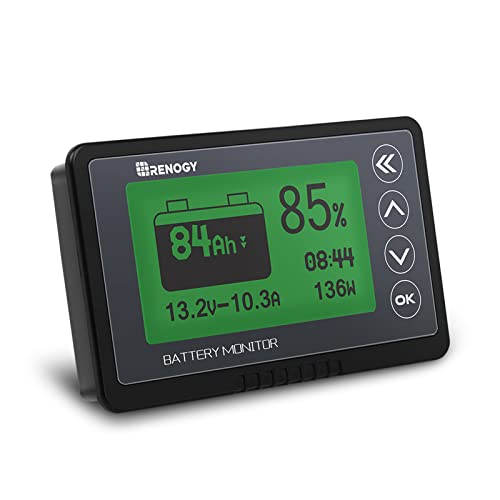
- Best for: Solar and RV banks that need a permanent wired display without phone dependence.
- 500-amp shunt with a 20-foot shielded cable
- Voltage range 10 to 120 volts DC
- High and low voltage programmable alarm
- Shows state of charge, remaining capacity, voltage, current and watts
All 4 Picks at a Glance
| Product | Specs | Action |
|---|---|---|
| Victron SmartShunt IP65 500A |
| Check price on Amazon |
| Victron BMV-712 Smart |
| Check price on Amazon |
| Renogy 500A Battery Monitor |
| Check price on Amazon |
 AiLi 350A Battery Monitor |
| Check price on Amazon |
🛒 Best Price Today on Amazon
Prime members get fast, free shipping on everything above, plus member-only deals. New members get a 30-day free trial — cancel anytime.
A lithium battery holds its voltage almost flat from 80 percent charge down to 20 percent, so a simple voltage gauge cannot tell you how much energy is left. That flat discharge curve is the real decision behind this guide: you need a monitor that counts amps flowing in and out through a shunt or a Hall sensor, then turns that count into a state of charge you can trust. Pick the wrong type and you will either run out of power with no warning or pay for features your setup never uses.
This guide is for RV owners, boat owners, van builders and off-grid solar users who run lithium iron phosphate or lithium-ion banks and want a dependable fuel gauge for them. Every monitor below was chosen from the name and the specifications on its Amazon product page, with the shunt size, voltage range and display type matched to real lithium setups rather than to generic battery use.
Quick Picks
As an Amazon Associate we earn from qualifying purchases
| Product | Best for | Key spec from title |
|---|---|---|
| Victron SmartShunt IP65 500A | App-based monitoring in wet locations | 500A shunt, Bluetooth, IP65 |
| Victron BMV-712 Smart | A panel display plus a phone app | 500A shunt, Bluetooth, 52 mm LCD |
| Renogy 500A Battery Monitor | Wired display on a budget | 500A shunt, 10-120V, 20 ft cable |
| AiLi 350A Battery Monitor | The lowest-cost shunt setup | 350A shunt, 8-100V, 999 Ah range |
| DROK 6-in-1 Multi-Meter | Installs without cutting the main cable | Hall sensor, 8-120V, 0.02-100A |
How to Choose
Shunt, Hall sensor, or voltage gauge?
A shunt sits in the main negative cable and measures every amp that enters or leaves the bank, which is the only way to track state of charge on lithium with real accuracy. A Hall sensor reads current through a ring around the cable, so nothing gets cut, but its low-end accuracy is weaker and small standby draws can slip past it. A plain voltage gauge is the weakest option of all: lithium voltage stays nearly flat across most of the usable range, then falls off a cliff near empty. If you want a trustworthy fuel gauge, buy a shunt monitor first and treat a voltage display as a backup, not as the main instrument.
Match the shunt to your biggest load
Add up the largest current your system can draw at once, then pick a monitor whose shunt covers it with room to spare. A 2000-watt inverter on a 12-volt bank can pull more than 160 amps, and a 3000-watt inverter can pass 250 amps, so a 100-amp meter would overload long before the inverter reaches full output. A 500-amp shunt covers most RV and marine inverters, while a 350-amp shunt suits smaller banks with modest inverters. Check the voltage range too: a monitor built for 12-volt systems may not suit a 24-volt or 48-volt bank, so confirm the listing covers your bank voltage before ordering.
Display on the wall or data on your phone?
Some monitors put the numbers on a panel you can glance at while walking past, while others send everything to a phone app and show nothing on the device itself. A wall display suits a fixed RV or boat panel, where a quick look before bed matters more than graphs. An app-only shunt suits a battery box or a locker with no flat surface for a display, and it usually adds history charts and alarms your phone can push. The strongest setups offer both: a display for instant checks and an app for trends. Decide where you will actually look at the numbers, then buy the form that puts them there.
Set it up for lithium, not for lead-acid
A monitor only stays accurate if its settings match your chemistry. Lithium iron phosphate charges to a different full voltage than lead-acid, and its charge efficiency sits near 99 percent, so a monitor left on lead-acid defaults will drift and report the wrong state of charge within days. Enter your real bank capacity in amp-hours, set the charged voltage and the tail current from your battery maker, and let the monitor sync to 100 percent at the end of a full charge. Skip this step and even the best shunt will slowly lie to you, which is why setup matters as much as the hardware you buy.
The 5 Best Options
Victron SmartShunt IP65 500A
- Best for: RV and boat owners who want full monitoring from a phone and a sealed unit near the bank.
- 500-amp shunt with Bluetooth built in
- Supply range 6.5 to 70 volts DC, for 12, 24 and 48-volt systems
- IP65 sealed housing for wet locations
- VE.Direct port for a wired connection to other Victron gear
RV and boat owners who want full monitoring from a phone and a sealed unit near the bank.
No display on the unit itself, so a dead phone battery means no reading; the VE.Direct cable is sold separately.
The SmartShunt IP65 is the monitor to buy when the battery lives somewhere wet, cramped or out of sight, because it hides beside the bank and sends every reading to your phone over Bluetooth. Its sealed housing shrugs off bilge spray and locker condensation, and the VictronConnect app shows state of charge, time remaining, voltage, current and watts, plus history you can check days later. The 500-amp shunt handles full-size RV and marine inverters, and the 6.5 to 70-volt range covers 12, 24 and 48-volt banks. The only real trade-off is the lack of a display: with no phone in hand, you cannot see the numbers.
Watch out for: No display on the unit itself, so a dead phone battery means no reading; the VE.Direct cable is sold separately.
Victron BMV-712 Smart
- Best for: Fixed RV and boat panels where a glanceable display matters as much as phone data.
- 500-amp, 50-millivolt shunt included
- Supply range 6.5 to 70 volts DC
- Bluetooth built in, with the VictronConnect app
- 52-millimetre backlit LCD display, round or square bezel
Fixed RV and boat panels where a glanceable display matters as much as phone data.
The head is rated IP55 and is not meant for outdoor mounting, so keep it under cover; grey and black versions are separate listings.
The BMV-712 is the pick when you want the numbers in two places at once: on a panel display by the door and on your phone through the VictronConnect app. Its 500-amp shunt and 10-metre RJ12 cable let you mount the head far from the bank, and the backlit screen shows state of charge and time remaining. A programmable alarm and a relay can switch off non-critical loads or start a generator when the bank runs low, and a second input tracks a starter battery, temperature or midpoint voltage. It costs more than a shunt alone, but nothing else in this guide pairs a display with Bluetooth this well.
Watch out for: The head is rated IP55 and is not meant for outdoor mounting, so keep it under cover; grey and black versions are separate listings.
Renogy 500A Battery Monitor
- Best for: Solar and RV banks that need a permanent wired display without phone dependence.
- 500-amp shunt with a 20-foot shielded cable
- Voltage range 10 to 120 volts DC
- High and low voltage programmable alarm
- Shows state of charge, remaining capacity, voltage, current and watts
Solar and RV banks that need a permanent wired display without phone dependence.
No Bluetooth or app, so there are no history graphs; mount the display where the cable reaches.
Renogy’s 500-amp monitor is the straightforward wired choice: a shunt at the bank, a display on a 20-foot shielded cable, and no app or phone needed to see the numbers. The screen shows state of charge, remaining amp-hours, voltage, current and watts, and high and low voltage alarms warn you before the bank drops too far. Its 10 to 120-volt range covers 12, 24, 36, 48 and 72-volt lithium banks, and the listing names lithium, sealed, gel and flooded batteries as compatible. It gives up Bluetooth and history charts, but for a fixed display at a sensible cost, it is hard to beat.
Watch out for: No Bluetooth or app, so there are no history graphs; mount the display where the cable reaches.
AiLi 350A Battery Monitor
- Best for: Smaller lithium banks and first-time shunt installs where the budget is tight.
- 350-amp shunt included
- Working voltage 8.0 to 100.0 volts DC
- Current range minus 350 to plus 350 amps
- Capacity range 0 to 999 amp-hours
Smaller lithium banks and first-time shunt installs where the budget is tight.
The 350-amp limit is too small for large inverters; check your peak draw before ordering.
The AiLi is the low-cost way into shunt monitoring, and it covers the essentials: voltage, charge and discharge current, remaining amp-hours and state of charge on a simple backlit screen. Its 350-amp shunt suits modest banks and smaller inverters, and the 8 to 100-volt working range covers 12, 24, 36 and 48-volt lithium setups with capacity settings up to 999 amp-hours. The kit includes the monitor, the shunt, a 2-metre cable and a manual, so there is little else to buy. Accuracy is listed at plus or minus 1 percent for voltage, current and capacity, which is respectable at this end of the market.
Watch out for: The 350-amp limit is too small for large inverters; check your peak draw before ordering.
DROK DC 8-120V 100A 6-in-1 Multi-Meter
The DROK takes a different approach: instead of a shunt in the negative cable, it reads current through a Hall sensor ring that clips around the wire, so you never cut the main cable at all. The display shows voltage, current, power, capacity, temperature and run time together, and the 8 to 120-volt range covers 12 through 72-volt lithium, LiFePO4 and lead-acid banks. It measures 20 times per second and draws only 0.2 watts with the backlight on. The 100-amp ceiling limits it to lighter systems, but for a golf cart, a small solar setup or a portable bank, the no-cut install is a genuine advantage.
Specs
- Hall sensor current reading, no shunt to wire into the main cable
- Voltage range 8 to 120 volts DC
- Current range 0.02 to 100 amps
- Capacity range 0.1 to 999 amp-hours
- Power range up to 60 kilowatts
- Voltage accuracy plus or minus 1 percent plus 2 digits; current accuracy plus or minus 0.5 percent plus 2 digits
- Temperature range minus 20 to 150 degrees Celsius
- 128 by 64 LCD display; measures 20 times per second
- Compatible with lead-acid, LiFePO4 and lithium-ion batteries
Best for: Golf carts, small solar setups and portable banks where cutting the main cable is not an option.
Watch out for: The 100-amp ceiling rules out big inverters, and Hall sensors read small standby draws less precisely than a shunt.
Which One Fits Your Situation
Your RV runs a big inverter and a lithium bank
Pick the Victron BMV-712 Smart. Its 500-amp shunt covers a 2000 or 3000-watt inverter, the panel display sits where you can see it from the living area, and the alarm relay can drop non-critical loads before the bank runs flat. If the display would sit in a damp locker, take the SmartShunt IP65 instead and read the same data on your phone.
Your battery lives in a boat or an open locker
Pick the Victron SmartShunt IP65 500A. Its sealed housing is built for spray and condensation, and there is no display to fog up or fail. Mount it beside the bank, pair it once with the VictronConnect app, and check state of charge from the helm. The BMV-712 is the wrong call here because its head is not meant for outdoor mounting.
You want the lowest spend that still counts amps
Pick the AiLi 350A if your inverter is modest, or the Renogy 500A if you run a bigger one. Both count amps through a real shunt and show state of charge on a wired display, which is the core job. The AiLi kit costs less and includes the shunt and cable, while the Renogy adds a wider voltage range and a longer cable. Skip the DROK here unless your loads stay under 100 amps.
You cannot cut the main battery cable
Pick the DROK 6-in-1 Multi-Meter. Its Hall sensor ring clips around the cable and reads current without breaking the circuit, which suits rented rigs, golf carts and sealed portable banks. Accept the trade-offs: a 100-amp ceiling and weaker readings on tiny standby draws. If your loads ever grow past 100 amps, plan a shunt monitor instead.
Common Mistakes
- Wiring the shunt into the positive cable or the wrong side of the negative cable, so some loads bypass it and the state of charge drifts.
- Leaving the monitor on lead-acid defaults with a lithium bank, so the charged voltage and efficiency settings never match the battery.
- Sizing the shunt for average draw instead of peak draw, then overloading the meter the first time the inverter runs at full output.
- Trusting a voltage-only gauge on lithium, where the voltage stays flat until the bank is nearly empty.
- Never syncing the monitor to 100 percent after a full charge, so small counting errors accumulate week after week.
Frequently Asked Questions
Do lithium batteries need a special monitor?
Not a special one, but a shunt-based one. Lithium voltage stays almost flat across most of its range, so a voltage gauge cannot show how much energy remains. A shunt monitor counts amps in and out and converts that count into a state of charge, which works for lithium as long as you enter the right bank capacity and charged voltage during setup.
Can I install a shunt monitor myself?
Yes, if you are comfortable working around a battery bank and you follow the wiring diagram exactly. The shunt goes in the main negative cable with every load and charger on the system side, and the small sense wires run to the display or the shunt head. If you are unsure about cable sizing or fusing, have a marine or RV electrician do the install rather than guessing.
Why does my monitor show the wrong state of charge?
The usual cause is setup, not hardware. A wrong bank capacity, a charged voltage set for lead-acid, or a monitor that never synced to 100 percent after a full charge will all drift the reading. Check that every negative connection runs through the shunt, confirm the capacity and charged voltage match your battery maker, then run a full charge and let the monitor sync.
Is a Bluetooth-only monitor enough, or do I need a display?
It depends on where you check the bank. A Bluetooth-only shunt is enough if you always carry your phone and the battery sits in a locker you rarely open. A wall display is better when several people use the rig, when you want a reading at a glance before bed, or when the battery area has weak phone signal. The BMV-712 covers both, which is why it suits shared rigs.