Our Short List of 3

- Best for: Living-room gaming where volume, bass and surround sound all matter.
- Power: 240W peak, 120W RMS
- Configuration: 2.1, two satellites and down-firing subwoofer
- Surround: DTS:X Ultra 7.1 virtual surround
- Lighting: LIGHTSYNC RGB, four zones

- Best for: A desk setup where detailed stereo sound matters more than deep bass.
- Drivers: 4-inch organic fibre drivers
- Bass port: front-firing
- Output: 150 watts maximum
- Connection: Bluetooth, 3.5mm aux
- Best for: A small desk or bedroom where space is tight and volume stays moderate.
- Output: 8W RMS, 16W peak
- Connection: USB-C audio, Bluetooth 5.0
- Drivers: 45-degree elevated
- Feature: Clear Dialog audio processing
All 3 Picks at a Glance
| Product | Specs | Action |
|---|---|---|
| Logitech G560 |
| Check price on Amazon |
| SteelSeries Arena 3 |
| Check price on Amazon |
| Creative Pebble V3 |
| Check price on Amazon |
🛒 Best Price Today on Amazon
Prime members get fast, free shipping on everything above, plus member-only deals. New members get a 30-day free trial — cancel anytime.
The Xbox Series X sends its audio through the television or monitor, not through a speaker output of its own, and the real decision is how the speakers connect to that screen. A soundbar or a desktop set can plug into the television’s audio output or the monitor’s headphone jack, and the choice comes down to room size, bass and available space. Getting the connection right matters more than chasing the biggest wattage figure, because a speaker that cannot plug into the setup is useless no matter how good it sounds.
This guide is for console players who want game audio that fills the room, from a compact desk setup to a living-room system with a subwoofer. The four speakers below were chosen from the names and specifications shown on their Amazon pages, with attention to connections, output power and the space each one needs. Each one suits a different room, from a compact desk bar to a living-room system with a subwoofer.
Quick Picks
As an Amazon Associate we earn from qualifying purchases.
| Product | Best for | Key spec from title |
|---|---|---|
| Razer Leviathan V2 X | Compact soundbar under a monitor | Two full-range drivers, USB-C audio |
| Logitech G560 | Big room-filling sound with a subwoofer | 240W peak, DTS:X Ultra surround |
| SteelSeries Arena 3 | Detailed stereo sound on a desk | 4-inch drivers, 150W maximum output |
| Creative Pebble V3 | Small desk or bedroom setup | 8W RMS, Bluetooth 5.0, USB-C |
How to Choose
Work out how the speakers connect
The Xbox Series X has no headphone jack or optical audio output, so the speakers connect through the television or the monitor instead. Check the back of the screen for a 3.5mm headphone output, an optical output or an HDMI ARC port, and match the speaker’s inputs to what is there. A soundbar with Bluetooth can also take audio from a phone, but Bluetooth does not carry game audio from the console itself, so the wired connection to the screen is the one that matters. A short test with the television’s built-in speakers confirms the audio path before anything is bought.
Match the size to the room
A compact soundbar suits a desk or a small bedroom, where the listener sits close to the screen and does not need huge volume. A 2.1 system with a subwoofer suits a living room, where the extra bass fills the space and the satellites can sit wider apart. Measure the shelf or desk before ordering, and leave room for the subwoofer on the floor if the set includes one. A speaker that is too large for the room will dominate the space, while one that is too small will strain to fill it.
Think about bass and volume
Bass makes explosions and engine notes feel bigger, but it needs a subwoofer or a large driver to do it properly. A soundbar without a subwoofer can still sound full at moderate volume, though it will not shake the room. Check the output power on the listing as a rough guide to loudness, and remember that a speaker that sounds good at normal volume matters more than one that can play very loudly for a few seconds. Dialogue clarity matters too, since story-driven games lean on voices as much as effects.
Check the extras that matter for gaming
Lighting that reacts to the game adds atmosphere, on-speaker controls make volume changes quick, and a headphone jack on the speaker is handy for late-night sessions. Some speakers include software that adjusts the sound for games, while others keep it simple with a single volume knob. Decide which extras will actually be used, because a feature that stays switched off is not worth paying for. A remote control is another small extra that matters more than it seems when the sofa is far from the screen.
The 4 Best Options
Razer Leviathan V2 X
The Razer Leviathan V2 X is a compact soundbar that sits under a monitor or television without taking up desk space. Its two full-range drivers and two passive radiators deliver clear stereo sound, a single USB-C cable handles power and audio, and Bluetooth 5.0 streams music from a phone. Fourteen Chroma RGB lighting zones add atmosphere that can sync with the game, and the bar reaches up to 90 decibels at one metre, which is plenty for a desk setup.
Specs
- Drivers: two full-range drivers, two passive radiators
- Connection: USB-C audio and power, Bluetooth 5.0
- Lighting: 14 Chroma RGB zones
- Output: up to 90 dB at 1 metre
- Model: RZ05-04160100-R3U1
Best for: A tidy desk setup where a single slim bar replaces a pair of speakers.
Watch out for: There is no separate subwoofer, so deep bass is limited compared with a 2.1 system.
Logitech G560
- Best for: Living-room gaming where volume, bass and surround sound all matter.
- Power: 240W peak, 120W RMS
- Configuration: 2.1, two satellites and down-firing subwoofer
- Surround: DTS:X Ultra 7.1 virtual surround
- Lighting: LIGHTSYNC RGB, four zones
Living-room gaming where volume, bass and surround sound all matter.
The surround and lighting effects need a Windows PC with a USB connection, so on a console setup they run in basic stereo mode.
The Logitech G560 is the most powerful system here, a 2.1 set with a down-firing subwoofer and two satellite speakers that together deliver 240 watts peak and 120 watts RMS. DTS:X Ultra surround sound renders positional audio for games, LIGHTSYNC RGB covers four lighting zones that react to the action, and USB, 3.5mm and Bluetooth inputs cover the television, the console setup and a phone. It suits a living room or a large gaming desk where big sound is the priority, and the subwoofer gives explosions and engine notes real weight.
Watch out for: The surround and lighting effects need a Windows PC with a USB connection, so on a console setup they run in basic stereo mode.
SteelSeries Arena 3
- Best for: A desk setup where detailed stereo sound matters more than deep bass.
- Drivers: 4-inch organic fibre drivers
- Bass port: front-firing
- Output: 150 watts maximum
- Connection: Bluetooth, 3.5mm aux
A desk setup where detailed stereo sound matters more than deep bass.
There is no subwoofer in the box, so low-end punch is modest until the separate subwoofer is added.
The SteelSeries Arena 3 is a pair of desktop speakers built around 4-inch organic fibre drivers and a front-firing bass port, giving detailed stereo sound for games and music alike. On-speaker controls keep volume changes simple, Bluetooth and 3.5mm inputs cover the television and a phone, and the set can later be paired with the Arena subwoofer for a 2.1 upgrade. It suits players who want clear, accurate sound on a desk without a large subwoofer under it, and the larger drivers give it a fuller sound than most compact sets.
Watch out for: There is no subwoofer in the box, so low-end punch is modest until the separate subwoofer is added.
Creative Pebble V3
- Best for: A small desk or bedroom where space is tight and volume stays moderate.
- Output: 8W RMS, 16W peak
- Connection: USB-C audio, Bluetooth 5.0
- Drivers: 45-degree elevated
- Feature: Clear Dialog audio processing
A small desk or bedroom where space is tight and volume stays moderate.
The small drivers cannot produce deep bass, so explosions and low notes sound thinner than on larger sets.
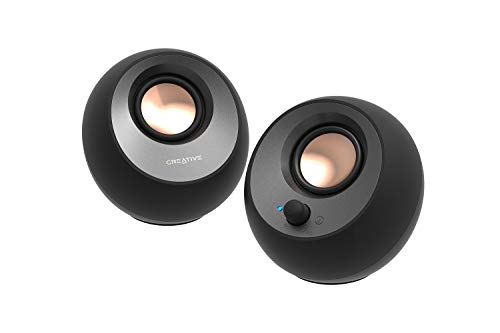
The Creative Pebble V3 is the compact option, a pair of small orb-shaped speakers with 45-degree elevated drivers that aim the sound directly at the listener. A single USB-C cable handles power and audio, Bluetooth 5.0 covers wireless playback, and the Clear Dialog processing lifts voices in films and cutscenes. At 8 watts RMS with 16 watts peak, it is made for a small desk or bedroom rather than a large room, and its small footprint leaves the desk free for a keyboard and mouse.
Watch out for: The small drivers cannot produce deep bass, so explosions and low notes sound thinner than on larger sets.
Which One Fits Your Situation
You play at a desk with limited space
Choose the Razer Leviathan V2 X or the Creative Pebble V3. The Leviathan sits as a single slim bar under the monitor with RGB lighting, while the Pebble V3 takes up almost no desk at all. Both connect easily to a monitor’s headphone output or a television’s audio output, and both keep the setup tidy. The Leviathan’s lighting adds atmosphere, while the Pebble leaves room for a keyboard.
You want the biggest sound in the living room
Choose the Logitech G560. Its subwoofer and 240 watts peak deliver the bass and volume a large room needs, and the satellite speakers spread the sound wider than any soundbar. Keep in mind that the surround and lighting effects need a PC connection, so on a console the set runs as a powerful stereo system.
You want detailed sound for games and music
Choose the SteelSeries Arena 3. Its 4-inch drivers and front-firing bass port give a fuller, more accurate sound than the compact options, and the on-speaker controls make adjustments quick. It also leaves a clear upgrade path to a 2.1 setup with the matching subwoofer, which is useful later.
You need speakers for a bedroom or a small room
Choose the Creative Pebble V3. Its small size, USB-C power and Bluetooth cover a bedroom setup neatly, and the angled drivers aim the sound at the listener rather than the wall. It is the cheapest way here to replace thin television speakers, and it takes minutes to set up.
Common Mistakes
- Buying speakers with the wrong inputs for the television or monitor they will connect to, which leaves the set unusable.
- Expecting Bluetooth speakers to carry game audio directly from the Xbox, when Bluetooth cannot do that job.
- Choosing a large 2.1 system for a small desk with no room for the subwoofer, which ends up on the floor in the way.
- Judging speakers by peak wattage instead of listening quality at normal volume, where most gaming actually happens.
- Forgetting to check whether surround and lighting features need a PC to work, and then wondering why they stay dark on a console.
Frequently Asked Questions
How do I connect speakers to an Xbox Series X?
Connect them through the television or monitor, since the console has no speaker output of its own. Use the screen’s 3.5mm headphone output, optical output or HDMI ARC port, depending on what the speakers accept. A soundbar or desktop set plugged into the screen plays everything the console sends to it, including game audio and voice chat.
Do I need a subwoofer for console gaming?
Not always. A subwoofer adds deep bass that makes explosions and engine sounds feel bigger, and it helps in a large room. In a small room or on a desk, a good pair of stereo speakers or a soundbar can sound full without one. The Logitech G560 includes a subwoofer, while the other three options here work without one.
Can I use PC gaming speakers with an Xbox?
Yes, because the speakers connect to the screen rather than the console. Any speaker with a 3.5mm, optical or HDMI ARC input works, and the same is true of a soundbar. The only features that may not work are PC-only extras, such as surround processing or lighting sync that needs Windows software.
Are soundbars or separate speakers better for Xbox?
A soundbar suits a tidy setup under a television or monitor, with one unit and one cable. Separate speakers spread the sound wider and usually give a better stereo image, which helps with positional audio in games. The choice comes down to space: a soundbar wins on a crowded desk, while separate speakers win in a room with space to place them.