Our Short List of 3

- Best for: Single-battery boats that sit unattended and need a lockable storage cutoff.
- Switch type: Single Circuit ON-OFF, locking with key
- Continuous rating: 300A
- Intermittent rating: 500A (5 min)
- Cranking rating: 900A (30 sec)

- Best for: Twin-battery boats that alternate banks daily and want an emergency combine position.
- Switch type: Selector 4 Position
- Battery inputs: 2
- Battery combine: Yes
- Alternator field disconnect: No
- Best for: Larger single-bank inboard boats that want the simplest possible high-capacity cutoff.
- Switch type: Single Circuit ON/OFF
- Current rating: 325A (per Amazon title)
- Maximum voltage: 32V DC (per Amazon title)
- Color: Red
All 3 Picks at a Glance
| Product | Specs | Action |
|---|---|---|
| Blue Sea Systems 6006 m-Series On/Off Battery Isolator Switch |
| Check price on Amazon |
| Blue Sea Systems 9001e e-Series Battery Switch Selector |
| Check price on Amazon |
| Blue Sea Systems 9003e e-Series Single Circuit On/Off Switch |
| Check price on Amazon |
🛒 Best Price Today on Amazon
Prime members get fast, free shipping on everything above, plus member-only deals. New members get a 30-day free trial — cancel anytime.
A battery switch looks like the simplest part on the boat, yet the real decision is not the knob — it is whether the switch can carry your engine’s cranking load and your house loads day after day without heating up, and whether its positions match the way your batteries are actually wired. A single-bank runabout, a twin-battery fishing boat, and a cruiser with separate start and house banks each need a different switch function, and buying the wrong function cannot be fixed with thicker cables.
This guide is for boat owners replacing a worn switch, wiring a second battery, or adding a proper cutoff for storage. Every pick below comes from the product titles and specification tables on the Amazon listings, and the three switches cover the three jobs that matter: a lockable on/off cutoff, a four-position selector for two banks, and a compact high-capacity on/off switch.
Quick Picks
As an Amazon Associate we earn from qualifying purchases.
| Product | Best for | Key spec from title |
|---|---|---|
| Blue Sea Systems 6006 m-Series | Single-battery boats that need a lockable cutoff | On/Off isolator switch with locking key |
| Blue Sea Systems 9001e e-Series | Twin-battery boats that run one bank at a time | Selector 4 Position, 32V DC, 325A |
| Blue Sea Systems 9003e e-Series | Single high-draw bank on a larger inboard boat | Single Circuit On/Off Compact, 32V DC, 325A |
How to Choose
Start With the Switch Function, Not the Brand
The first choice is what the knob actually does. A single-circuit on/off switch connects one battery to one load group and simply cuts it off — that is all a single-battery boat needs, and it doubles as a storage and emergency cutoff. A four-position selector adds choice: battery 1, battery 2, both combined, or off, which suits boats that alternate between a start battery and a house battery. Dual-circuit models switch two isolated banks at once. Count your battery banks and decide whether you ever need to combine them for an emergency start; that answer picks the function before price or size enters the discussion.
Read the Continuous Rating, Not the Biggest Number
Every listing prints three current figures, and they are not interchangeable. The continuous rating is the load the switch can carry indefinitely — house loads, electronics, and a running engine’s charging circuit all count against it. The intermittent rating covers a few minutes at a time, and the cranking rating is a thirty-second burst for starter motors. A switch that looks strong on its cranking number can still be undersized for a boat whose inverter, refrigerator, and lights pull steady current for hours. Match the continuous rating to your largest steady load with headroom to spare, then check that the cranking figure clears your starter’s demand.
Check the Voltage Ceiling and Ignition Protection
Most small-boat systems run at 12 volts, but the switch’s maximum operating voltage still matters: listings here top out at either 32V DC or 48V DC, and a 24V or 36V system must stay under the stated ceiling. Just as important for gasoline boats is ignition protection. A switch mounted in an engine compartment with a gasoline inboard or near fuel vapor must be ignition protected, so stray sparks from the contacts cannot ignite fumes. The listings below state this protection in their descriptions. Diesel installations are less sensitive to this point, but the rating costs nothing and widens where the switch may legally be mounted.
Look at Studs, Cable Size, and the Mounting Pattern
A switch only performs as well as its connections. Listings specify tinned copper studs, a maximum terminal torque, and the cable size needed to meet the printed ratings — the e-Series switches below call for 4/0 AWG cable to reach their full rating, so reusing thin battery leads quietly derates the whole installation. Mounting matters too: panel, surface, and rear-panel options decide whether the switch fits your existing cutout, and some models follow the common competitor hole patterns so a replacement drops into the old opening. Measure the space behind the panel as well, because stud length and cable bend radius eat room fast.
The 3 Best Options
Blue Sea Systems 6006 m-Series On/Off Battery Isolator Switch
- Best for: Single-battery boats that sit unattended and need a lockable storage cutoff.
- Switch type: Single Circuit ON-OFF, locking with key
- Continuous rating: 300A
- Intermittent rating: 500A (5 min)
- Cranking rating: 900A (30 sec)
Single-battery boats that sit unattended and need a lockable storage cutoff.
It switches one battery only — there is no selector or combine function, so twin-bank boats need a different model. One listing crawl showed no featured offer while others showed active sales, so confirm the buy box before ordering.
This is the switch for a single-battery boat whose owner wants a genuine cutoff rather than a suggestion. The 6006 is a single-circuit on/off isolator from the compact m-Series line, and its locking key sets it apart: turn it off, take the key, and nobody restarts the boat or drains the battery while it sits at the dock or on the trailer. The listing rates it at 300 amps continuous with a 48V DC ceiling, generous headroom for outboards and small inboard engines, and the case is sealed to IP66. Surface, front-panel, and rear-panel mounting options make it an easy fit in tight consoles.
Blue Sea Systems 9001e e-Series Battery Switch Selector
- Best for: Twin-battery boats that alternate banks daily and want an emergency combine position.
- Switch type: Selector 4 Position
- Battery inputs: 2
- Battery combine: Yes
- Alternator field disconnect: No
Twin-battery boats that alternate banks daily and want an emergency combine position.
There is no alternator field disconnect on this model, and the listing’s product-information field lists the current rating as 325 amps while its specification table states 350A continuous — decide which figure your load calculation uses before installing. The 32V DC ceiling also rules out 36V and 48V systems.
Boats with a start battery and a house battery need a referee, and the 9001e is built for exactly that job. Its four positions — battery 1, battery 2, both, and off — let you run the day on one bank, keep the other in reserve, and still combine both for a stubborn cold start. The listing’s specification table gives a 350A continuous rating and a 1200A cranking rating, the strongest figures in this roundup, with two battery inputs and a make-before-break style combine function. It mounts on the surface or through a rear panel, carries an IP66 rating, and the description confirms ignition protection for gasoline engine rooms.
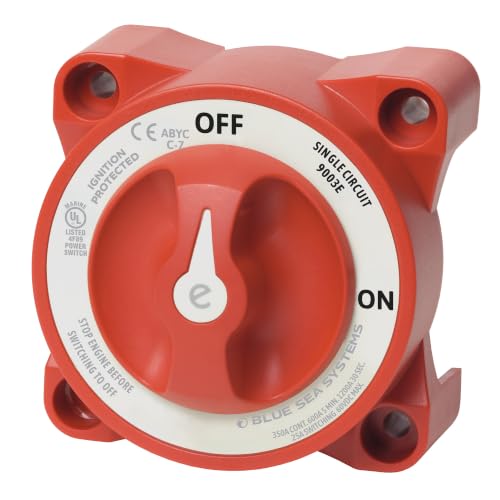
Blue Sea Systems 9003e e-Series Single Circuit On/Off Switch
- Best for: Larger single-bank inboard boats that want the simplest possible high-capacity cutoff.
- Switch type: Single Circuit ON/OFF
- Current rating: 325A (per Amazon title)
- Maximum voltage: 32V DC (per Amazon title)
- Color: Red
Larger single-bank inboard boats that want the simplest possible high-capacity cutoff.
Amazon’s title figures (325A, 32V DC) are lower than the ratings Blue Sea publishes for this family in its own catalog (350A continuous, 48V maximum), so verify the numbers on the product page and plan your wiring around the conservative set. Like the 6006, it has no selector function for twin banks.
The 9003e answers a narrower question: what on/off switch handles a big single bank without becoming the weak link? It is the compact single-circuit member of the e-Series family, built for inboard boats where one battery bank feeds everything and the cutoff must simply work, every time, for years. Amazon lists it as its overall pick in boat battery switches, and the title figures — 325A and 32V DC — put it at the top of the on/off class alongside its selector sibling. There are no extra positions to mismanage: the knob turns between on and off, which is precisely what a storage cutoff and emergency disconnect should do.
Which One Fits Your Situation
Your Boat Sits in Storage for Weeks at a Time
Choose the 6006 m-Series. A lockable on/off switch is the correct tool for storage: it stops parasitic drains from clocks, alarms, and stereo memory, and the removable key means the boat cannot be started or silently switched back on while you are away. Its 300A continuous rating covers the single outboard or small inboard it will serve, and the compact case fits the crowded panel space most small boats offer.
You Run a Start Battery and a House Battery
Choose the 9001e selector. Alternating banks is a daily habit on twin-battery boats — run the house bank at anchor, keep the start battery untouched, then combine both if the starter ever sounds weak. The four-position knob makes that routine one twist instead of a wiring change, and its 350A continuous and 1200A cranking figures are the strongest here, which suits larger inboards that draw hard at start-up.
One Big Bank Feeds Everything on an Inboard Boat
Choose the 9003e. When a single bank handles starting and house loads together, a selector adds positions you will never use; a plain on/off switch with the highest capacity you can mount is the honest answer. The 9003e gives you that simple, positive cutoff for maintenance, emergencies, and lay-up, in the same e-Series footprint as its selector sibling if you ever rewire to two banks later.
You Are Replacing a Failed Switch in an Existing Panel
Start by matching function and footprint, not by shopping ratings. If the old switch was a selector, the 9001e follows the common e-Series layout and mounts on the surface or rear panel; if it was a plain cutoff, either on/off model here works, and the 6006 adds a locking key the old one probably lacked. Check your cable size against the listing’s requirement before reusing leads, because undersized cable quietly caps the new switch’s rating.
Common Mistakes
- Buying a selector switch for a single-battery boat, then leaving it on “both” with only one bank wired — dead positions and confusing labels help nobody.
- Sizing by the cranking number alone and ignoring the continuous rating that house loads actually stress for hours.
- Mounting a non-ignition-protected switch in a gasoline engine compartment to save a little money.
- Reusing thin battery cables on a high-rated switch; the listing’s cable-size requirement is part of the rating, not a suggestion.
- Switching to “off” while the engine is running on a model without alternator field disconnect, which can damage the alternator.
Frequently Asked Questions
What is the difference between an on/off switch and a selector switch?
An on/off switch connects or isolates a single battery — nothing more. A selector switch, like the 9001e above, adds positions for choosing between two battery banks or combining them. If your boat has one battery, a selector’s extra positions go unused; if it has two banks that share loads, an on/off switch cannot separate them.
Can I turn the switch off while the engine is running?
On switches without an alternator field disconnect — including the 9001e listed here — turning to off under a running engine can spike the charging system and damage the alternator. The safe habit is to shut the engine down first, then switch. Selector models move between battery positions without breaking the circuit, but the off position is for a stopped engine.
What continuous rating does my boat need?
Add up the steady loads the switch will carry: electronics, lights, pumps, refrigeration, and the charging current passing through it. Most single-engine boats with modest house loads sit comfortably under 300 amps continuous, which is why the switches here start there. Boats running large inverters through the switch should do the math carefully and keep real headroom above the total.
Does a battery switch stop my battery from going flat in storage?
Yes, provided every load runs through it. A switch in the off position physically breaks the circuit, so parasitic draws from bilge alarms, clocks, and control heads cannot sip the bank down over weeks. The catch is wiring: any device wired directly to the battery posts, bypassing the switch, keeps drawing. Check for bypass leads when you install.