🛒 Best Price Today on Amazon
Prime members get fast, free shipping on everything above, plus member-only deals. New members get a 30-day free trial — cancel anytime.
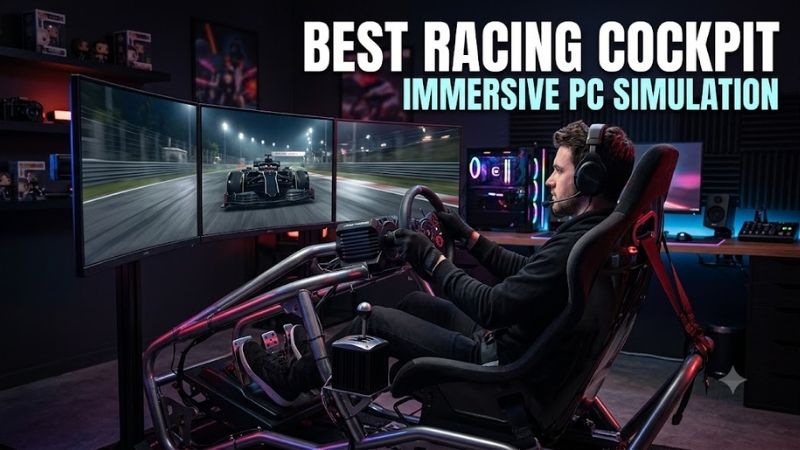
Choosing the best racing cockpit means balancing frame rigidity, driving position, pedal support, wheelbase compatibility, adjustability, seat options, and future upgrades. A strong cockpit should remain stable under direct drive force feedback and heavy braking while keeping the wheel, pedals, and seat aligned comfortably.
Quick answer: For most people in 2026, the best racing cockpit is the Racing Cockpit — our #1 rated choice. See the full ranked comparison, alternatives and buying advice below.
Best Racing Cockpits Compared
Sim racing cockpits range from foldable frames to modular aluminum-profile rigs. Entry models save space, while heavier profile systems provide greater rigidity for direct drive wheelbases and load-cell pedals. Your wheel torque, pedal force, available room, preferred seating position, and upgrade plans should determine the right design.
| Racing Cockpit | Best For | Frame Type | Driving Position | Direct Drive Ready | Seat Included |
|---|---|---|---|---|---|
| Next Level Racing F-GT Elite Lite | Overall versatility | Aluminum profile | GT, Formula, Hybrid | Yes | No |
| Sim-Lab GT1 Evo | Upgradeable GT rigs | Aluminum profile | GT | Yes, with compatible mounting | No |
| GT Omega PRIME Lite | Value aluminum rig | 8040 aluminum profile | GT | Yes | No |
| Trak Racer TR80-Lite | Expandable ecosystem | 8040 aluminum profile | GT | Yes | Optional |
| Next Level Racing F-GT Lite | Small rooms | Foldable tubular frame | GT and Formula | Entry to mid-range setups | Integrated |
Next Level Racing F-GT Elite Lite
Best For: Overall versatile sim racing setups
The Next Level Racing F-GT Elite Lite uses an aluminum-profile chassis designed to support GT, Formula, hybrid, truck, and other driving positions. Unlike a fixed GT rig, the seat, wheel, and pedal geometry can be changed substantially, making the cockpit attractive to users who race several disciplines instead of one category.
The frame uses 4080-profile construction with reinforced components around high-load areas. Next Level Racing designed the cockpit for direct drive wheelbases, where steering torque can expose movement that would barely be noticeable with an entry-level belt or gear-driven wheel. A rigid wheel mount makes force-feedback detail easier to feel.
The Front and Side Mount Edition includes heavy steel mounting hardware intended for compatible front- or side-mounted direct drive bases. The side mounting arrangement also leaves more open space underneath the wheelbase, which can improve leg clearance and create a cleaner appearance than a large universal wheel deck.
Pedal positioning is highly adjustable for both GT and Formula-style layouts. This matters when using a stiff load-cell or hydraulic brake because the pedal deck must resist substantial force without changing angle. A stable pedal platform also helps muscle memory because the braking position remains consistent between laps.
Seat position can be adjusted through Next Level Racing’s sliding system, while the frame supports a broad range of user heights. Because the cockpit does not include a seat by default, buyers can choose a bucket, recliner, or other compatible racing seat based on body size, driving style, and long-session comfort requirements.
What makes the F-GT Elite Lite different is its ability to move between several driving positions without abandoning aluminum-profile rigidity. The trade-off is complexity. Users who only race GT cars may find a simpler fixed-position chassis easier to assemble and configure, while Formula fans can benefit from the additional range.
Key Features:
- 4080 aluminum-profile construction
- GT, Formula, and hybrid positions
- Front and side direct drive mounting options
- Highly adjustable pedal position
- Adjustable wheel angle and position
- Adjustable seat position
- Motion-platform upgrade compatibility
- Wide accessory ecosystem
Pros:
- Excellent driving-position flexibility
- Strong direct drive support
- Highly adjustable geometry
- Suitable for advanced pedal sets
Cons:
- Seat normally purchased separately
- More setup work than a fixed-position rig
Use Case: iRacing, Assetto Corsa Competizione, F1 titles, rally, endurance racing, and multi-discipline sim racing with premium wheel and pedal hardware.
Who It’s For: Sim racers who want one rigid cockpit that can adapt between GT and Formula-style seating.
Sim-Lab GT1 Evo
Best For: Upgradeable GT sim racing setups
The Sim-Lab GT1 Evo is an aluminum-profile cockpit built around a straightforward GT driving position. Its rigid frame is intended to provide a stable foundation for popular wheelbases and pedal sets, while the open profile construction makes it easy to reposition hardware or add accessories without replacing the entire chassis.
The wheel area can accommodate many mainstream wheelbases through its included mounting solution, while Sim-Lab offers additional direct drive mounting accessories for specialized hardware. This gives beginners the option to start with a modest wheel and later move to a stronger direct drive system while retaining the same main cockpit.
Its pedal tray supports height and angle adjustment, allowing users to position the pedals around their leg length and preferred seating posture. This is especially important when upgrading from light potentiometer pedals to a stiff load-cell brake, because comfortable leverage becomes critical as braking force increases.
The aluminum-profile sides also provide mounting surfaces for shifters, handbrakes, keyboard trays, button boxes, and other peripherals. A side mounting point for shifters and handbrakes is included, while additional accessories can be attached later. This modularity is one of the major advantages of profile-style cockpits.
Sim-Lab also offers integrated monitor mounting solutions for users who want the display connected directly to the rig. A separate freestanding stand can provide better isolation from direct drive vibrations, but an integrated mount reduces total floor space and keeps the monitor position tied directly to the cockpit.
What makes the GT1 Evo different is its simple upgrade path. It does not attempt to transform between GT and Formula seating positions, instead concentrating on a conventional GT chassis that can evolve with new wheelbases, pedals, displays, and accessories. That makes it especially practical for long-term progression.
Key Features:
- Aluminum-profile chassis
- GT seating position
- Adjustable pedal tray
- Wheel mounting support
- Optional direct drive upgrades
- Included side accessory mounting
- Single and triple monitor options
- Modular profile construction
Pros:
- Strong upgrade potential
- Simple GT-focused geometry
- Easy accessory mounting
- Compatible with many hardware setups
Cons:
- Seat not included
- Formula positioning is not its focus
Use Case: GT racing, endurance simulation, touring cars, rally, and users building a long-term direct drive setup.
Who It’s For: Racers who want a clean aluminum-profile foundation that can grow with better hardware over several years.
GT Omega PRIME Lite
Best For: Value-focused aluminum-profile builds
The GT Omega PRIME Lite uses 8040 aluminum profile for its main frame and aims to provide the rigidity of a profile cockpit without moving into the company’s heavier premium chassis. Its approximately 137 cm length and 68 cm width create a conventional GT footprint suitable for dedicated sim racing rooms and gaming spaces.
Both the wheel deck and pedal plate offer vertical, horizontal, and angle adjustment. This allows the steering wheel to be brought closer to the driver without forcing the seat forward, while the pedal plate can be adjusted independently. Separating those positions makes fitting different body proportions considerably easier.
The pedal tray is pre-drilled for popular pedal sets and can be repositioned to suit different angles. A stronger brake pedal can place significant force through the chassis, so the ability to maintain a stable relationship between the seat and pedals is particularly important for consistent trail braking and threshold braking.
The included shifter mounting solution can be installed on the left or right and adjusted vertically and horizontally. This is useful for drivers who alternate between paddle-shift race cars and manual vehicles, while the aluminum frame also leaves room for adding handbrakes, button boxes, and other accessories.
Seats can move horizontally through compatible mounting hardware, helping several household users share the same setup. The PRIME Lite does not include a seat as part of the bare chassis, which lets buyers select a suitable GT Omega seat or compatible alternative based on comfort and body size rather than accepting one bundled option.
What makes PRIME Lite appealing is its straightforward 8040 aluminum construction and broad adjustment without unnecessary complexity. It stays focused on the needs of a GT-style rig. Users who want extreme Formula positioning or a heavier industrial profile can move higher in the market, but many home racers do not need that.
Key Features:
- 8040 aluminum-profile frame
- Approximately 137 cm long
- Approximately 68 cm wide
- Adjustable wheel deck
- Adjustable pedal plate
- Left or right shifter mounting
- Horizontal seat adjustment
- Modular accessory support
Pros:
- Strong aluminum-profile construction
- Broad wheel and pedal adjustment
- Adjustable shifter position
- Good long-term upgrade potential
Cons:
- Seat purchased separately
- Requires permanent floor space
Use Case: Direct drive GT racing setups, load-cell pedals, manual shifter configurations, and long-term home simulator builds.
Who It’s For: Buyers who want aluminum-profile rigidity without moving immediately to the largest and most expensive chassis.
Trak Racer TR80-Lite
Best For: Expandable sim racing ecosystems
The Trak Racer TR80-Lite uses 80 x 40 mm anodized aluminum profiles for both the base and steering uprights. Its chassis measures roughly 1200 mm long and 580 mm wide, creating a relatively compact aluminum rig while still providing the structural foundation needed for direct drive wheelbases and stiff pedal systems.
A heavy universal wheel plate is supported by 80 x 40 mm uprights and reinforced brackets. Trak Racer specifically designs the frame around both belt-driven and direct drive wheel systems, making it practical for users starting with mainstream equipment who expect to upgrade torque later without replacing the entire cockpit.
The pedal mount uses thick carbon steel construction and offers multiple height and angle positions. It is pre-drilled for major pedal brands and is designed to tolerate substantial braking force. That rigidity matters most with load-cell pedals, where the driver’s braking pressure can expose flex in weaker pedal trays or lightweight frames.
Trak Racer offers optional seat brackets, sliders, shifter mounts, monitor stands, keyboard trays, bass shaker mounts, and numerous other accessories. The T-slot frame also makes custom mounting easier because accessories are not limited to a small number of factory holes or predetermined attachment points.
The cockpit can support optional bucket or reclining seats, allowing the driver to choose between fixed racing posture and easier everyday entry. This flexibility is useful for endurance sessions because a seat that looks authentic is not necessarily comfortable for every user’s hips, shoulders, or back over several hours.
What makes the TR80-Lite different is its accessory ecosystem and straightforward 8040-style foundation. The standard configuration is intentionally simple, but the frame can become much more complex over time. Buyers should account for optional accessories because adding seat hardware, shifters, and monitor mounts increases total cost.
Key Features:
- 80 x 40 mm aluminum profiles
- Approximately 1200 mm long
- Approximately 580 mm wide
- Universal wheel plate
- Direct drive support
- Heavy carbon-steel pedal mount
- Optional seat slider system
- Large accessory ecosystem
Pros:
- Strong wheel mounting
- Compact profile-rig width
- Excellent accessory expansion
- Stiff pedal mounting
Cons:
- Many extras are optional
- Front-mount compatibility depends on configuration
Use Case: GT, rally, drifting, endurance racing, and modular setups expected to gain more peripherals over time.
Who It’s For: Sim racers who want to build a customized ecosystem gradually instead of purchasing every accessory at the beginning.
Next Level Racing F-GT Lite
Best For: Small rooms and portable setups
The Next Level Racing F-GT Lite is fundamentally different from aluminum-profile cockpits because it uses a foldable frame with an integrated fabric seat. Its main advantage is storage: the cockpit can be folded when not in use, even with compatible electronics installed, making it practical for apartments and shared gaming rooms.
Its adjustable hubs allow the rig to change between GT and Formula-style seating positions. The user can lower the seating posture and raise the pedals for Formula games, then switch back toward a more conventional upright layout for GT, rally, or road-car simulation without owning two separate cockpit frames.
The frame is pre-drilled for popular Logitech, Thrustmaster, and Fanatec wheels and pedals, while clamping options can support additional hardware. A shifter mount is included and can be fitted to either side. This provides a more complete starter package than bare aluminum cockpits that require a separate seat and mounting accessories.
The limitation appears as wheel and brake forces increase. A folding cockpit cannot match the absolute rigidity of a heavy aluminum-profile chassis, particularly with powerful direct drive wheelbases or very stiff load-cell pedals. Some movement is the trade-off for being able to collapse and store the entire rig after a session.
For entry and mid-range sim hardware, however, the portability can be more important than ultimate stiffness. A rigid 40-kilogram profile cockpit is not useful if there is nowhere permanent to place it. F-GT Lite lets a living room or office become a racing space temporarily and then return to normal afterward.
What makes F-GT Lite different is its combination of Formula and GT positioning with foldable storage. It is not intended to replace an advanced profile rig for very high-torque systems. Instead, it solves the practical problem faced by racers who want an immersive seated setup but cannot dedicate permanent floor space.
Key Features:
- Foldable cockpit design
- Integrated seat
- GT seating position
- Formula seating position
- Included shifter mount
- Left or right shifter installation
- Pre-drilled wheel and pedal mounts
- Foldable with compatible electronics attached
Pros:
- Excellent for small rooms
- Seat included
- GT and Formula positions
- Easier storage than profile rigs
Cons:
- Less rigid than aluminum-profile cockpits
- Not ideal for very powerful direct drive systems
Use Case: Apartments, bedrooms, shared offices, and entry-level sim setups that need to be stored between racing sessions.
Who It’s For: Racers who value compact storage more than maximum frame rigidity.
Which Racing Cockpit Fits Different Sim Racers?
For users switching between Formula and GT cars, the F-GT Elite Lite offers the strongest combination of positioning flexibility and aluminum-profile rigidity. Its broad adjustment makes more sense than a fixed GT chassis when the same setup must feel reasonable in Formula cars, prototypes, touring cars, and conventional road vehicles.
For a straightforward GT setup, Sim-Lab GT1 Evo provides a clean foundation without forcing the buyer into specialized seating geometry. It is particularly attractive for users who want to add direct drive hardware, monitor mounts, handbrakes, or shifters later rather than purchasing a finished all-in-one simulator immediately.
GT Omega PRIME Lite works well when price-to-rigidity is a major consideration. Its 8040 frame, adjustable wheel deck, pedal system, and shifter mount cover the core requirements of a serious GT cockpit. It lacks the multi-position specialization of the F-GT Elite Lite but keeps setup relatively straightforward.
Trak Racer TR80-Lite is appealing for users who enjoy customizing their rigs. The T-slot structure and broad accessory catalog allow the cockpit to expand around monitor stands, speakers, handbrakes, tactile feedback, and other equipment. It can start simple and gradually become the center of a complex simulator.
For limited rooms, F-GT Lite solves a problem that none of the heavy profile cockpits can address as effectively. Folding the rig creates usable floor space when racing is finished. The compromise is frame movement, so it is best matched with entry or moderate-force hardware rather than extreme direct drive systems.
How to Choose the Best Racing Cockpit
Match Rig Rigidity to Wheel Torque
Direct drive wheelbases generate forces that can twist weak wheel decks and uprights. Higher torque makes chassis rigidity increasingly important because movement absorbs some of the force-feedback detail intended for the driver’s hands. Aluminum-profile cockpits are generally the safest long-term foundation for powerful wheelbases.
Consider Pedal Force
Load-cell pedals can stress a cockpit more than many wheelbases. Heavy braking pushes the seat backward and pedal tray forward at the same time, exposing flex throughout the frame. Look for thick pedal plates, strong mounting points, and a rigid seat connection if you plan to use a high brake-force setting.
Choose GT or Formula Positioning
GT seating places the driver relatively upright with pedals lower than Formula seating. Formula layouts recline the torso and raise the legs significantly. A dedicated GT cockpit is simpler if you mainly race touring or road cars, while adjustable rigs are useful when F1 and prototype simulation are major priorities.
Measure Available Floor Space
Aluminum rigs are effectively permanent pieces of furniture. Measure not only the chassis but also the monitor stand, seat travel, shifter, and space needed to enter the cockpit. If a permanent footprint is impossible, a folding rig may produce a better real-world experience even if it sacrifices some absolute stiffness.
Think About Monitor Mounting
An integrated monitor stand saves floor space and keeps the screen aligned with the cockpit. A freestanding stand isolates the display from force-feedback vibration and makes positioning easier when using large monitors. Triple-screen users should consider adjustment range and frame rigidity before choosing an integrated solution.
Plan Future Accessories
Shifters, handbrakes, button boxes, keyboard trays, bass shakers, motion systems, and flight-sim controls all require mounting points. Aluminum T-slot profiles are particularly convenient because accessories can move along the rails. A cockpit that appears inexpensive can become limiting if upgrades require replacing the main frame.
FAQ
Is a Racing Cockpit Worth It?
A racing cockpit can substantially improve consistency because the wheel, pedals, and seat remain in fixed positions. Desk-mounted wheels often move under strong force feedback, while office chairs can roll backward under braking. A dedicated rig also allows the controls to be positioned more like an actual driving environment.
Do I Need an Aluminum Cockpit for Direct Drive?
Not every direct drive wheel requires an aluminum cockpit, especially at lower torque settings. However, stronger wheelbases benefit from rigid wheel uprights and a stable base. Aluminum-profile systems also make future upgrades easier, so they are often the better long-term option for enthusiasts expecting to increase wheel torque.
Can a Racing Cockpit Fit Load-Cell Pedals?
Most serious cockpits support load-cell pedals, but stiffness varies. A strong brake can flex lightweight pedal trays or push folding frames backward. Check the pedal mount construction and seat stability, especially if you plan to use high brake forces. Profile rigs generally provide the strongest foundation.
Is a Formula Cockpit Better Than a GT Cockpit?
Neither position is universally better. Formula seating creates a low, reclined posture with raised legs, while GT seating is more upright and easier to enter. Choose based on the vehicles you simulate most often. Adjustable rigs provide greater versatility but usually require more setup when changing between positions.
Can I Use a Normal Car Seat on a Sim Rig?
Many aluminum-profile cockpits can accept automotive seats when appropriate brackets and sliders are used. A real car seat can provide excellent comfort for endurance racing, but mounting dimensions and rails vary. Bucket racing seats offer a more authentic appearance but should be selected carefully for body width.
Should the Monitor Be Attached to the Cockpit?
Integrated monitor mounts save room and make it easy to keep the display close to the wheel. Freestanding mounts reduce the chance that wheelbase vibration reaches the screen and can offer more positioning flexibility. Both designs work, so the better choice depends on space, display weight, and force-feedback strength.
Conclusion
The best racing cockpit should match your wheel torque, pedals, space, and preferred driving position. F-GT Elite Lite offers GT and Formula flexibility, GT1 Evo and PRIME Lite provide modular profile foundations, TR80-Lite emphasizes expansion, while F-GT Lite gives space-limited racers a practical foldable alternative.
Ready to decide? Our #1 pick for 2026 is the Racing Cockpit.
Live price & availability on Amazon.