AYANEO 3 Buyer Analysis: Modular Handheld Trade-Offs
The AYANEO 3 is less a single specification than a set of choices: Ryzen AI 9 HX 370 or Ryzen 7 8840U, OLED or LCD, four memory-and-storage tiers, and optional control modules. Its defining idea is hardware customization, but that also makes buying one more complicated than choosing the fastest processor.
This is a specification-based buyer analysis, not a hands-on review. It uses AYANEO and AMD documentation to identify what changes between versions, what remains common, and where a buyer should verify regional listings before paying. Readers comparing the wider category can start with our Windows handheld gaming PC guide.
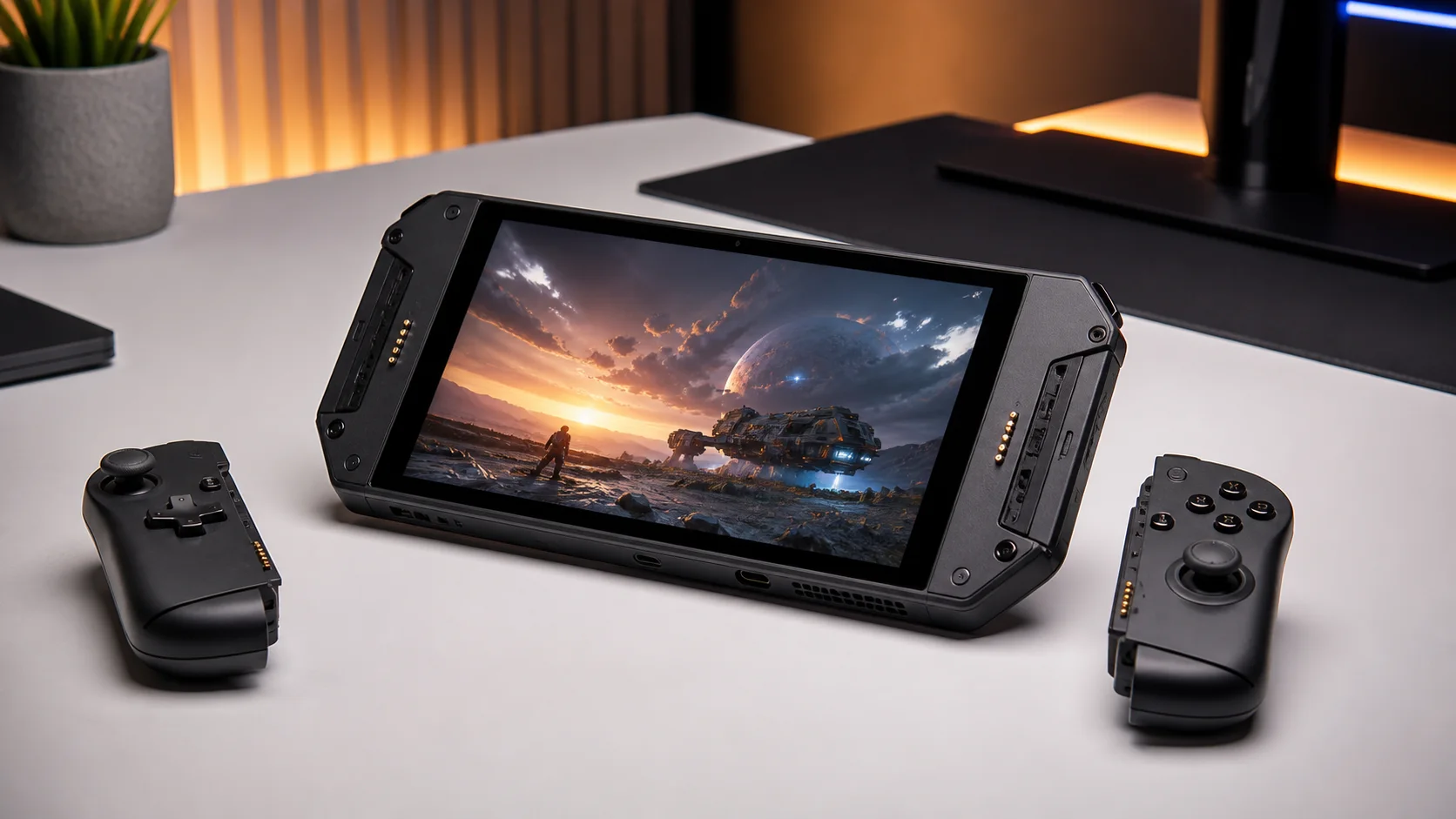
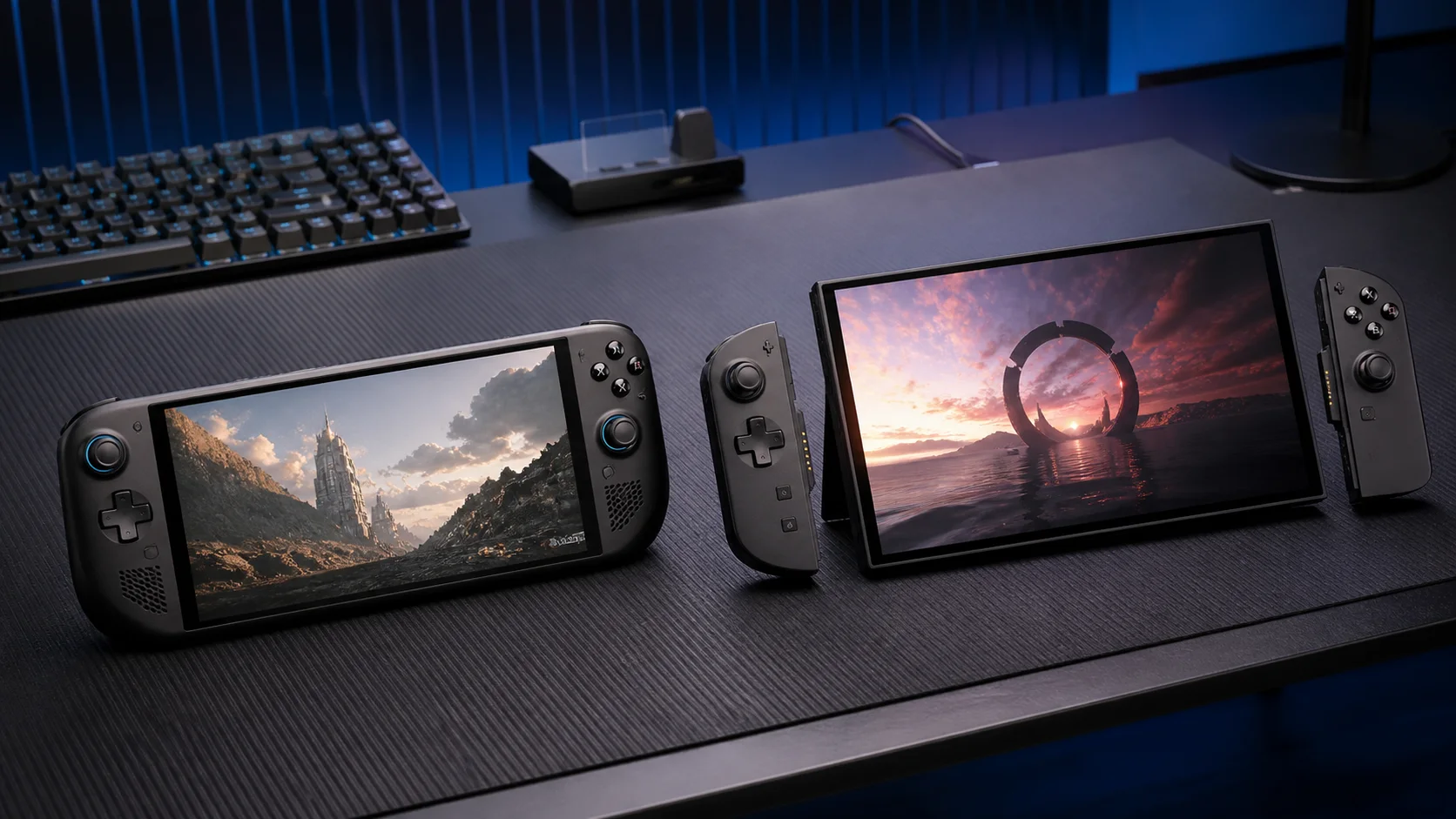
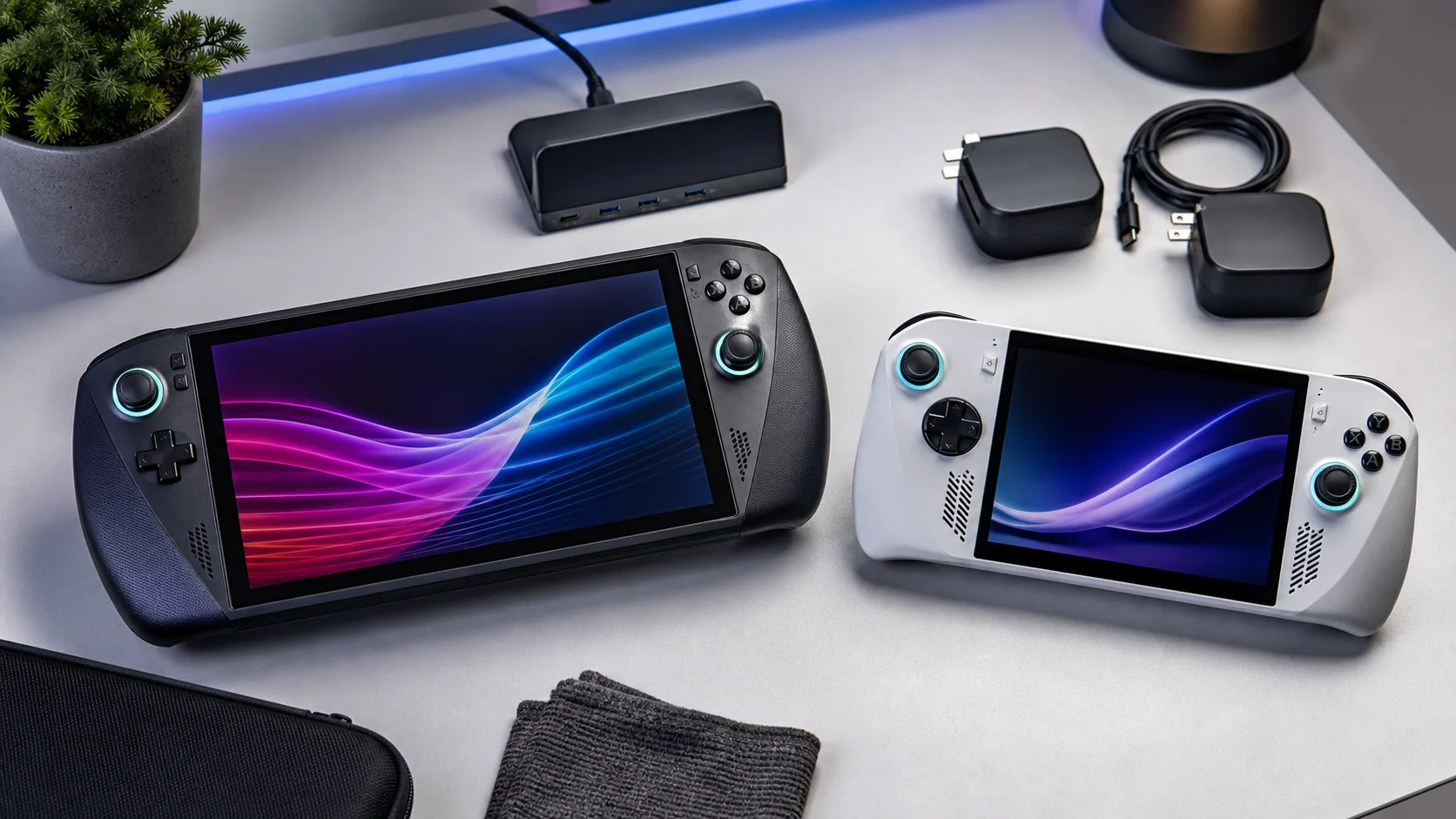
Conceptual modular-handheld illustration; it is not a product photo or testing record.
Quick answer: Our top pick in 2026 is the Highest listed platform tier — our #1 rated choice. See the full ranked comparison, alternatives and buying advice below.
Product map: four major choices, not four fixed models
The official AYANEO 3 specification page lists two processors, two 7-inch 1080p displays, and these memory/storage combinations: 16GB/512GB, 32GB/1TB, 64GB/2TB, and 64GB/4TB. It also lists Starry Black, Sky White, and Retro Power colors.
Do not assume that creates sixteen universally available SKUs. AYANEO’s page describes the product family, while actual CPU, display, capacity, and color bundles can differ by store, campaign, stock, and destination. Treat the seller’s exact line item as the contract. Confirm all four attributes before checkout, especially when a marketplace title shortens the model name.
The practical hierarchy is straightforward. The HX 370 is the higher-spec processor option. The 8840U is the value-oriented alternative. OLED prioritizes refresh-rate range, stated brightness, and color volume; LCD adds VRR and native-landscape orientation. Capacity should be chosen around workload and price, not used as a proxy for processor or screen type.
Modular controls: what is included and what costs extra
Every AYANEO 3 centers on removable left and right controller modules. AYASpace 3.0 commands a motorized latch-and-ejection mechanism, recognizes installed modules, and exposes relevant mappings. The standard configuration uses joystick modules with Hall sticks, a D-pad, and detachable ABXY buttons. AYANEO says the included standard modules use conductive-rubber buttons.
Optional hardware changes the control layout. The thin-film micro-action standard modules offer a different switch construction. The touchpad joystick module substitutes a touchpad on one side while retaining joystick, D-pad, and ABXY functions across the pair. The fighting set combines a joystick, eight-way D-pad, and six-button face module. The six-button module cannot be installed upside down, and its buttons are not detachable.
Standard joystick modules can be reversed by 180 degrees, and individual ABXY caps can be rearranged with the supplied puller. AYANEO advertises up to 56 layouts, but that count includes combinations and orientations; it does not mean 56 distinct modules. More importantly, AYANEO’s launch article says the device ships with the conductive-rubber joystick pair while the other six modules were offered as a separate set. Bundle contents and module availability should therefore be checked at the time and place of purchase.
The modular system is valuable only if a buyer expects to reconfigure it. Otherwise, it introduces proprietary parts, an ejection mechanism, and additional software dependency without changing the basic Windows-handheld role.
Screen and CPU combinations
Both displays are 7-inch, 1920×1080 touch panels with a 16:9 aspect ratio, but their feature sets are not interchangeable.
The OLED is specified for selectable 60Hz, 90Hz, 120Hz, and 144Hz modes, up to 800 nits maximum global brightness, 150% sRGB color-gamut volume, and 110% DCI-P3. AYANEO does not list VRR for this panel. The LCD is specified for 60Hz or 120Hz, up to 500 nits, 100% sRGB coverage, a stated 7ms response time, AMD FreeSync Premium VRR, and native-landscape orientation. Color-gamut volume and coverage are different metrics, so the percentages should not be compared as though they were identical tests.
The LCD is the more defensible choice for buyers who specifically require documented VRR or native-landscape behavior. OLED is the specification-led choice for buyers prioritizing the higher refresh ceiling, higher claimed maximum brightness, and broader stated color volume. Neither spec sheet establishes real-world battery life, input latency, or panel uniformity.
AMD lists the Ryzen AI 9 HX 370 with 12 cores and 24 threads, Radeon 890M graphics with 16 graphics cores, and an XDNA 2 NPU. AYANEO lists the Ryzen 7 8840U alternative with eight cores and 16 threads; it is the older platform tier in this family. That architecture gap supports choosing HX 370 for the highest on-paper compute and graphics specification, but it does not justify an FPS claim. Buyers focused primarily on maximum hardware capability should also compare the alternatives in our powerful handheld gaming PC guide.
Connectivity and expansion
Connectivity is unusually broad on paper: two 40Gbps USB4 ports with DisplayPort 1.4 support, one 64Gbps OCuLink port, a microSD slot specified for SD 4.0 and up to 300MB/s, and a 3.5mm audio jack. Wireless support is listed as Wi-Fi and Bluetooth 5.3.
The two USB4 ports can handle charging, data, and display output. OCuLink creates a direct option for a compatible external GPU setup, but the enclosure, graphics card, power supply, display routing, drivers, and regional accessory availability remain separate buying decisions. The internal SSD is M.2 2280 PCIe 4.0, a useful standard form factor, though opening the device may affect service handling; check the applicable warranty terms before upgrading.
Battery, charging, dimensions, and mass
All listed versions share a 49Wh battery and 65W USB Power Delivery charging, including bypass-charging support. The chassis is specified at 289.8 × 115 × 22.4mm, increasing to 34.8mm through the grip area. Weight is 690g with the standard modules installed.
Those figures are more useful than an unsupported runtime estimate. Processor choice, power profile, display mode, brightness, wireless activity, and workload all affect endurance. The 690g figure also excludes the practical travel impact of a charger, case, optional module set, or dock. Buyers seeking the best overall device rather than this particular Windows design can use our broader handheld gaming device comparison.
Support, region, and firmware risk
AYANEO 3’s special functions depend more heavily on vendor software and firmware than a fixed-control handheld. AYASpace manages module detection and release, remapping, performance settings, display modes, and other device functions. That makes update quality and long-term availability material parts of the purchase.
Before ordering, verify the seller, destination-country warranty process, return window, import tax, charger plug, keyboard/OS language, and whether the advertised module bundle is included. Firmware, BIOS, drivers, and AYASpace features may vary by release and region; a launch announcement is not proof that every promised software function remains identical today. Keep the original installer and recovery information when practical, and avoid assuming support logistics will match those of a locally distributed mainstream PC brand.
Compact decision matrix
| Priority | Best-fit configuration | Evidence-based reason | Check before buying |
|---|---|---|---|
| Highest listed platform tier | HX 370, screen to preference | 12-core/24-thread CPU and Radeon 890M specification | Exact RAM/storage bundle and local price |
| Lower entry cost | 8840U, usually lower-capacity listing | Retains the same modular chassis and port set | Whether the saving is meaningful versus HX 370 |
| OLED display attributes | Either CPU + OLED | 144Hz ceiling, stated 800-nit maximum, wider stated gamut volume | No VRR is listed by AYANEO |
| Documented VRR and native landscape | Either CPU + LCD | FreeSync Premium VRR and native-landscape panel are specified | 120Hz ceiling and 500-nit stated maximum |
| Fighting or touchpad layouts | Any version + optional module set | Proprietary modules change physical controls | Bundle contents, stock, price, and orientation limits |
| Desk expansion | Prefer capacity/CPU to workload | Two USB4 ports plus OCuLink | eGPU/dock compatibility and total system cost |
Who should buy the AYANEO 3?
Buy it if modular physical controls are a primary requirement, you want both USB4 and OCuLink, and you accept a vendor-managed Windows layer. The HX 370 makes sense when the top platform specification matters enough to justify its premium. The 8840U is rational when a verified listing is substantially cheaper and the chassis, ports, and modules are the real attraction. Choose LCD for its documented VRR/native-landscape features; choose OLED for its listed brightness, color, and 144Hz advantages.
Skip it if you want the simplest support path, have no use for optional modules, or prefer a lighter and less software-dependent device. The strongest reason to buy AYANEO 3 is its configurable hardware, not an assumed performance or endurance result.
FAQ
Does every AYANEO 3 include every controller module?
No. AYANEO states that standard conductive-rubber joystick modules are installed with the device. The micro-action, touchpad, and fighting options are separate module-set hardware unless a seller explicitly bundles them.
Is the OLED automatically the best screen?
No. OLED has the higher specified refresh ceiling and brightness, while LCD uniquely lists FreeSync Premium VRR and native-landscape orientation. The better choice depends on which documented features matter.
Can the 8840U and HX 370 be ordered with either screen?
AYANEO presents both CPUs and both screens within the product family, but regional stores may offer only selected bundles. Confirm the exact CPU-screen pairing in the current listing rather than inferring availability from the family specification.
Does AYANEO publish a battery-runtime figure?
The cited specification page lists a 49Wh capacity and 65W charging, not a universal runtime. A responsible estimate requires a defined workload and settings, so this analysis does not invent one.
What should be checked immediately after delivery?
Confirm the CPU, memory, SSD capacity, panel type, color, included modules, charger, and software/firmware versions against the invoice. Test the module detection and ejection process within the return period, following AYANEO’s instructions.
Sources
- AYANEO 3 official product page
- AYANEO 3 official launch article
- AMD Ryzen AI 9 HX 370 official specifications
Ready to decide? Our #1 pick for 2026 is the Highest listed platform tier.
Live price & availability on Amazon.