🛒 Best Price Today on Amazon
Prime members get fast, free shipping on everything above, plus member-only deals. New members get a 30-day free trial — cancel anytime.
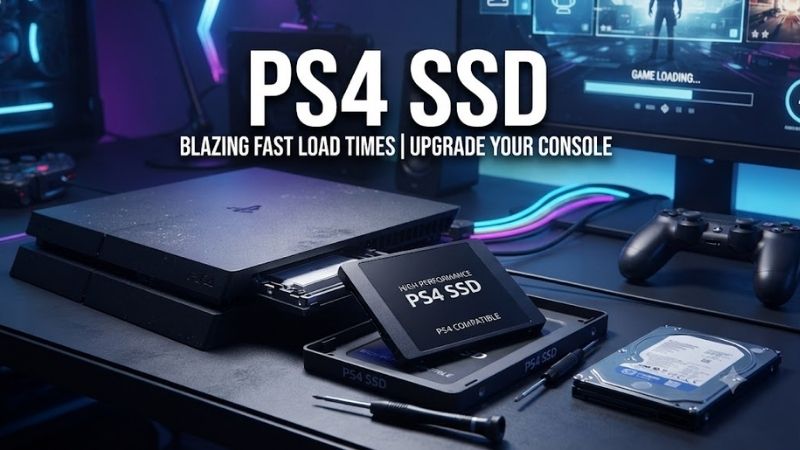
A PS4 SSD is one of the most useful upgrades for an aging PlayStation 4 because it can shorten many loading screens, improve menu responsiveness, and remove the noise of a mechanical hard drive. The best option is a 2.5-inch SATA SSD that fits the internal bay and offers enough capacity for your game library.
Best PS4 SSD Upgrades Compared
| Product | Best For | Key Advantage | Limitation |
|---|---|---|---|
| Samsung 870 EVO 1TB | Best Overall | TLC NAND and strong SATA performance | Costs more than budget drives |
| Crucial MX500 1TB | Best Alternative | Proven 2.5-inch SATA design | Premium over entry SSDs |
| WD Blue SA510 1TB | Best Balanced Value | 560MB/s read and 5-year warranty | PC-rated speed exceeds PS4 needs |
| Kingston KC600 1TB | Best Endurance Choice | TLC NAND, DRAM cache, 600TBW | Extra security features add little on PS4 |
| Crucial BX500 1TB | Best Budget Pick | Affordable 1TB capacity | Entry-level design |
| Samsung 870 QVO 2TB | Best High-Capacity Pick | Large capacity and fast SATA reads | QLC NAND favors capacity over endurance |
Best PS4 SSD Picks
Samsung 870 EVO 1TB
Best For: Players who want a premium, dependable internal PS4 SSD.
The Samsung 870 EVO 1TB is a 2.5-inch SATA SSD rated for sequential reads up to 560MB/s and writes up to 530MB/s. It measures only 6.8mm thick, comfortably fitting the type of 2.5-inch Serial ATA storage bay specified for PS4 replacement drives. Samsung also equips the 1TB version with 1GB of LPDDR4 DRAM.
Key Features
- 1TB capacity
- 2.5-inch form factor
- 6.8mm thickness
- SATA 6Gb/s interface
- Up to 560MB/s sequential read
- Up to 530MB/s sequential write
- Samsung V-NAND
- 1GB LPDDR4 cache
- Five-year limited warranty
What makes the 870 EVO appealing for PS4 use is not that the console can exploit every benchmark number, but that it is a mature SATA design with solid sustained behavior. Replacing the stock mechanical drive removes seek delays and gives the console much faster access to frequently requested game and system files.
Pros
- Strong SATA performance
- TLC-class V-NAND design
- Slim 2.5-inch body
Cons
- More expensive than entry-level SSDs
- PS4 cannot exploit modern SSD speeds fully
Who Should Buy It: Choose the 870 EVO if you want a simple premium upgrade for a PS4, PS4 Slim, or PS4 Pro and prefer an established SATA SSD rather than the cheapest available drive. A 1TB model provides practical space for multiple games without pushing the purchase price as high as larger capacities.
Crucial MX500 1TB
Best For: Buyers who want a well-rounded alternative to Samsung.
The Crucial MX500 1TB uses a 2.5-inch, 7mm SATA enclosure and is rated for sequential reads up to 560MB/s and writes up to 510MB/s. Crucial’s published specifications also list up to 95K random-read and 90K random-write IOPS for the family, making it a capable SATA drive well beyond the demands of basic console storage.
Key Features
- 1TB capacity
- 2.5-inch form factor
- 7mm thickness
- SATA 6Gb/s
- Up to 560MB/s read
- Up to 510MB/s write
- 3D NAND
- Five-year warranty
- 7mm-to-9.5mm spacer included in standard package
The MX500 is particularly attractive when its price falls below the 870 EVO. On a PS4, the real-world difference between quality SATA SSDs is usually less important than the difference between any good SSD and the original mechanical hard drive, so paying heavily for small benchmark advantages rarely makes sense.
Pros
- Strong SATA read performance
- Thin PS4-friendly form factor
- Good reputation as an upgrade drive
Cons
- Often costs more than budget SATA SSDs
- Peak specifications exceed what PS4 requires
Who Should Buy It: The MX500 is ideal for players who find it at a competitive price and want a recognizable 1TB drive for an internal upgrade. It provides enough capacity for a meaningful game library while keeping the installation simple because its standard 2.5-inch body matches the PS4 storage format.
WD Blue SA510 1TB
Best For: Players seeking a balanced 1TB SATA upgrade.
The WD Blue SA510 1TB uses a 2.5-inch, 7mm enclosure and is rated for sequential reads up to 560MB/s and writes up to 520MB/s. The 1TB model carries a 400TBW endurance specification and a five-year limited warranty, giving buyers clear durability figures while remaining physically suitable for a PS4 storage bay.
Key Features
- 1TB capacity
- 2.5-inch design
- 7mm thickness
- SATA interface
- Up to 560MB/s read
- Up to 520MB/s write
- 400TBW endurance
- Five-year limited warranty
- 3D NAND
The SA510 is a sensible middle-ground option because it avoids the positioning of both ultra-budget and premium SATA drives. Its advertised PC performance is higher than the PS4 can fully use, but that is normal for modern SATA replacements. What matters more is consistent storage behavior, capacity, and physical compatibility.
Pros
- Strong rated SATA speeds
- Five-year warranty
- 400TBW endurance rating
Cons
- No meaningful PS4 advantage over faster premium drives
- Availability can vary by capacity
Who Should Buy It: Choose the WD Blue SA510 if you want a 1TB PS4 SSD from an established storage brand and its current price undercuts Samsung or Crucial alternatives. It is particularly sensible for a PS4 Pro that will continue serving as a primary gaming system for several more years.
Kingston KC600 1TB
Best For: Buyers who prioritize endurance and TLC NAND.
The Kingston KC600 1TB is a 2.5-inch SATA SSD using 3D TLC NAND, an SM2259 controller, and a dedicated DRAM cache. Kingston rates the 1TB model for reads up to 550MB/s, writes up to 520MB/s, and 600TBW endurance. Its enclosure measures 100.1 x 69.85 x 7mm and carries a five-year limited warranty.
Key Features
- 1TB capacity
- 2.5-inch, 7mm design
- 3D TLC NAND
- DRAM cache
- Up to 550MB/s read
- Up to 520MB/s write
- 600TBW endurance
- Five-year limited warranty
- Hardware encryption support
The KC600 includes security capabilities such as AES 256-bit encryption and TCG Opal, although those features are far more relevant to computers than a PS4. Its real attraction for console use is the combination of TLC NAND, DRAM, high endurance, and a conventional 2.5-inch form factor that makes installation straightforward.
Pros
- TLC NAND with DRAM cache
- 600TBW endurance at 1TB
- Strong five-year warranty
Cons
- Encryption features provide little PS4 benefit
- Can cost more than basic alternatives
Who Should Buy It: Pick the KC600 if pricing is close to other premium SATA models and you value its endurance specifications. It is particularly attractive for a heavily used console where games are frequently installed, deleted, patched, and reinstalled, although normal PS4 users are unlikely to approach its write endurance limit.
Crucial BX500 1TB
Best For: Budget-focused players upgrading from the original hard drive.
The Crucial BX500 1TB is a 2.5-inch SATA 6Gb/s SSD positioned below Crucial’s MX500 line. Crucial lists the 1TB and 2TB family with sequential reads around 540MB/s and writes around 500MB/s, while the enclosure uses a 7mm profile that fits comfortably within the dimensional requirements of the PS4 internal drive bay.
Key Features
- 1TB capacity
- 2.5-inch design
- 7mm thickness
- SATA 6Gb/s
- Up to around 540MB/s read
- Up to around 500MB/s write
- 3D NAND
- Three-year limited warranty
The BX500 makes sense because PS4 hardware does not require an expensive SATA drive to benefit from solid-state storage. Moving away from the stock hard disk provides the major improvement, while the performance gap between affordable and premium SATA SSDs can be less meaningful once the console itself becomes the limiting factor.
Pros
- Usually positioned as a budget SSD
- Standard PS4-compatible physical format
- 1TB is practical for gaming
Cons
- Three-year warranty is shorter than several rivals
- Entry-level design offers fewer premium features
Who Should Buy It: The BX500 is for players who want the lowest reasonable cost of entry into a 1TB PS4 SSD upgrade. If it is substantially cheaper than the 870 EVO, MX500, or KC600, it can be a more rational console purchase because paying extra for PC-oriented performance features may deliver little additional benefit.
Samsung 870 QVO 2TB
Best For: Players who prioritize a larger installed game library.
The Samsung 870 QVO 2TB uses a 2.5-inch SATA enclosure and Samsung 4-bit V-NAND, commonly described as QLC. Samsung rates the drive for sequential reads up to 560MB/s and writes up to 530MB/s with Intelligent TurboWrite active. The 2TB version also uses a 2GB LPDDR4 cache and remains only 6.8mm thick.
Key Features
- 2TB capacity
- 2.5-inch form factor
- 6.8mm thickness
- SATA 6Gb/s
- Up to 560MB/s read
- Up to 530MB/s write
- Samsung QLC V-NAND
- 2GB LPDDR4 cache
- Intelligent TurboWrite
Capacity is the reason to choose the QVO rather than its EVO sibling. A 2TB drive lets you keep substantially more games installed at once, reducing the need to delete large titles whenever storage fills. QLC is less endurance-focused than TLC, but console workloads are generally dominated by reads after installation.
Pros
- Large 2TB capacity
- Strong rated SATA read speed
- Slim PS4-compatible enclosure
Cons
- QLC NAND has lower endurance than TLC alternatives
- Costs more upfront than 1TB options
Who Should Buy It: Choose the 870 QVO 2TB if storage management frustrates you more than purchase price. It makes particular sense for players with large digital libraries who regularly switch among many games. A 1TB premium SSD remains the better value when you normally keep only a handful of large titles installed.
PS4 SSD Buying Guide
Confirm the 2.5-Inch SATA Form Factor
Sony specifies a 2.5-inch internal Serial ATA drive for PS4 replacement storage, and PS4 Pro documentation states that replacement drives must be no thicker than 9.5mm. Every internal SSD in this roundup uses a 2.5-inch enclosure around 7mm thick or less, making the physical format appropriate for the console’s removable drive bracket.
Do not buy an M.2 NVMe SSD for the internal PS4 bay. M.2 drives use a completely different physical connector and shape. They are common in modern PCs and PS5 expansion storage, but the PlayStation 4 family was designed around a 2.5-inch SATA device mounted inside a removable bracket.
Choose 1TB or 2TB Based on Your Library
A 1TB SSD is the best starting point for most PS4 owners because it provides a meaningful capacity upgrade without making the storage purchase unusually expensive. Players who keep a rotating selection of games installed can comfortably manage 1TB, although large modern titles and downloadable content can consume space rapidly.
Two terabytes makes more sense for large digital libraries. Capacity does not make games run at a higher frame rate, but it reduces how often you need to delete and redownload titles. If a 2TB SATA SSD costs only moderately more than the 1TB version you are considering, the larger model can offer better long-term convenience.
Understand What an SSD Improves
An SSD primarily improves storage-related tasks. Games that spend significant time loading assets from the drive can reach menus or levels sooner, while the operating system may feel more responsive when opening storage-heavy screens. Installing, copying, and launching content can also benefit compared with an aging mechanical hard drive.
An SSD does not upgrade the PS4 CPU or GPU, so it should not be purchased as a way to transform graphics quality or dramatically raise frame rates. Performance gains vary from game to game because some loading sequences are limited by software, decompression, networking, or processing rather than raw storage speed.
Do Not Overpay for Maximum SATA Speed
Samsung 870 EVO, MX500, SA510, and similar drives are capable of roughly 500MB/s or more in PC sequential tests, but a PS4 should not be treated like a modern desktop benchmark platform. Console architecture and workload behavior mean the highest advertised SSD number does not translate directly into proportionally shorter game loading.
For that reason, price, capacity, warranty, NAND quality, and availability should carry significant weight. A cheaper 1TB SSD can be the smarter PS4 purchase if the premium alternative offers only specifications that the console cannot meaningfully exploit. Spend extra for capacity before paying heavily for tiny speed differences.
How to Upgrade a PS4 to an SSD
Back Up Important Saved Data
Before removing the existing drive, back up saves and any other data you cannot afford to lose. Sony’s upgrade instructions recommend backing up saved data before changing the internal storage. PlayStation Plus subscribers can also use supported cloud storage for saves, while USB storage can be used for appropriate backups.
Replacing the internal drive requires system software to be installed again, so treat the process as a storage replacement rather than a simple plug-and-play swap. Confirm that important saves exist somewhere outside the old drive before opening the console, especially if the original disk is already showing signs of failure.
Install the SSD in the Drive Bracket
The exact cover location differs among original PS4, PS4 Slim, and PS4 Pro chassis, but Sony’s procedure follows the same basic concept: power down the console, remove the drive-bay cover, remove the retaining screw, slide out the drive bracket, replace the existing disk, and secure the replacement drive inside the bracket.
Use the correct Phillips screwdriver and avoid overtightening the four mounting screws. Keep the rubber inserts in place where Sony specifies them because they help isolate the drive assembly. A solid-state drive has no moving platters, but installing it correctly still prevents unnecessary movement and ensures the bracket slides back into the console properly.
Reinstall PS4 System Software
After installing a blank SSD, the console needs the PS4 system software reinstallation file. Sony instructs users to place the file on a FAT32 or exFAT USB drive using a folder named PS4 with an UPDATE subfolder, save the required file with the specified PS4UPDATE.PUP name, and start the console in Safe Mode.
Be careful to obtain the reinstallation package required for replacing a drive rather than assuming any update file will work. The reinstallation process erases console storage, which is another reason the backup step matters. Once setup is complete, sign back into your account and restore supported saves or other backed-up content.
Frequently Asked Questions
Is an SSD Worth It for PS4?
Yes, particularly if you plan to keep using the console for several years. An SSD can improve storage responsiveness and reduce loading in many games compared with the original 5400RPM hard drive. It will not increase GPU performance or transform frame rates, so the upgrade is best viewed as a quality-of-life and storage improvement.
What Type of SSD Does PS4 Need?
For an internal upgrade, use a 2.5-inch SATA SSD. Sony specifies 2.5-inch Serial ATA storage for the PS4 replacement bay, while PS4 Pro documentation sets a maximum drive thickness of 9.5mm. Standard 7mm SATA SSDs such as the models in this roundup fit within that physical requirement.
Is 1TB Enough for a PS4 SSD?
One terabyte is sufficient for many players and is usually the best balance between price and usable space. The answer depends heavily on your game library because some large titles, expansions, patches, screenshots, and captures consume significant storage. Choose 2TB if you dislike regularly removing games to free space.
Will an SSD Increase PS4 FPS?
Usually not in a meaningful way. The SSD changes the storage subsystem, not the processor or graphics hardware responsible for rendering the game. It can reduce storage-related waiting and improve asset access in some situations, but buyers should not expect the upgrade to turn a 30 FPS game into a consistent 60 FPS experience.
Can I Use an NVMe SSD in a PS4?
Not directly in the internal drive bay. PS4 consoles use a 2.5-inch SATA storage format rather than the M.2 NVMe slot used by modern PCs and PS5 expansion storage. Buying a fast PCIe NVMe drive for an internal PS4 upgrade would therefore provide the wrong physical interface and require a different storage approach.
Is PS4 Pro Better With an SSD?
PS4 Pro is an excellent candidate for an SSD because storage-heavy tasks can benefit from the lower latency of solid-state media, while the console itself may already be valuable enough to justify the upgrade. The improvement still varies by game, so choose the SSD mainly for loading, responsiveness, capacity, and reliability rather than graphics performance.
Conclusion
The best PS4 SSD depends more on capacity, price, and reliability than headline benchmark speed. Samsung 870 EVO 1TB is the strongest all-around pick, Crucial MX500 and WD Blue SA510 offer balanced alternatives, Kingston KC600 emphasizes endurance, BX500 targets tighter budgets, and Samsung 870 QVO 2TB is ideal for larger game libraries.