🛒 Best Price Today on Amazon
Prime members get fast, free shipping on everything above, plus member-only deals. New members get a 30-day free trial — cancel anytime.
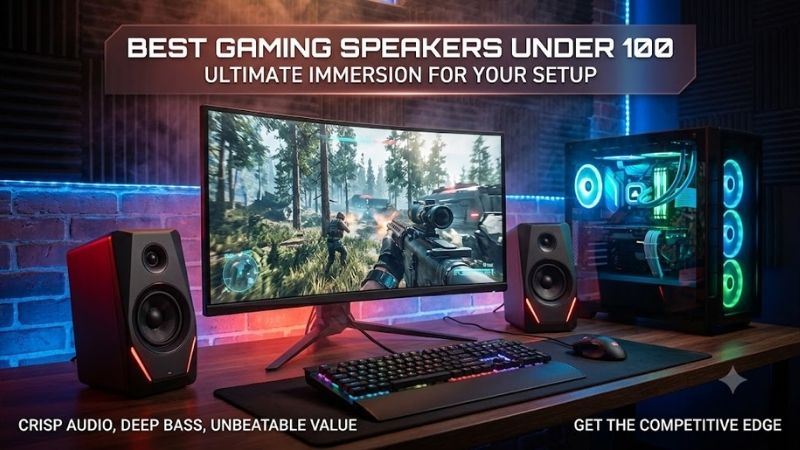
Finding the best gaming speakers under 100 means balancing sound clarity, bass, desk space, connectivity, and volume without paying for features your setup will never use. The strongest budget options include compact stereo systems, RGB speakers, soundbars, and affordable 2.1 setups that work well for PC gaming.
Quick answer: For most people in 2026, the best gaming speakers under $100 is the Gaming Speakers — our #1 rated choice. See the full ranked comparison, alternatives and buying advice below.
Best Gaming Speakers Under $100 Compared
Budget gaming speakers vary more than their prices suggest. Some prioritize a small footprint, while others add a subwoofer, RGB lighting, Bluetooth, or USB audio. All five models below were listed below $100 through their official U.S. stores when checked, although retail pricing and promotions can change over time.
| Gaming Speakers | Best For | System | Connectivity | Power | Official Price Checked |
|---|---|---|---|---|---|
| Creative Pebble X | Overall gaming | 2.0 | USB-C, Bluetooth 5.3, AUX | Up to 30W RMS with PD | $89.99 |
| Creative Pebble Pro | Compact RGB setup | 2.0 | USB, Bluetooth 5.3, AUX | Up to 30W RMS with PD | $64.99 |
| Sound Blaster GS3 | Small desks | Soundbar | USB-C, Bluetooth 5.4, AUX | 12W RMS / 24W peak | $59.99 |
| Creative Pebble Plus | Budget bass | 2.1 | 3.5 mm AUX | USB-powered | $52.24 |
| Logitech Z207 | Multi-device use | 2.0 | Bluetooth, 3.5 mm | 5W RMS / 10W peak | $69.99 |
Creative Pebble X
Best For: Overall gaming setup
Creative Pebble X uses two 2.75-inch full-range drivers in a compact 2.0 system. The angled speaker design points audio upward toward the listener, helping a desktop setup create a more direct listening position. USB audio, Bluetooth 5.3, and a 3.5 mm input make the pair easy to use with several gaming devices.
Connected directly to a suitable PC USB-C port, Pebble X can deliver up to 15W RMS and 30W peak. Adding a compatible 30W or higher USB Power Delivery adapter raises the system ceiling to 30W RMS and 60W peak. The adapter is not included, so reaching maximum output requires an additional power source.
The speakers also include customizable RGB lighting with multiple built-in effects and support for up to 16.8 million colors. Lighting is not necessary for gaming audio, but it helps the pair blend into RGB-oriented desk setups. Creative’s software can also provide EQ and other Sound Blaster processing options on supported PCs.
Connectivity is one of the strongest reasons to choose Pebble X. Alongside USB-C audio and Bluetooth, Creative includes AUX input, a headphone output, and a microphone input. That combination can reduce cable swapping if the desk is used for gaming, voice chat, music, and private headphone listening throughout the day.
What makes Pebble X different is how much functionality Creative fits into a relatively small stereo pair. It does not include a dedicated subwoofer, so deep bass cannot match a larger 2.1 system. In return, it saves floor and desk space while providing stronger connectivity and lighting options than most basic budget speakers.
Key Features:
- 2.0 stereo configuration
- Dual 2.75-inch full-range drivers
- 60 Hz–20 kHz frequency response
- USB-C digital audio
- Bluetooth 5.3
- 3.5 mm AUX input
- Headphone and microphone ports
- Customizable RGB lighting
- Optional higher output with USB-PD power
Pros:
- Compact footprint
- Strong connectivity
- USB digital audio
- RGB lighting
- High output potential with PD power
Cons:
- No dedicated subwoofer
- Maximum power requires a separate PD adapter
Use Case: Desktop PC gaming where space is limited but USB audio, Bluetooth, lighting, and stronger output are all useful.
Who It’s For: Gamers who want a versatile stereo system rather than a larger subwoofer-based setup.
Creative Pebble Pro
Best For: Compact RGB gaming desks
Creative Pebble Pro uses two redesigned 2.25-inch full-range drivers with passive radiators inside compact rounded cabinets. Each speaker measures roughly 4.8 inches across, making the system easy to place beside a monitor. The 45-degree style associated with the Pebble line directs the speakers toward a seated desktop listener.
With standard USB-C power, the system can produce up to 10W RMS and 20W peak. A compatible 30W USB-PD adapter increases output to as much as 30W RMS and 60W peak. This gives users the option to keep the setup simple or add more power later, although the required PD adapter is sold separately.
Pebble Pro supports USB audio, Bluetooth 5.3, and 3.5 mm AUX input. Separate headset and microphone ports are also built into the right speaker. That arrangement makes the system convenient for gamers who frequently move between open speakers and a wired headset without reaching behind the PC to reconnect their audio devices.
Creative adds BassFlex and Clear Dialog processing. BassFlex is intended to increase low-frequency presence without requiring a separate subwoofer, while Clear Dialog emphasizes speech. These features can be useful for story-driven games, dialogue-heavy RPGs, videos, and general desktop entertainment where vocal clarity matters.
What makes Pebble Pro attractive is its balance between size, connectivity, and price. It costs less than Pebble X and occupies slightly less desk space, but uses smaller drivers. Gamers who need maximum output may prefer Pebble X, while users with compact desks may consider Pebble Pro’s smaller footprint more useful.
Key Features:
- 2.0 stereo system
- Two 2.25-inch full-range drivers
- Passive radiators
- 80 Hz–20 kHz frequency response
- USB audio
- Bluetooth 5.3
- AUX input
- Headphone and microphone ports
- RGB lighting
- BassFlex and Clear Dialog
Pros:
- Very compact
- Flexible connectivity
- RGB lighting
- Headset and microphone ports
- Optional higher-power mode
Cons:
- Limited deep bass without a subwoofer
- PD adapter needed for maximum output
Use Case: Compact RGB gaming desks where large speakers or a separate floor subwoofer would use too much space.
Who It’s For: PC gamers who want small speakers with modern connections and convenient headset switching.
Sound Blaster GS3
Best For: Small gaming desks
The Sound Blaster GS3 replaces separate left and right speakers with one compact soundbar measuring about 16.1 inches wide. It can sit beneath many monitors, keeping the sides of the desk open for a mouse pad, controller dock, microphone arm, or other peripherals. This layout is useful when horizontal space is restricted.
Creative equips the GS3 with full-range racetrack drivers and a rear port tube. The system is rated for up to 12W RMS and 24W peak, with a 65 Hz–20 kHz frequency response. It will not produce the deep physical bass of a large subwoofer, but its design aims to provide fuller desktop audio than typical monitor speakers.
Connectivity includes USB audio, 3.5 mm AUX, Bluetooth 5.4, and a headphone output. USB-C can carry audio directly from a compatible PC or console while also simplifying the desk setup. Bluetooth is useful for casual music from a phone, although a wired USB connection is generally preferable for predictable gaming audio latency.
GS3 also includes Creative’s SuperWide processing, which is intended to make the soundstage feel wider than the physical dimensions of the soundbar. The effect can increase perceived spaciousness during games and movies, although stereo imaging from two widely separated speakers can still provide clearer physical channel separation.
RGB lighting provides several effects and supports up to 16.8 million colors. Because the lighting is integrated into one compact unit, the GS3 can add visual interest without placing multiple RGB speakers around the monitor. The design works especially well on minimalist desks where keeping peripheral count low is part of the goal.
Key Features:
- One-piece gaming soundbar
- Full-range racetrack drivers
- 12W RMS output
- 24W peak output
- 65 Hz–20 kHz frequency response
- USB audio
- Bluetooth 5.4
- 3.5 mm AUX input
- Headphone output
- RGB lighting
- SuperWide technology
Pros:
- Saves desk space
- USB digital audio
- Bluetooth 5.4
- Headphone output
- Integrated RGB
Cons:
- No dedicated subwoofer
- Less physical stereo separation than two speakers
Use Case: Small gaming desks, laptop stations, and monitor setups where placing two separate speakers is inconvenient.
Who It’s For: Gamers who value a clean desktop and simple under-monitor placement more than powerful low bass.
Creative Pebble Plus
Best For: Affordable 2.1 bass
Creative Pebble Plus is different from the other compact Creative systems because it includes a dedicated down-firing subwoofer. The two satellite speakers use 2-inch full-range drivers angled toward the listener, while the separate subwoofer adds low-frequency output that a small stereo pair cannot reproduce with the same physical impact.
This 2.1 layout can make explosions, vehicle sounds, music, and cinematic effects feel more substantial than on tiny desktop speakers. The trade-off is additional floor or desk space for the subwoofer. Small rooms can still accommodate the system, but cable routing and subwoofer placement require more planning than a simple two-speaker setup.
Pebble Plus uses USB for power and a 3.5 mm analog connection for audio rather than the digital USB audio found on newer Pebble models. That makes it straightforward to connect to PCs and other devices with an analog output. It also means users wanting Bluetooth or a direct USB audio interface should choose another model.
A high-gain mode can increase the available output when the system is connected to an appropriate USB power source. The design remains focused on affordability rather than advanced software or lighting. Gamers are therefore paying mainly for the basic 2.1 speaker arrangement instead of RGB effects, apps, or multiple wireless features.
What makes Pebble Plus different is simple: it is the only traditional 2.1 system in this group. If bass matters more than Bluetooth, RGB, or digital USB audio, the subwoofer provides a meaningful advantage. Users who share thin walls or mainly play competitive shooters may find a compact stereo pair easier to live with.
Key Features:
- 2.1 speaker system
- Two 2-inch satellite drivers
- Dedicated down-firing subwoofer
- 45-degree elevated satellite design
- USB-powered operation
- 3.5 mm analog audio
- High-gain mode
- Compact satellite speakers
Pros:
- Dedicated subwoofer
- Strong value for cinematic gaming
- Simple controls
- Compact satellites
Cons:
- No Bluetooth
- No RGB lighting
- Requires extra space for the subwoofer
Use Case: Single-player games, racing titles, movies, and desktop setups where stronger bass matters more than wireless connectivity.
Who It’s For: Gamers who want an inexpensive 2.1 system rather than feature-heavy RGB speakers.
Logitech Z207
Best For: Multiple devices and Bluetooth
Logitech Z207 is a straightforward 2.0 stereo system with Bluetooth and a 3.5 mm wired input. Each cabinet uses one active full-range driver and one passive radiator, with the complete system rated at 5W RMS and 10W peak. It is less powerful than several Creative models but focuses on simple everyday connectivity.
Easy-Switch functionality allows users to connect two source devices and move between them without repeatedly disconnecting cables. A gaming PC can remain connected by 3.5 mm while a phone or tablet uses Bluetooth. That can be convenient when the same desk serves as a gaming station, study area, and general entertainment setup.
Controls for power, volume, Bluetooth pairing, and headphones are placed on the right speaker, keeping everyday adjustments accessible. The headphone jack also provides an easy transition to private listening. This is useful for late-night gaming when switching from speakers to headphones should not require reaching behind the computer.
The Z207 does not include RGB, USB digital audio, a separate subwoofer, or gaming-specific sound processing. Its appeal is simplicity. The 5W RMS output is more appropriate for near-field desktop listening than filling a large room, but that can be enough when the user sits directly in front of the speakers at a PC desk.
What makes Z207 different is its emphasis on easy source switching rather than gaming effects. Gamers who frequently use a phone alongside the PC may value Bluetooth more than RGB lighting or software EQ. Those wanting stronger output, USB audio, or heavier bass should consider the Pebble X, Pebble Pro, or Pebble Plus instead.
Key Features:
- 2.0 stereo configuration
- Active full-range drivers
- Passive radiators
- 5W RMS output
- 10W peak output
- Bluetooth connectivity
- 3.5 mm audio input
- Easy-Switch source control
- Headphone output
Pros:
- Bluetooth connectivity
- Easy device switching
- Simple desktop controls
- Headphone jack
Cons:
- Lower power than several competitors
- No USB digital audio
- No dedicated subwoofer
Use Case: Gaming desks shared between a PC, smartphone, tablet, or other everyday audio sources.
Who It’s For: Users who prioritize simple Bluetooth switching over maximum volume or gaming-specific features.
Which Gaming Speakers Under $100 Fit Different Setups?
For a balanced PC gaming setup, Pebble X offers the broadest mix of features. USB digital audio, Bluetooth, AUX, RGB, headset connections, and optional higher-power operation make it adaptable to different systems. Its main limitation is the lack of a subwoofer, so buyers focused primarily on bass should consider a 2.1 setup instead.
Pebble Pro makes more sense when desk space is tight. It provides many of the same connection options while using smaller cabinets and costing less. The system is particularly practical beside a 24-inch or 27-inch monitor where large bookshelf-style speakers would consume too much space needed for a mouse pad or other gaming peripherals.
For an extremely clean setup, the Sound Blaster GS3 can sit beneath the monitor instead of occupying space on both sides. Its USB connection and compact soundbar shape suit small desks particularly well. The trade-off is narrower physical speaker separation, so players prioritizing stereo positioning may prefer two separate satellites.
Pebble Plus is the option to consider when explosions, music, and cinematic bass matter more than Bluetooth or RGB. Its dedicated subwoofer gives low-frequency effects a physical source that tiny desktop speakers cannot duplicate. It also requires more cables and placement space, so the benefit depends on how much room is available.
Logitech Z207 is best viewed as a simple multi-device speaker system that also works for gaming. Easy Bluetooth switching is its strongest advantage, especially for users who frequently move between a computer and phone. Its lower power makes it more suitable for close desktop listening than a loud room-filling setup.
How to Choose Gaming Speakers Under $100
Choose 2.0, 2.1, or a Soundbar
A 2.0 system uses two speakers for left-right separation and requires no subwoofer. A 2.1 system adds stronger bass but occupies more space, while a soundbar keeps the desk visually clean. Competitive gamers may prefer stereo separation, whereas cinematic games can benefit more noticeably from a dedicated subwoofer.
Check Your Desk Space
Measure the area beside and beneath the monitor before buying speakers. Large cabinets can interfere with a mouse pad, second monitor, or microphone arm. Compact Pebble speakers require little room, while the GS3 uses the otherwise empty area beneath a screen. A subwoofer needs a separate location with enough clearance.
Prefer Wired Audio for Gaming
Bluetooth is convenient for music and mobile devices, but wired USB or analog audio provides a simpler path for gaming where predictable latency matters. USB digital audio also bypasses the PC’s analog output circuitry. Bluetooth remains valuable as a secondary connection rather than the only reason to select a gaming speaker system.
Consider Bass Expectations
Small desktop speakers cannot produce the same deep bass as a dedicated subwoofer because cabinet and driver size limit low-frequency output. Passive radiators and processing can improve perceived bass, but physics still matters. Choose a 2.1 system if deep impact is a priority and you have somewhere suitable to place the subwoofer.
Look at Controls and Headphone Access
Accessible controls become important when speakers are used every day. A front or side volume knob is easier than changing Windows volume constantly, while a headphone jack simplifies late-night gaming. Microphone inputs, RGB controls, and source buttons can also reduce the number of separate adapters required around the desk.
Do Not Buy Based on Peak Power Alone
Peak wattage represents a short-term maximum and does not tell the whole story about loudness or sound quality. RMS output is more useful for comparing continuous power, but driver design, listening distance, cabinet construction, and distortion also matter. For desktop gaming, moderate clean output is often enough.
FAQ
Are Gaming Speakers Under $100 Worth Buying?
Yes. Budget speakers can provide a substantial upgrade over monitor or laptop speakers, particularly in stereo separation, volume, and bass. Spending more can add larger drivers, subwoofers, stronger amplification, or surround configurations, but a well-chosen sub-$100 system is enough for many desktop gaming setups.
Are Speakers Good for Competitive Gaming?
Speakers can provide useful stereo positioning, but competitive players often prefer headphones because they reduce room influence and place the drivers directly beside the ears. Speakers remain useful for casual competitive play, single-player games, and situations where wearing a headset for several hours becomes uncomfortable.
Is a 2.1 Speaker System Better for Gaming?
A 2.1 system provides a dedicated subwoofer, which can make explosions, engines, music, and cinematic effects more impactful. It is not automatically better for positional cues, however. A good 2.0 system may provide cleaner desk placement and clearer left-right separation while requiring less room and fewer cables.
Is USB Audio Better Than 3.5 mm?
USB audio sends a digital signal to the speaker system, while a 3.5 mm connection uses the source device’s analog output. USB can reduce dependence on motherboard audio quality and simplify setup, but a clean analog connection can also sound good. For gaming, both can provide low-latency wired playback.
Do I Need Bluetooth in Gaming Speakers?
Bluetooth is not necessary for gaming, but it is convenient when the same speakers are used with phones or tablets. A wired connection is generally preferable for the main gaming device, while Bluetooth can serve as a secondary input. This combination gives the desk flexibility without making wireless audio the only connection.
How Much Power Do Desktop Gaming Speakers Need?
Near-field desktop listening does not require huge amplifier numbers because the speakers sit close to the listener. Clean output at moderate volume matters more than chasing the highest peak wattage. Larger rooms and louder listening need more headroom, while a small bedroom can work well with a modest stereo system.
Conclusion
The best gaming speakers under 100 should match your desk and listening priorities. Pebble X offers the strongest feature mix, Pebble Pro saves space, Sound Blaster GS3 provides a compact soundbar layout, Pebble Plus adds a real subwoofer, and Logitech Z207 excels at simple Bluetooth switching between everyday devices.
Ready to decide? Our #1 pick for 2026 is the Gaming Speakers.
Live price & availability on Amazon.