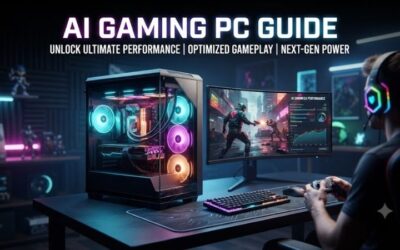
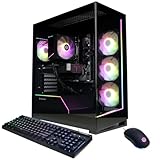
- Top Pick: KOTIN Prebuilt Gaming PC RTX 5070 12GB, Ryzen 7 9700X, 32GB DDR5, 1TB SSD
- Best Value: STGAubron Gaming PC Desktop,Core I7,RX 580 8G,16G RAM,512G SSD
- Premium Choice: ZYNEEX Prebuilt Gaming Desktop PC, AMD Ryzen 5 5500, GeForce RTX 3050 6GB,16GB DDR4 3200MHz RAM, 1TB NVMe SSD, ARGB Air Cooling, Wi-Fi,Tower Computer for Gaming, Streaming, Editing
Streaming while you game asks more of a computer than gaming alone. Your system has to render the game at high frame rates while simultaneously encoding video for your audience, and a machine that handles one but not the other will drop frames right when viewers are watching. The best gaming-and-streaming PCs pair a strong GPU with a multi-core CPU and ample memory to juggle both jobs smoothly.
- Watch: Best Computer For Gaming And Streaming — Video Review
- How to Choose a Gaming and Streaming PC
- The Best Gaming and Streaming PCs Reviewed
- What to Look For in a Streaming Setup
- Which One Should You Buy?
- Common Mistakes When Buying a Gaming and Streaming Computer
- A Step-by-Step Streaming Setup
- What to Do If Performance Drops
- Related Guides
- Frequently Asked Questions
- Final Thoughts
- Related Articles
We evaluated computers built to game and stream at once, weighing GPU power, CPU cores, RAM, and encoding capability. Whether you’re starting a channel or upgrading your setup, there’s a capable pick here. Below are our favorites, followed by a guide to choosing a rig that keeps both your gameplay and your stream buttery smooth.


As an Amazon Associate we earn from qualifying purchases at no extra cost to you.



🎮 Get More From Your Setup — Free
Prime Gaming gives you free PC games every month, in-game loot, and a free Twitch channel sub — plus fast free shipping on all the gear above. New members get a 30-day free trial.
Watch: Best Computer For Gaming And Streaming — Video Review
How to Choose a Gaming and Streaming PC
- Strong GPU with encoders: Modern RTX cards include hardware encoders that offload streaming, keeping your frame rates high.
- Multi-core CPU: More cores help handle gaming and encoding simultaneously; a Ryzen 7 or better is ideal.
- 32GB of RAM: Streaming software, chat, and games together benefit from extra memory to avoid slowdowns.
- Fast storage: A 1TB or larger NVMe SSD keeps games and recordings loading quickly with room to spare.
- Cooling and connectivity: Good cooling sustains performance under dual loads, and Wi-Fi plus solid ports add convenience.
The Best Gaming and Streaming PCs Reviewed
KOTIN RTX 5070 Build
This KOTIN pairs an RTX 5070 with a Ryzen 7 9700X, 32GB of DDR5, and liquid cooling. Its strong GPU encoder and multi-core CPU make it the top pick for smooth gaming and streaming.
CyberPowerPC Ryzen 7 8700F
The Gamer Master with a Ryzen 7 8700F and RTX 5060 Ti offers capable dual-task performance with DDR5. It’s a well-rounded choice for 1080p and 1440p streamers.
WIWB Ryzen 7 (RTX 5060 Ti)
This WIWB desktop pairs a Ryzen 7 with an RTX 5060 Ti and a 1TB NVMe SSD for solid streaming and gaming. It’s a strong value option for content creators on a budget.
ZYNEEX Ryzen 5 5500 (RTX 3050)
The ZYNEEX with a Ryzen 5 5500, RTX 3050, and 16GB of RAM is an affordable entry point for new streamers. It handles 1080p gaming and streaming for less demanding titles.
STGAubron Core i7 Desktop
The STGAubron with a Core i7, RX 580, and SSD is a budget pick for light streaming and 1080p gaming. It’s a practical starter for those testing the waters.
What to Look For in a Streaming Setup
The Video Encoder Decides Whether Games Stay Smooth
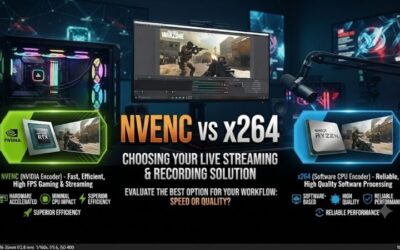
Streaming software can encode video on the processor or on a dedicated block of the GPU. Encoding on the CPU is flexible but competes with the game for cores. Modern NVIDIA GPUs include a hardware encoder (NVENC) that handles most of that work with little frame-rate cost. RTX 40-series and 50-series cards add AV1 encoding, which can deliver cleaner video at the same bitrate on platforms that accept it, while older cards such as the RTX 3050 6GB lack AV1 encoding. Check that the platform you stream to supports the codec you plan to use.
Memory and Cores for Multitasking
A game, streaming software, a browser, a chat app and overlays all run together. 16 GB of RAM is workable, while 32 GB reduces slowdowns when many applications are open. An eight-core processor, such as the Ryzen 7 8700F, gives the background tasks space, while a six-core chip like the Ryzen 5 5500 can work if the GPU handles encoding.
Upload Speed and Storage Math
Stream quality depends on your connection as much as your PC. A common guideline for 1080p at 60 frames per second is a bitrate around 6,000 kbps, and a safe plan is to keep it well below your stable upload speed, leaving room for other household traffic. A 6 Mbps stream, for instance, wants a connection with at least 10 Mbps of dependable upload.
Recording locally takes space. At 50 Mbps, a one-hour recording is about 22.5 GB (50 megabits per second multiplied by 3,600 seconds, divided by 8,000 to reach gigabytes). A 6 Mbps stream is about 2.7 GB per hour. Over several sessions a week, an extra drive for recordings is more practical than filling the system drive.
Comfort for Long Sessions
Streams often run for hours, and several listings above include chairs rather than computers. Adjustable lumbar support, armrest height and seat depth matter more than a racing-style look. Chairs and computers solve different problems, so decide on each one separately.
Which One Should You Buy?
| If you… | Choose… |
|---|---|
| Want the strongest GPU for gaming and encoding together | KOTIN RTX 5070 Build |
| Want a balanced mid-range machine with a modern GPU | WIWB Ryzen 7 (RTX 5060 Ti) |
| Want an eight-core processor for multitasking | CyberPowerPC Ryzen 7 8700F |
| Are starting out and mostly play lighter games | ZYNEEX Ryzen 5 5500 (RTX 3050) |
| Need a chair with adjustable lumbar and armrests | Secretlab Titan Evo, or the Homall and Dowinx chairs for simpler seating |
Common Mistakes When Buying a Gaming and Streaming Computer
- Buying for gaming alone. Streaming adds encoding load, so a machine that barely runs the game will struggle with both.
- Ignoring upload speed. The best PC cannot fix a connection that drops under load.
- Underestimating storage. Recordings and clips grow quickly.
- Using a single memory stick. Two modules provide dual-channel bandwidth.
- Forgetting capture and audio gear. A microphone, a webcam and a capture device add to the total plan.
- Treating a chair as an afterthought. Comfort affects how long you can stream.
A Step-by-Step Streaming Setup
- Run an upload speed test several times at the hours when you plan to stream, and note the lowest result.
- Choose a bitrate comfortably under that figure, then pick 1080p at 60 frames per second or 720p if your upload is limited.
- In your streaming software, select the hardware encoder for the GPU and set a quality preset appropriate for your card.
- Capture the game with a method that suits it, and add a separate audio track for voice so you can adjust levels afterward.
- Start a private test stream, watch the dropped-frame and encoding-overload indicators, and lower the bitrate or resolution if they climb.
What to Do If Performance Drops
- Dropped frames over the network: Lower the bitrate, use a wired connection instead of Wi-Fi, and pause other uploads.
- Encoding overload: Switch from CPU to hardware encoding or choose a faster preset.
- In-game stutter while streaming: Cap the game’s frame rate slightly below the maximum to free GPU headroom for encoding.
- Disk stalls during recording: Record to a separate drive instead of the one holding the game.
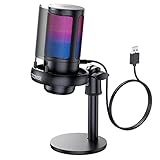
Lighting and audio also deserve a place in the plan. A webcam benefits from steady light, and a dedicated microphone sounds clearer than a headset boom when viewers listen for hours. Neither depends on the PC itself, but both affect how professional the stream feels.
Related Guides
- Gaming Notebook Review (2026)
- Free Aim Trainer (2026 Guide)
- Cool Gaming Setup Accessories (2026)
- Best Gaming Switch (2026)
- Aim Trainer Unblocked (2026 Guide)
Frequently Asked Questions
Do I need a powerful PC to stream and game?
You need a balanced one. A strong GPU with a hardware encoder, a multi-core CPU, and 32GB of RAM handle both tasks smoothly.
Does the GPU handle streaming?
Modern RTX cards include dedicated encoders that offload streaming from the CPU, keeping your gaming frame rates high while you broadcast.
How much RAM do I need for streaming?
32GB is ideal for running games, streaming software, and chat together without slowdowns. 16GB works for lighter setups.
Can budget PCs stream well?
Yes, for less demanding games. Builds with an RTX 3050 or better can stream 1080p, though higher-end rigs handle demanding titles more smoothly.
Final Thoughts
The KOTIN RTX 5070 build is our top pick for its power and encoding, with the CyberPowerPC Ryzen 7 8700F a strong mid-range choice. Budget streamers will find the ZYNEEX Ryzen 5 build a capable starting point.