🛒 Best Price Today on Amazon
Prime members get fast, free shipping on everything above, plus member-only deals. New members get a 30-day free trial — cancel anytime.
- Do You Need Tower Speakers? Room Fit and Amplifier Basics
- Budget Tier: Best Floor Speakers for a First Home Theater
- Mid-Range Tier: Best Tower Speakers for Most Homes
- Mid-Range to Premium Tier: Best Bass Towers for Home Theater
- Best 300-Tier and 1000-Tier Floor Speakers
- Best DIY Tower Speakers
- Best Tower PA Speakers and UTV Tower Speakers
- Receiver and Amplifier Matching Guide
- Room Placement Tips for Floor-Standing Speakers
- Towers vs Bookshelf Speakers: When Each Wins
- Break-In, Cables and Safety Notes
- Pick X If … Decision Table
- How to Choose Between the Top Picks
- Alternatives to Consider
- Frequently Asked Questions
Updated November 2026 – The best tower speakers for most living rooms are the Klipsch RP-6000F II for lively, efficient sound, the Polk Reserve R700 for a bass-rich home theater pair, the SVS Prime Pinnacle for deeper bass and imaging, the Q Acoustics 3050i for a refined mid-range pick, and the Elac Debut 2.0 F5.2 for a budget floor-standing pair.
If you are comparing the best tower speakers, also called floor-standing speakers or floor speakers, the first question is not which brand but what drives them. Tower speakers are passive, so they need a stereo receiver, an integrated amplifier or an AV receiver, and the match between speaker impedance and amplifier power matters. This guide covers the best floor speakers by tier, bass-focused towers, DIY tower speaker routes, and answers questions about PA towers and UTV towers, using the makers’ listed specs and reviewer reports only.
Do You Need Tower Speakers? Room Fit and Amplifier Basics
Choose tower speakers if you have a medium to large room, want deeper bass without a separate subwoofer, and own or plan to buy an amplifier or receiver. In a small room, towers can boom and overload the space, and bookshelf speakers with a subwoofer may be easier to place.
- Room size: towers suit medium to large living rooms; in small rooms, leave space from rear and side walls.
- Amplifier: use a receiver or amplifier that lists a power range and impedance compatible with the speaker. Many towers are 8 ohm; some, such as the Polk Reserve R700, are listed at 4 ohm nominal.
- Wiring: use speaker cable of suitable gauge and keep polarity (plus to plus, minus to minus) consistent.
- Surround sound: towers work well as front left and right speakers in a home theater, with an AVR driving them.
- Floor and decor: consider spikes or outriggers on hard floors and carpet, and the cabinet width.
| Model | Tier | Best for | Key stated specs | Limits |
|---|---|---|---|---|
| Elac Debut 2.0 F5.2 | Budget | Value floor-standing pair | Triple 5.25-inch woofers as reviewers list | Not for very large rooms |
| Klipsch R-26FA | Budget to mid-range | Dolby Atmos-ready towers | Integrated Atmos module per roundups | Needs an Atmos-capable AVR to use it |
| Q Acoustics 3050i | Mid-range | Refined music and movies | P2P bracing, 91 dB sensitivity per a roundup | Slim cabinets; moderate bass |
| Klipsch RP-6000F II | Mid-range | Lively, efficient sound | Titanium tweeter and horn-loaded design per the maker | Bright tuning can be tiring to some listeners |
| Polk Reserve R700 | Mid-range to premium | Home theater with strong bass | 4-ohm nominal, 300 W or more per channel recommended, Hi-Res and IMAX Enhanced | Demanding load for entry-level receivers |
| SVS Prime Pinnacle | Mid-range to premium | Bass depth and imaging | Three-way design with triple woofer array; reported to reach down to about 29 Hz | Large and heavy |
| SVS Prime Tower | Mid-range | Critical music listening | Slimmer tower, audiophile-leaning per one roundup | Less bass than the Pinnacle |
Budget Tier: Best Floor Speakers for a First Home Theater
For the best floor speakers on a budget, start with proven value towers that offer three drivers or more and sensible 8-ohm loads, rather than chasing the lowest-tier model.
Elac Debut 2.0 F5.2 – Best for a Budget Floor-Standing Pair
The Debut 2.0 F5.2 is the Elac floor-standing pair that roundups list with three 5.25-inch woofers. Spec line: triple 5.25-inch woofers · soft-dome tweeter · passive · rear port · designed with Andrew Jones per the maker’s marketing. It suits a first stereo or home theater setup in a medium room. It does not reach the bass depth of larger towers, so add a subwoofer if you want rumble.
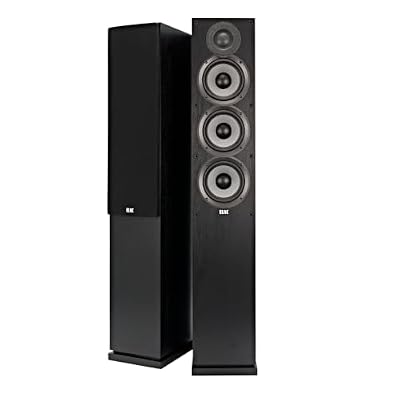
ELAC Debut 2.0 F5.2 Floorstanding Speaker, Black (Each) - 1” Cloth Dome Tweeter & Triple 5.25” Aramid Fiber Woofers - 3-Way Bass Reflex - Up to 35,000 Hz Response
Included for 'Best Tower and Floor-Standing Speakers in 2026' as a representative home product in this roundup; selection reflects the product set returned for this topic.
View on AmazonKlipsch R-26FA – Best for Atmos-Ready Towers
The Klipsch R-26FA has an integrated up-firing Dolby Atmos module, and some 2026 roundups name it the Editor’s Choice for that reason. Spec line: floor-standing tower · integrated Atmos height module · horn-loaded tweeter · passive. It is useful when you want Atmos height effects without installing ceiling speakers, and it needs an AVR with Atmos decoding to use that feature.

Klipsch Reference R-26FA Floorstanding Speaker, Black, Pair | Includes 2 Floorstanding Speakers, front grilles and top grilles for Dolby Atmos, home theater and immersive audio
Included for 'Best Tower and Floor-Standing Speakers in 2026' as a representative home product in this roundup; selection reflects the product set returned for this topic.
View on AmazonMid-Range Tier: Best Tower Speakers for Most Homes
The mid-range is where the best tower speakers for music and movies sit, with more refined cabinets and better drivers.
Klipsch RP-6000F II – Best for Lively, Efficient Sound
The RP-6000F II is a frequent roundup pick, named Editor’s Choice in one roundup for its efficient horn-loaded design and titanium tweeter. Spec line: horn-loaded titanium tweeter · dual woofers · high sensitivity as the maker lists · 8-ohm load. High sensitivity means a given receiver can drive them to higher volume with less power, which helps modest receivers. Some listeners find the sound bright, so room treatment and source quality matter.

Klipsch RP-6000F II 2.0 Dual Floorstanding Speaker Pair with 90° x 90° Hybrid Tractrix Horn, 1” LTS Tweeter, 6.5” Cerametallic Woofers, and Dolby Atmos Options for Premium Home Theater Sound in Walnut
Included for 'Best Tower and Floor-Standing Speakers in 2026' because the listing is a hybrid/pocket-spring build, which is the attribute this article compares.
View on AmazonQ Acoustics 3050i – Best for a Refined Mid-Range Pair
The Q Acoustics 3050i appears in a roundup as a mid-range tower with point-to-point bracing and a 91 dB sensitivity. Spec line: P2P cabinet bracing · 91 dB sensitivity · twin bass drivers · slim cabinet. It suits music listening and mixed use in living rooms that want a discreet design. Its cabinet is smaller than the heaviest towers, so bass is controlled rather than dramatic.
SVS Prime Tower – Best for Critical Music Listening
One roundup calls the SVS Prime Tower the best audiophile tower in its list for critical listening. Spec line: slim floor-standing tower · multiple woofers · passive design · SVS’s sound-focused tuning. It suits listeners who value detail and imaging over maximum bass. Confirm the driver complement and impedance on the maker’s specification sheet.

SVS Prime Tower Speakers - Pair (Piano Gloss Black)
Included for 'Best Tower and Floor-Standing Speakers in 2026' as a representative home product in this roundup; selection reflects the product set returned for this topic.
View on AmazonMid-Range to Premium Tier: Best Bass Towers for Home Theater
For the best bass tower and bass floor speakers, look for larger woofers, three-way designs and an amplifier that can drive them. These towers produce more low-frequency output than slim designs, but they also interact more with your room.
Polk Reserve R700 – Best for Bass-Rich Home Theater
The Polk Reserve R700 is a frequent premium or value pick and is both Hi-Res Audio and IMAX Enhanced certified. Spec line: 4-ohm nominal impedance · Polk recommends amplifiers rated 300 W or more per channel · Hi-Res Audio certified · IMAX Enhanced certified. Pair it with a receiver that is comfortable with low-impedance loads. It is the best choice here if you want a big, bass-led sound from a stereo or home theater system.

Polk Audio Reserve Series R700 Tower Speaker for Home Theater, Walnut Brown | 1" Tweeter, 6.5" Woofer, Dual 8" Long-Throw Drivers, Hi-Res Certified, Dolby Atmos & IMAX Enhanced for Dynamic Audio
Included for 'Best Tower and Floor-Standing Speakers in 2026' as a representative home product in this roundup; selection reflects the product set returned for this topic.
View on AmazonSVS Prime Pinnacle – Best for Bass Depth and Imaging
The SVS Prime Pinnacle is named Best Value in one roundup for its three-way design and triple woofer array, and another says it offers better imaging and deeper bass extension than the others in that roundup. Spec line: three-way design · triple woofer array · bass extension listed to about 29 Hz in one source · passive. It is large, so check the floor space and weight before you order. It suits music and movie rooms where you want the least reliance on a subwoofer.

SVS Prime Pinnacle – 3-Way Tower Speaker (Single) - Premium Black Ash
Included for 'Best Tower and Floor-Standing Speakers in 2026' as a representative home product in this roundup; selection reflects the product set returned for this topic.
View on AmazonBest 300-Tier and 1000-Tier Floor Speakers
Searches for the best 300 floor speakers or best 1000 tower speakers are really budget searches, so think in tiers rather than a number. A budget pair, such as the Elac Debut 2.0 F5.2 or Klipsch R-26FA, covers the lowest tier. A mid-range tier, such as the Q Acoustics 3050i, Klipsch RP-6000F II and SVS Prime Tower, covers most buyers. The premium tier, such as the Polk Reserve R700 or SVS Prime Pinnacle, gives you deeper bass and more refined cabinets. Remember to keep money in reserve for a receiver and cables.
Best DIY Tower Speakers
If you want DIY tower speakers, buy a complete kit or a published design that includes the cabinet drawings, crossover and drivers, rather than sourcing parts separately. DIY suits people who enjoy woodworking and soldering and who want to tune the result to their room. It takes more time than buying a finished pair, and results depend on cabinet build quality and crossover assembly. Plenty of kit suppliers and forum designs exist, so choose a design with a clear parts list and wiring diagram.
Best Tower PA Speakers and UTV Tower Speakers
These are different product categories from home towers. Tower PA speakers are tall column or line-array style units designed for live sound and often include built-in amplification and a subwoofer. They suit bands, venues and events more than a living room. UTV tower speakers are weatherproof powered speakers for side-by-sides and powersports vehicles, designed to resist dust, water and vibration. Neither group works the same way as passive home towers, so read the maker’s information on amplification, input and weatherproofing before choosing. In both categories, keep volume at safe listening levels to protect your hearing.
Receiver and Amplifier Matching Guide
| Speaker trait | What it means | What to look for |
|---|---|---|
| 8-ohm nominal impedance | Easier load for most receivers | Any receiver that lists 8-ohm compatibility |
| 4-ohm nominal impedance (for example Polk Reserve R700) | Demands more current | A receiver or amplifier that lists 4-ohm operation and plenty of power |
| High sensitivity (for example around 91 dB or higher) | Louder from a given amount of power | Good for modest receivers in medium rooms |
| Atmos module (Klipsch R-26FA) | Up-firing height speaker built in | An AVR that decodes Dolby Atmos |
| Three-way tower with several woofers | Deep bass in a big cabinet | A stable amplifier and a room with space |
Do I need an AV receiver for tower speakers? You need an amplifier of some kind. A stereo receiver is enough for a two-speaker music setup, and an AVR adds surround channels, HDMI inputs and room correction. Turn the volume down before you connect or disconnect speaker cables, and never use damaged cables.
Room Placement Tips for Floor-Standing Speakers
- Place towers away from the rear wall, starting at a distance the manual suggests, and move them in small steps to limit boomy bass.
- Angle them slightly toward the listening position (toe-in) and adjust until the center image is stable.
- Use spikes or isolators to reduce vibration on the floor, and take care with wood floors.
- Use stable bases and keep towers away from children and pets. Tip-over is a real risk, so use anti-tip hardware if the maker supplies it.
- In a surround system, match the front towers with a compatible center channel and surrounds from the same range.
Towers vs Bookshelf Speakers: When Each Wins
Towers win when you want deeper bass, higher output and fewer boxes than a bookshelf-plus-subwoofer system. Bookshelf speakers win in small rooms, on tight budgets and when you want to place the speakers on stands closer to ear height. A pair of towers also takes more floor space and weighs more, so measure the room and the doorways before you order.
- Sensitivity: a higher sensitivity rating (such as the 91 dB listed for the Q Acoustics 3050i) lets a given receiver play louder.
- Frequency response: makers list a low-frequency limit (about 29 Hz in one source for the SVS Prime Pinnacle); in-room results vary.
- Surround use: match the front towers with a centre and surrounds from the same range so voices and effects blend.
- Warranty and returns: large speakers are costly to ship, so read the seller’s return terms.
Break-In, Cables and Safety Notes
Many makers say that drivers loosen slightly over the first hours of use, so do not judge the sound in the first session. Use speaker cable of a gauge suited to the run length, strip the ends cleanly and keep stray strands from touching the other terminal, which can trip an amplifier’s protection. Tower speakers are tall and top-heavy, so keep them off uneven surfaces and use the maker’s outriggers or anti-tip fixings, especially around children and pets. Turn the amplifier off before connecting speakers, and keep listening levels safe.
Pick X If … Decision Table
| Pick this | If you … |
|---|---|
| Elac Debut 2.0 F5.2 | want a value floor-standing pair for a first system |
| Klipsch R-26FA | want Atmos height effects from the towers themselves |
| Q Acoustics 3050i | want a refined, slimmer mid-range pair |
| Klipsch RP-6000F II | want high efficiency and a lively sound |
| Polk Reserve R700 | have a capable receiver and want strong bass for home theater |
| SVS Prime Pinnacle | want deeper bass and imaging and have the space |
| SVS Prime Tower | listen to music critically and want a slimmer tower |
How to Choose Between the Top Picks
Start with the amplifier you own. If your receiver is modest or older, favour high-sensitivity 8-ohm towers such as the Klipsch RP-6000F II or the Q Acoustics 3050i, since they play louder from less power. If you own a capable AVR, the Polk Reserve R700 and SVS Prime Pinnacle make more of it. Then consider the room: slim towers suit smaller living spaces, while large three-way designs need space to breathe. Finally, think about the use. Movie fans gain from deeper bass and Atmos-ready models, and music listeners often prefer the slimmer, detail-focused designs.
Alternatives to Consider
- KEF Q Series and Wharfedale ranges: European makers with well-regarded floor-standing lines. Exact model names change, so read each maker’s current range page.
- Bookshelf speakers with a subwoofer: easier to place in smaller rooms and often better value for bass control.
- Powered speakers: if you want no receiver at all, see the best powered speakers guide on this site.
Frequently Asked Questions
What are the best tower speakers for most people?
The Klipsch RP-6000F II and Polk Reserve R700 are common mid-range to premium picks. The Elac Debut 2.0 F5.2 is a popular budget option.
Do tower speakers need a subwoofer?
Not always. Larger towers such as the SVS Prime Pinnacle and Polk R700 go deep on their own, but a subwoofer can still add low-frequency effects in a home theater.
Do I need an AV receiver for floor-standing speakers?
You need an amplifier, which can be a stereo receiver for two speakers or an AVR for surround sound. Match the amplifier to the speaker impedance and recommended power.
What are the best bass floor speakers?
The Polk Reserve R700 and SVS Prime Pinnacle are leading choices for bass among those covered here. Both need space and a capable amplifier, and room placement affects the result.
Can I build DIY tower speakers?
Yes. Choose a full kit or a published design with a parts list and crossover drawings. DIY takes time and skill, but you can tune the result to your room.
Are tower PA speakers the same as home tower speakers?
No. Tower PA speakers are designed for live sound and often include built-in amplification, while home towers are passive and need a separate amplifier. Choose by the way you plan to use them.