🛒 Best Price Today on Amazon
Prime members get fast, free shipping on everything above, plus member-only deals. New members get a 30-day free trial — cancel anytime.
- At a Glance: SFX Power Supplies Compared
- SFX vs SFX-L vs ATX: What Actually Changes
- How Much Wattage Do You Need?
- ATX 3.1, 12V-2×6 and Cable Planning
- Corsair SF750 (2024): The Reference Pick
- Cooler Master V SFX Gold (V750 and V850): The Value Route
- ASUS ROG Loki 750 W: When SFX-L Fits
- Pick X If… Decision Table
- Alternatives Worth Considering
- Compatibility Checklist Before You Buy
- Frequently Asked Questions
For most small-form-factor gaming builds, a 750 W fully modular ATX 3.1 SFX unit such as the Corsair SF750 (2024) is the safest choice. The Cooler Master V SFX Gold line suits buyers who want lower cost and a long warranty. An SFX-L unit like the ASUS ROG Loki 750 W suits cases with a little extra depth that want quieter running. The right pick depends mainly on your graphics card, your case PSU bay, and how much cable length you need.
At a Glance: SFX Power Supplies Compared
| Model | Best for | Key stated specs | Limits |
|---|---|---|---|
| Corsair SF750 (2024) | Compact builds with a mid-range to high-end GPU | 750 W, 80 Plus Platinum, ATX 3.1, fully modular, zero-RPM fan mode, bracket for ATX bays, 7-year warranty as listed by roundups | Premium tier; 750 W is a ceiling for the most power-hungry GPUs |
| Cooler Master V750 SFX Gold | Value-focused SFX builds | 750 W, 80 Plus Gold, ATX 3.1, fully modular, 90-degree 12V-2×6 cable, 10-year warranty as listed | Gold rather than Platinum efficiency; fan noise at load varies by review |
| Cooler Master V850 SFX Gold | High-end GPU with extra headroom | 850 W, 80 Plus Gold, same family features as the V750 | Costs more; leave room for cable bends |
| ASUS ROG Loki 750 W | Cases that accept SFX-L | 750 W, 80 Plus Platinum, SFX-L size, ARGB fan | Longer than standard SFX; will not fit every SFX-only bay |
| Corsair SF850 and SF1000 | Flagship GPUs in tiny cases | Higher wattage within the SFX footprint | Roundups disagree on ATX version labels, so read the maker’s product page |
SFX vs SFX-L vs ATX: What Actually Changes
An SFX power supply is a smaller box than a standard ATX unit. The SFX-L variant is longer to make room for a larger fan, which usually means lower noise at the same output. Standard SFX units typically use an 80 mm fan, while SFX-L units are built around a 120 mm fan. Many small-case makers list SFX and SFX-L support separately, so always read the case manual for the maximum PSU length, not just the form-factor name.

LIAN LI SP750 V2 750W SFX Power Supply, 80 Plus Gold, Black (SP750G.B) | ATX 3.1-ready SFX power with native 12V-2x6 cable, fully modular design, quiet 92mm FDB fan, and 10-year warranty.
Included for 'Best SFX Power Supply: Which One to Buy' because the listing specifies 80 Plus Gold and Black (SP750G.B), details this guide uses to compare options.
View on Amazon
CORSAIR SF850 (2024) Fully Modular Low Noise ATX Power Supply – Black | Low-Noise, Fully Modular, 80 PLUS Platinum, Zero RPM Mode, SFX-to-ATX Bracket Included, NA
Included for 'Best SFX Power Supply: Which One to Buy' because the listing specifies Black and Low-Noise, details this guide uses to compare options.
View on Amazon
Apevia SFX-AP500W Mini ITX Solution/Micro ATX/SFX 500W Power Supply | SFX Form Factor, 80mm Auto Thermal Fan, 500W SFX Power Supply, Sleeved PSU Cables, Heavy Duty Protections
Included for 'Best SFX Power Supply: Which One to Buy' because the listing specifies SFX Form Factor and 80mm Auto Thermal Fan, details this guide uses to compare options.
View on Amazon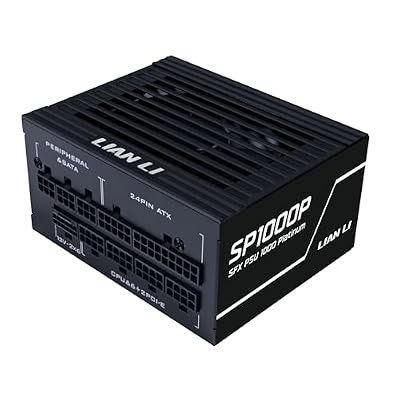
LIAN LI SP1000P 1000W SFX Power Supply, 80 Plus Platinum, Black (SP1000P.B) | 12V-2x6 Cable, ATX 3.1 & PCIE 5.1 Compliant, Full Modular, 100% Japanese 105C Capacitors, 10-Year Warranty
Included for 'Best SFX Power Supply: Which One to Buy' because the listing specifies 80 Plus Platinum and Black (SP1000P.B), details this guide uses to compare options.
View on AmazonIf your case takes a full ATX unit, you generally do not need SFX at all. SFX is the right answer for a compact mini-ITX chassis, a sandwich-layout design, or a small micro-ATX tower with a shortened PSU shroud. Some SFX units, including the Corsair SF750 (2024), ship with a bracket that lets the unit mount in a standard ATX bay, which helps if you later move to a larger case.
How Much Wattage Do You Need?
Wattage should follow the graphics card. Makers publish a recommended system power figure for each GPU, and that figure assumes a typical desktop with one drive and a mainstream CPU. Use it as the starting point and add margin if you overclock or run a high-power processor.
- Budget and mainstream GPUs (RTX 5060 class, Radeon RX 9060 XT class): a 550 to 650 W unit is typically enough per maker guidance. SFX units in this range are easy to find and keep cable clutter low.
- Upper mid-range GPUs (RTX 5070 and RX 9070 class): 650 to 750 W is the usual recommendation. A 750 W unit gives comfortable headroom with a mainstream CPU.
- High-end GPUs (RTX 5070 Ti, RTX 5080, RX 9070 XT): 750 to 850 W is the typical range. Read the card maker’s own listing, since board partner models can differ from the reference figure.
- Flagship GPUs (RTX 5090 class): maker guidance sits at the top of what SFX can deliver, so this is where 1000 W SFX units come into play and where case airflow matters most.
Efficiency ratings such as 80 Plus Gold and Platinum describe how much wall power is turned into usable output at set load points. Platinum units waste somewhat less heat, which helps in tight cases, but Gold units are perfectly acceptable for most builds.
ATX 3.1, 12V-2×6 and Cable Planning
Current graphics cards use the 12V-2×6 connector, the revised successor to 12VHPWR. An ATX 3.1 power supply is designed to cope with the short power excursions that modern GPUs produce, and it ships with a native 12V-2×6 cable. A native cable is preferable to an adapter, because adapters add bulk and bends in small cases.
In compact builds, cable routing is the real constraint. Look for a 90-degree connector on the GPU end if the side panel is close to the card, as the Cooler Master V SFX Gold line lists. Do not bend the cable sharply right at the connector; follow the manufacturer’s manual and leave room for a gentle curve. If a build looks cramped, a flat-cable set or a shorter cable sold by the PSU maker can help.
Corsair SF750 (2024): The Reference Pick
Roundups consistently name the Corsair SF750 (2024) as their top overall SFX choice. It is a 750 W, 80 Plus Platinum, ATX 3.1 unit with a fully modular cable set and a zero-RPM mode, where the fan stays off at low load. TechPowerUp has published an independent review of the SF750, which is the main lab-style source for its electrical behavior. The 750 W rating is enough for most single-GPU gaming rigs up to the upper mid-range and many high-end cards.
The trade-offs are cost, since it sits in the premium tier, and capacity. If you plan a flagship GPU with a high-power CPU, step up to a higher-wattage SFX model rather than running at the limit.
Cooler Master V SFX Gold (V750 and V850): The Value Route
Cooler Master’s V SFX Gold models are the usual value picks in roundups. The V750 and V850 are listed as fully modular, 80 Plus Gold, ATX 3.1 and PCIe 5.1 ready, with a 90-degree 12V-2×6 cable and a 10-year warranty. The long warranty is a genuine selling point for a part expected to survive several GPU upgrades. The trade-off is Gold rather than Platinum efficiency, and fan acoustics that reviewers describe as acceptable rather than class-leading.
ASUS ROG Loki 750 W: When SFX-L Fits
The ROG Loki 750 W is an SFX-L, Platinum-rated unit with an addressable RGB fan. Its larger fan is the reason SFX-L units tend to be quieter, and it is a good match for cases that explicitly list SFX-L support. The limits are physical: it is longer than a standard SFX unit, so it will not fit every compact case. If you do not want lighting, a plain SFX unit may be a better use of the budget.
Pick X If… Decision Table
| If you want… | Pick | Why |
|---|---|---|
| The best all-round SFX unit for a mainstream-to-high-end build | Corsair SF750 (2024) | Platinum, ATX 3.1, ATX bracket, zero-RPM mode |
| Lowest cost with a long warranty | Cooler Master V750 SFX Gold | Gold efficiency, 10-year warranty as listed |
| Extra headroom for a high-end GPU | Cooler Master V850 SFX Gold or a higher-wattage SF-series | 850 W or more within the SFX footprint |
| Quieter running and your case allows more length | ASUS ROG Loki 750 W (SFX-L) | Larger fan, Platinum efficiency |
| A budget build with a mainstream GPU | A 550 to 650 W SFX Gold unit from an established maker | Enough power for RTX 5060 and RX 9060 XT class cards |
Alternatives Worth Considering
- SilverStone SX series: SilverStone has long made SFX units and offers models up to 1000 W. Read the maker’s lineup for ATX 3.1 and native 12V-2×6 support.
- Lian Li SP series: Lian Li lists SFX units for compact builds and is an option if you are already buying its cases.
- A shortened ATX unit: some small cases accept ATX units under a specific length. A compact ATX Gold unit can be cheaper than SFX, but only if the case manual lists support.
Compatibility Checklist Before You Buy
- Read the case manual for PSU form factor and maximum length. SFX-L is not the same as SFX.
- Count the connectors your GPU needs and confirm the PSU has the matching native cable.
- Match wattage to the GPU maker’s recommended system power, then add margin for overclocking.
- Plan cable routing: a short, fully modular set is much easier to manage in a small case.
- Note the warranty length and keep the receipt; PSUs are worth registering.
For electrical safety, never open a power supply, and have a qualified electrician look at household wiring if you see repeated breaker trips or burning smells.
Frequently Asked Questions
Is an SFX power supply as good as an ATX one?
Quality depends on the model, not the size. Good SFX units from established makers reach Gold and Platinum efficiency and power high-end GPUs. The main trade-offs are a smaller fan, which can be louder under heavy load, and a higher cost per watt.
Will an SFX power supply fit a normal ATX case?
Often yes, if it comes with an ATX adapter bracket. Several SFX units, including the Corsair SF750 (2024), list a bracket for this purpose. Without the bracket, the unit can sit loose in the bay, which is not advisable.
How much wattage do I need for an RTX 5070 or RX 9070 XT?
Maker guidance for cards in this class usually lands between 650 and 850 W depending on the model and CPU. A 750 W unit covers most combinations, but read the specific graphics card’s product page, since partner cards can differ.
Do I need an ATX 3.1 power supply?
It is not required for the card to run, but it is the current standard and is designed for the sudden power spikes of modern GPUs. It also means a native 12V-2×6 cable, which avoids bulky adapters in a small case.
What is the difference between SFX and SFX-L?
SFX-L is longer so it can use a larger fan, which generally means quieter operation. The extra length means some compact cases cannot take it, so confirm support in the case manual before buying.
Is 80 Plus Platinum worth it over Gold?
Platinum wastes less power as heat, which can slightly help in tight cases and lower electricity use. For most gaming loads the difference is small, so Gold with a strong warranty is a reasonable choice for tighter budgets.