Choosing the best camping portable charger means matching capacity and output to how far you travel and how many devices you need to keep alive. A weekend trip with one phone and a headlamp calls for something entirely different than a week off-grid powering a laptop, cooler, and camera gear. The market in 2026 ranges from compact solar banks under thirty dollars to full power stations that can run small appliances, so the gap between a good fit and a bad one often comes down to honest math on watt-hours versus what you actually draw per day.
Owner feedback reveals that the most common failure points are inflated capacity claims on budget solar banks and AC-inverter units that throttle output when hot. Conversely, the chargers that earn long-term loyalty tend to be transparent about their real-world limits, offer at least one fast-charging protocol, and survive being tossed in a pack without their ports working loose. The picks below reflect published specs, listed prices, and aggregated owner reviews rather than product research.
As an Amazon Associate we earn from qualifying purchases at no extra cost to you. Product prices and availability are accurate as of the date shown and are subject to change.


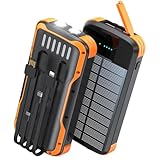
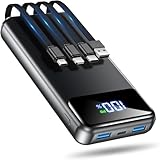
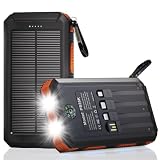

Quick Picks
| Product | Best for | Price |
|---|---|---|
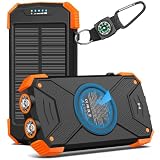
| BLAVOR Solar Power Bank | Day hikes and emergency backup | $29.99 |
| Jackery Explorer 300 | Car camping and small appliances | $259 |
| HOWEASY Power Station | Budget AC power for light loads | $76.99 |
| ZZI 60000mAh | High-capacity charging without AC outlet | $48.99 |
| SOXONO Solar Power Bank | Sun-rich trips with multiple devices | $33.99 |
| OHOVIV 50000mAh | Cable-free convenience for group camping | $51.98 |
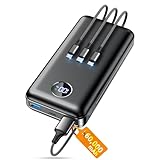
| Durecopow Solar Charger | Lightest budget option with flashlight | $20.50 |
| Daran 89.6Wh LiFePO4 | Cycle-life-focused AC and DC output | $89.99 |
How We Picked
Four criteria drove every decision here. First, capacity honesty: we weighted published watt-hour or milliamp-hour figures and cross-checked them against owner reports of real-world recharge cycles. Second, output versatility — whether the unit supports at least one fast-charge protocol (PD, QC, or proprietary) and, for power stations, whether AC output is pure sine wave. Third, form factor and weight relative to use case; a 60,000mAh brick is excellent for basecamp and useless for a summit push. Fourth, price-to-capacity ratio within each tier, because the camping-charger market punishes buyers who pay a premium for marketing labels rather than usable energy.
The 8 Best Camping Portable Charger in 2026
BLAVOR Solar Power Bank 10,000mAh
This is the charger for people who want one phone topped off and nothing more. The 10,000mAh cell delivers roughly two to three full charges for a modern smartphone, which is enough for a weekend trip if you ration screen time. Wireless charging is a genuine convenience when your hands are cold or occupied, and the solar panel adds trickle power in emergencies.
- Pro: Pocketable at minimal weight, easy to forget in a pack lid.
- Pro: Wireless pad works with most Qi-compatible phones without a cable.
- Con: Solar input is slow; owners report it takes multiple days of direct sun to noticeably recharge.
Skip it if you need to charge tablets, laptops, or more than two devices on a single trip.
Jackery Explorer 300
At 292Wh, this sits in a different category from the power banks above. It runs CPAP machines, small coolers, and laptops on a single charge, making it the go-to for car campers who pitch within reach of nothing but nature. The pure sine wave output means sensitive electronics will not complain, and Jackery’s ecosystem of pass-through solar panels is well documented in owner forums.
- Pro: True AC outlet handles devices that USB-only banks cannot.
- Pro: Strong owner-community feedback on long-term reliability.
- Con: Nearly nine pounds with integrated carry handle; bulky for backpacking.
Skip it if your trips require you to carry the charger more than a few hundred yards from the car.
HOWEASY Portable Power Station 120W (240W Peak)
For under eighty dollars, this is the cheapest entry into AC-powered camping. Owners praise its ability to run a laptop or small LED fan for several hours, and the 240W peak handles brief surges from compressors. It is not a whole-camp solution, but it fills a niche between USB banks and full power stations at a fraction of the cost.
- Pro: Lowest price among units with a real AC outlet.
- Pro: Compact footprint fits easily in a cooler bag or glove box.
- Con: Owners report the cooling fan runs loudly under sustained load.
Skip it if you need quiet operation or plan to run anything near its continuous 120W ceiling for hours.
ZZI Portable Charger Power Bank 60000mAh
The headline capacity is enormous, and at 22.5W PD output it can fast-charge a phone from dead to usable in roughly thirty minutes. This is a basecamp or overland rig bank — something you leave in the van and pull out for a week of off-grid phone, camera, and drone charges. The weight is proportionally high, which is the honest trade-off.
- Pro: Highest milliamp-hour figure on this list; multiple full device charges without a plug.
- Pro: PD fast-charge keeps modern phones topping up quickly.
- Con: Owners consistently flag its bulk and weight as a dealbreaker for anything beyond car-based camping.
Skip it if every gram matters on your pack. This one is a brick by design.
SOXONO Solar Power Bank 40000mAh
Splitting the difference between a solar bank and a high-capacity pack, the SOXONO gives you 40,000mAh with PD 20W output and a solar panel for opportunistic top-ups. It suits multi-day hikers who want two or three phone recharges plus power for a GPS unit, with solar as insurance rather than primary input.
- Pro: Generous capacity paired with a genuine PD protocol at a sub-$35 price.
- Pro: Solar panel adds marginal trickle charge on sunny rest days.
- Con: At roughly the size of a paperback, it is heavier than hikers expect for a “portable” bank.
Skip it if you want the lightest possible option; there are smaller banks that meet basic phone-charge needs.
OHOVIV Portable Charger Power Bank 50000mAh
Four built-in cables mean you never dig through a pack for the right connector. With 50,000mAh and broad device compatibility, this works well as a shared charging hub at group campsites or for families keeping multiple phones and tablets alive on a road trip.
- Pro: Integrated cables eliminate the single most common complaint about power banks: forgotten cords.
- Pro: High capacity handles multiple devices simultaneously without dramatic drop-off.
- Con: Built-in cables mean if one frays or its port loosens, you lose that cable entirely rather than swapping it.
Skip it if you prefer replaceable cables or have proprietary-connector devices not covered by the four built-in lines.
Durecopow Solar Charger Power Bank 20,000mAh
At twenty dollars and change, this is the cheapest usable option on the list. The 20,000mAh cell provides a reliable phone-plus-earbuds weekend, and the dual flashlight is a practical bonus that owners mention repeatedly in positive reviews. Four cables and three ports give it surprising flexibility for the price.
- Pro: Lowest price here while still offering meaningful capacity and multiple outputs.
- Pro: Integrated dual flashlight replaces a small backup torch.
- Con: Solar charging is decorative; owners confirm it adds negligible capacity in realistic conditions.
Skip it if you need fast-charge protocols, AC output, or more than two phone recharges per cycle.
Daran Portable Power Station 89.6Wh LiFePO4
Lithium iron phosphate cells give this station a significantly longer cycle life than conventional lithium-ion units at similar capacity, meaning it will likely outlast cheaper alternatives across years of use. With 100W continuous, 200W peak, AC outlets, and PD fast charging, it covers laptops, small fans, and phone banks in one box.
- Pro: LiFePO4 chemistry is rated for thousands of charge cycles versus a few hundred for standard lithium-ion.
- Pro: Combines AC and DC outputs in a sub-$100 unit.
- Con: 89.6Wh is modest; owners report it depletes quickly when running a cooler or anything with a compressor.
Skip it if your loads exceed 100W continuous for more than a short window; look at the Jackery Explorer 300 instead.
Buying Guide
Capacity: Milliamp-Hours Versus Watt-Hours
Power banks list capacity in milliamp-hours because they output at 3.7V nominal, while power stations use watt-hours because they output at higher voltages. A useful conversion: divide milliamp-hours by 1000 and multiply by 3.7 to approximate watt-hours. A 10,000mAh bank holds roughly 37Wh; a 60,000mAh bank holds about 222Wh. Real-world usable capacity is typically 70-80% of the stated figure due to conversion losses and battery-management overhead, so budget accordingly.
Output Protocols and AC Versus DC
USB Power Delivery has become the de facto fast-charge standard for phones and many laptops. If your device requires 20W or more via USB-C, confirm the bank explicitly lists PD rather than generic “fast charge,” which often means proprietary Qualcomm QC only. AC outlets, found in power stations, are necessary for anything with a three-prong plug: CPAP machines, small coolers, or laptop chargers that lack USB-C input. Match the protocol to the device, not the marketing.
Chemistry, Cycle Life, and Storage
LiFePO4 cells degrade more slowly, tolerate full-discharge cycles better, and generally last three to five times as many charge cycles as standard lithium-ion or lithium-polymer. If you camp seasonally over several years, LiFePO4 is worth the modest price premium. For occasional use, lithium-polymer banks are lighter and cheaper and will still serve adequately if you store them at around 50% charge between seasons rather than full or empty.
Our Verdict
The Daran 89.6Wh LiFePO4 stands as the overall best camping portable charger for anyone who wants AC outlets, meaningful DC fast charging, and a battery chemistry that will still function after years of seasonal use. The Durecopow 20,000mAh is the budget pick that punches well above its twenty-dollar price tag. If your situation is strictly car-based and you need to run a cooler or CPAP overnight, the Jackery Explorer 300 is the one to buy despite its higher cost.
FAQ
Can a solar power bank actually recharge itself in the wild?
Integrated solar panels on power banks produce a trickle of current, often under 1-2W in ideal sunlight. That is enough to add meaningful capacity over several days of exposure but nowhere near sufficient to recharge the bank from empty in a single afternoon. Treat solar as a top-up, not a primary input.
How many charges does a 10,000mAh power bank provide?
For a typical modern smartphone with a 4,000-5,000mAh internal battery, expect roughly two to three full charges from a 10,000mAh bank, accounting for conversion losses. Devices with larger batteries, such as tablets, will get significantly fewer.
Is a power station with 200W peak output enough for a small cooler?
Small 12V coolers with compressor technology typically draw 45-65W continuous with brief surges higher. A 200W peak unit should start the compressor without stalling, but total runtime on a 89.6Wh battery will be limited to a few hours before you need a recharge source.
What is the safest way to store a power bank between camping seasons?
Store lithium batteries at approximately 50% state of charge in a cool, dry place. Avoid leaving a bank fully charged or fully depleted for months, as both extremes accelerate capacity loss. A quick recharge to roughly half every three to six months is sufficient.